
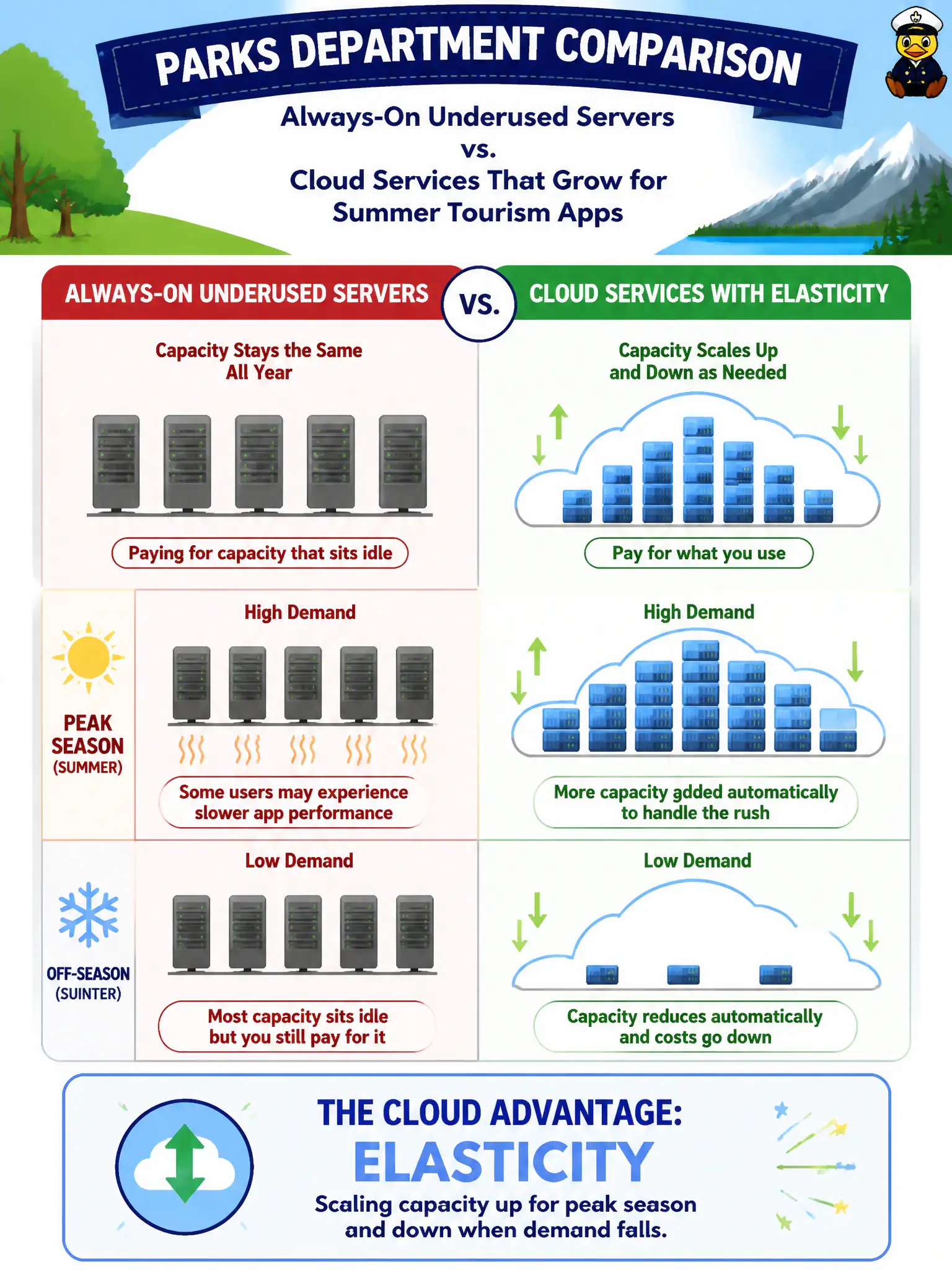
A parks department compares always-on underused servers with cloud services that grow for summer tourism apps. Which cloud advantage is primarily illustrated?
Select an answer to reveal the explanation.
Short Explanation
Summer rush, winter quiet—cloud elasticity is the dimmer switch for capacity. Fixed always-on servers burn power in the off-season; elastic cloud grows when tourism apps need it.
Full Explanation
Elasticity is the cloud advantage of scaling capacity upward for peak demand and downward when demand falls. A parks department that compares always-on underused servers with cloud services that grow for summer tourism apps is primarily illustrating elasticity: seasonal stretch without year-round idle capacity sitting powered on in a municipal closet or datacenter cage.
Mandatory perpetual CapEx purchases that prevent any seasonal capacity change fail because that describes inflexible ownership, not the illustrated cloud benefit. Removing all identity and access controls from tourism applications fails conceptually and would be a security regression rather than an elasticity feature. Private cloud requirements that forbid any public cloud use fail because the scenario contrasts seasonal public-cloud growth with static always-on servers.
Exam caveat: elasticity still requires automation hooks, monitoring, and budget alerts so summer scale-up does not become unmanaged spend that finance discovers in September. Operational check: define scale triggers for tourism apps, set budget ceilings and owner approvals, and schedule a post-season scale-down verification jointly with parks operations and finance.