
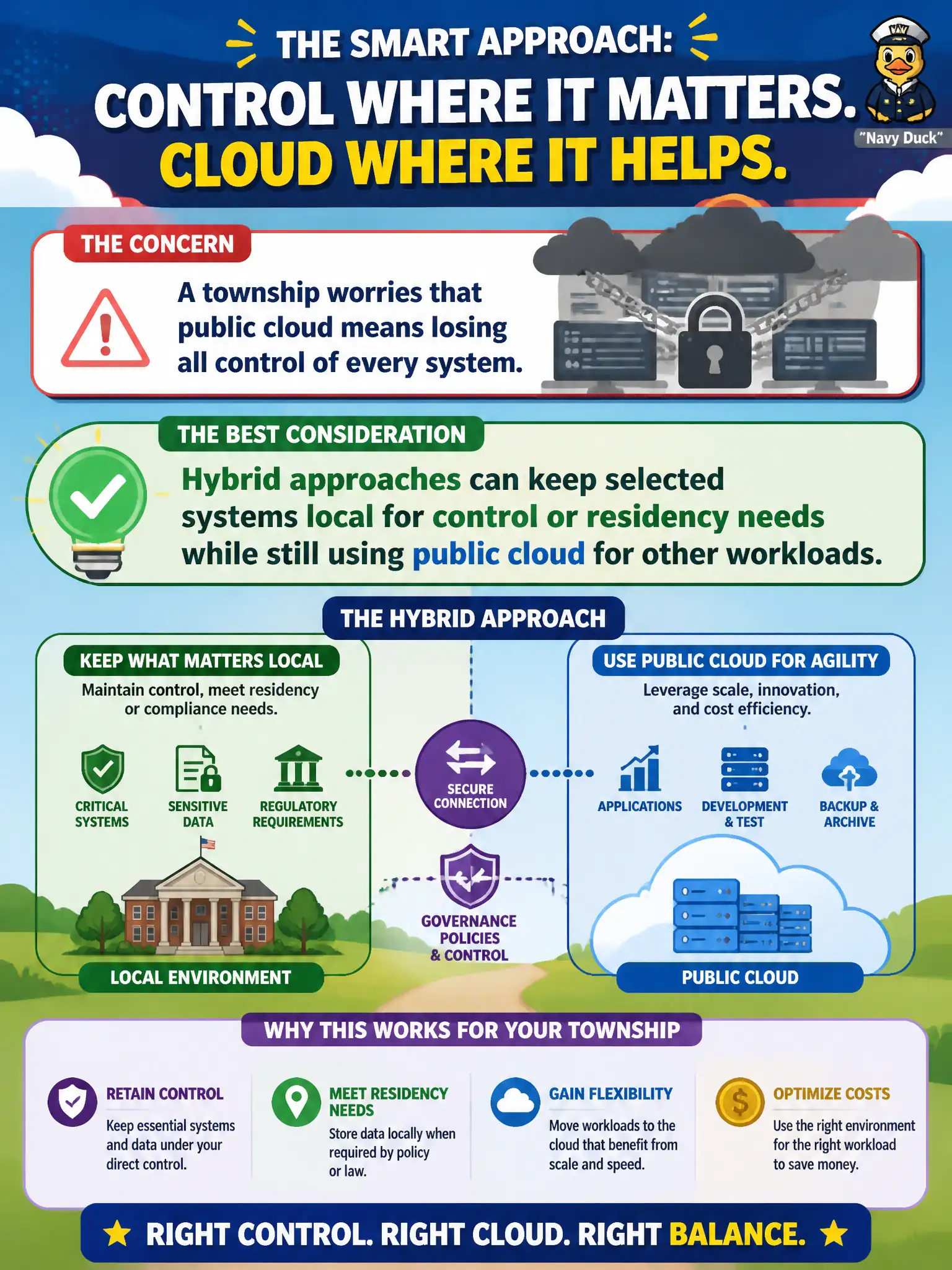
A township worries that public cloud means losing all control of every system. Which consideration best addresses that concern?
Select an answer to reveal the explanation.
Short Explanation
Public cloud is not an all-or-nothing eviction notice for the server room. Hybrid lets the township keep sensitive or tightly controlled systems local and still use cloud for everything else that fits.
Full Explanation
Townships often worry that adopting public cloud means losing control of every system. Hybrid approaches address that concern by keeping selected systems local for control, latency, or data-residency needs while still using public cloud for other workloads such as productivity SaaS. Control becomes a deliberate workload-by-workload placement decision rather than an all-or-nothing rejection of cloud services that staff and constituents already expect.
Requiring deletion of every on-premises system before any Microsoft 365 mailbox can exist fails because hybrid and coexistence patterns are common and supported. Claiming that private cloud policies worldwide forbid any Microsoft SaaS email fails as an absolute and misstates how municipalities actually operate. Refusing SaaS, IaaS, and PaaS entirely while banning internet connectivity fails conceptually and would cripple modern civic service delivery and constituent access.
Exam caveat: hybrid “control” only works when data classification and placement rules are written and enforced—not merely assumed in hallway conversation. Operational check: publish a workload placement matrix (local versus public cloud), map compliance and residency drivers for each tier, and review exceptions quarterly with legal, records, and security officers.