
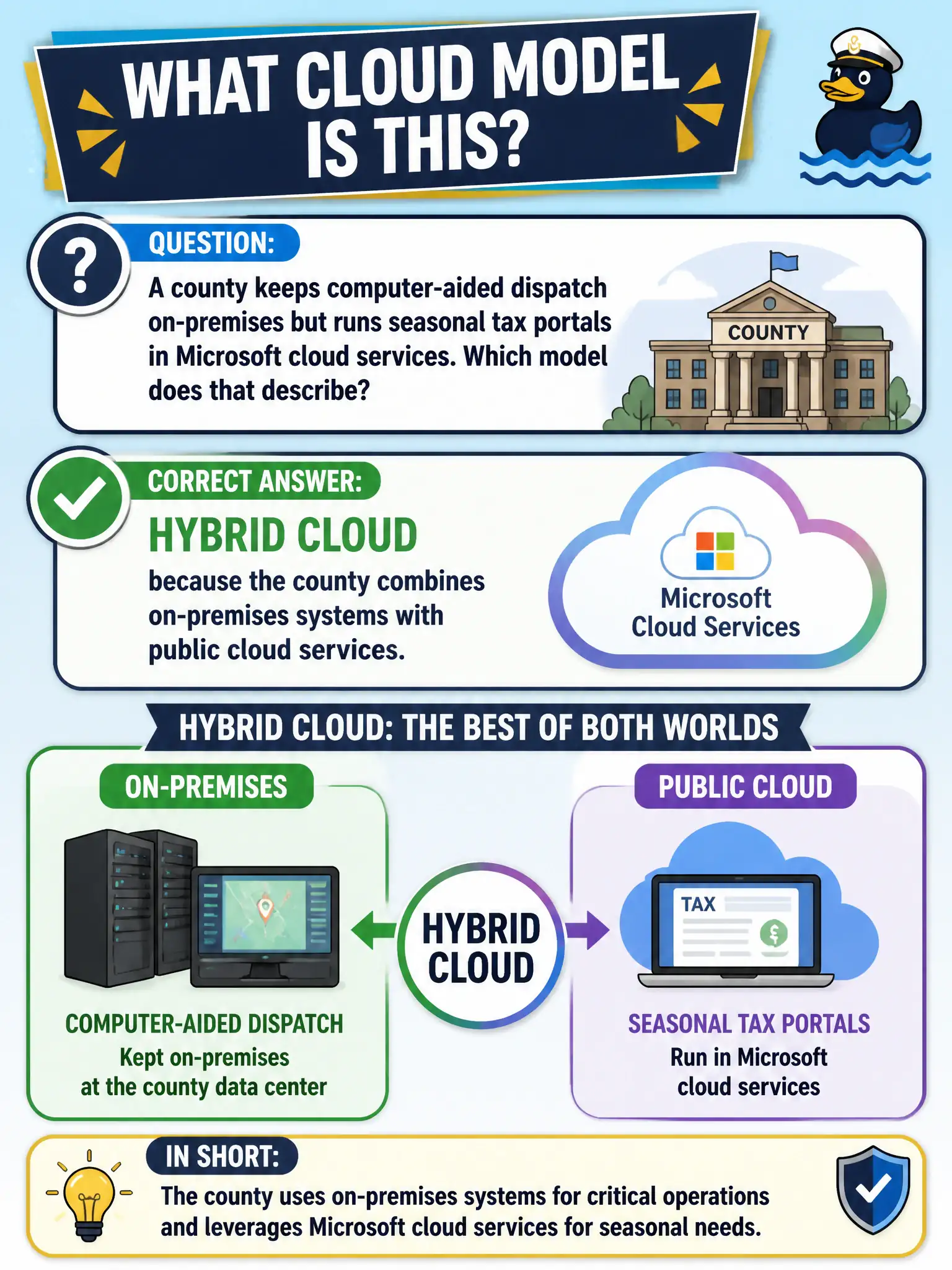
A county keeps computer-aided dispatch on-premises but runs seasonal tax portals in Microsoft cloud services. Which model does that describe?
Select an answer to reveal the explanation.
Short Explanation
Some systems stay in the county basement; others ride Microsoft's cloud for tax season. That mix is hybrid cloud—not "all public" or "all private."
Full Explanation
Hybrid cloud combines on-premises systems with public cloud services in one operating model. A county that keeps computer-aided dispatch on-premises for control and latency reasons while running seasonal tax portals on Microsoft cloud services is deliberately mixing deployment locations—classic hybrid cloud. That mixed posture is the correct fundamentals description for civic IT portfolios that cannot move every system at once.
Public cloud only fails because retaining CAD on-premises means the county is not operating exclusively in public cloud. Private cloud only fails because seasonal tax portals on shared Microsoft capacity are not a private-only estate. Framing the design as SaaS email licensing only fails conceptually: hybrid cloud is a recognized deployment model and is not limited to mailbox SKUs or messaging decisions.
Exam caveat: hybrid increases identity, networking, and integration complexity; inconsistent access policies across on-premises and cloud tiers create operational blind spots. Operational check: maintain an architecture diagram of on-premises versus Microsoft cloud systems, document Entra ID or hybrid identity paths, test seasonal portal scale-up, and prove CAD availability is isolated from tax-portal demand spikes.