
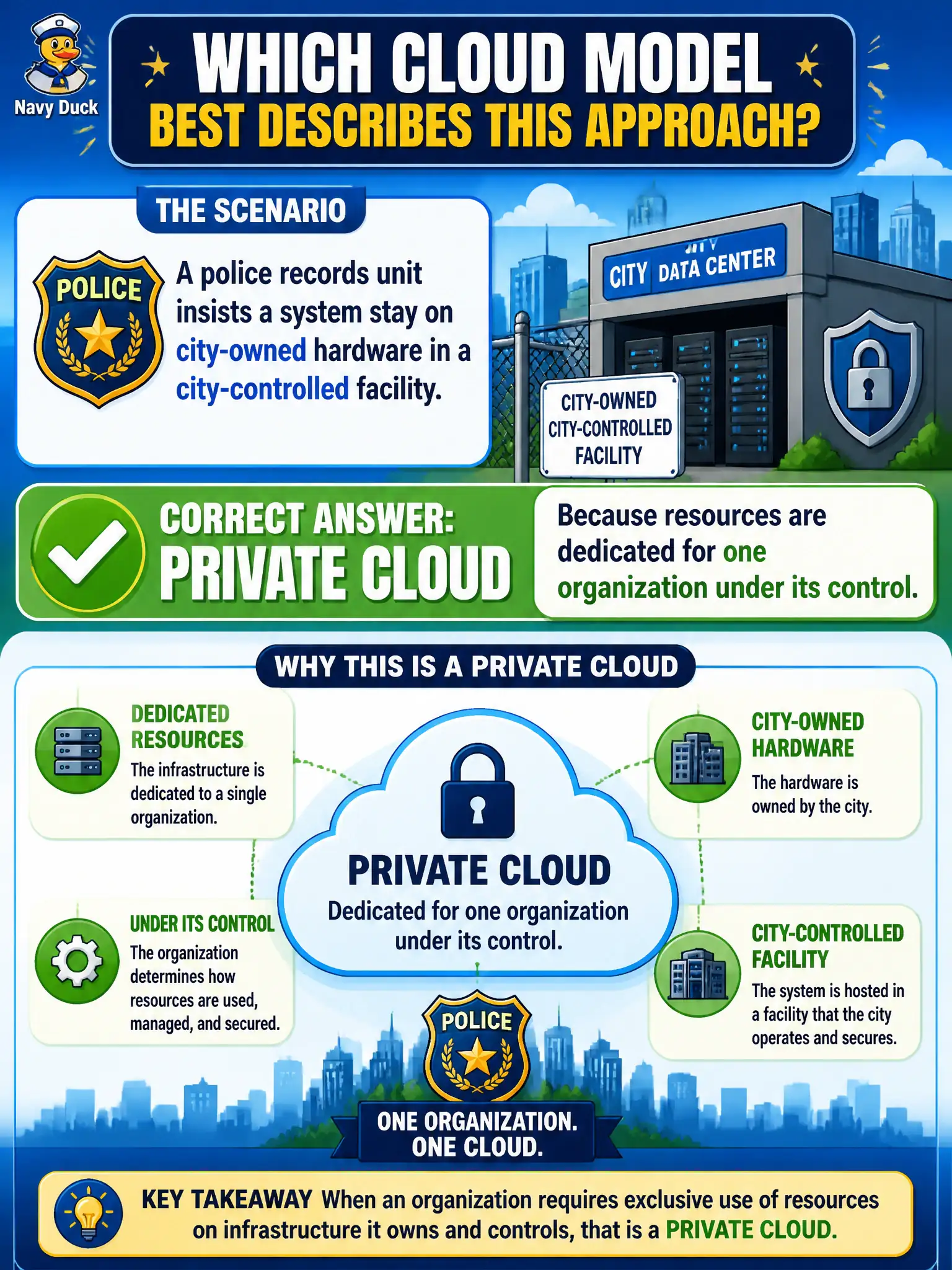
A police records unit insists a system stay on city-owned hardware in a city-controlled facility. Which cloud model best describes that approach?
Select an answer to reveal the explanation.
Short Explanation
City-owned gear, city-controlled building, one org's workloads—that is private-cloud thinking. Public cloud would mean sharing provider-operated multi-tenant capacity instead.
Full Explanation
Private cloud describes computing resources dedicated for one organization and operated under that organization’s control, commonly on owned or exclusively dedicated hardware in a controlled facility. A police records unit that insists a system remain on city-owned hardware inside a city-controlled facility is expressing a private-cloud posture: dedicated capacity, local control, and exclusive tenancy rather than shared public multi-tenant cloud.
Public cloud fails because city-owned hardware in a city facility is not automatically shared with every other municipality on a provider’s fabric. Saying the approach is software as a service only fails because dedicated facilities can host many kinds of applications; SaaS is a service model, not a rule that dedicated buildings cannot run software. Microsoft 365 Apps Current Channel fails conceptually because update channels govern how productivity apps update, not which cloud deployment model a records system uses.
Exam caveat: choosing private or on-premises placement does not remove patching, logging, physical security, or backup duties—the city still operates the stack it keeps. Operational check: document legal and policy drivers for private placement, verify facility and backup controls, and schedule an annual review of whether a compliant cloud option could meet the same residency requirements.