
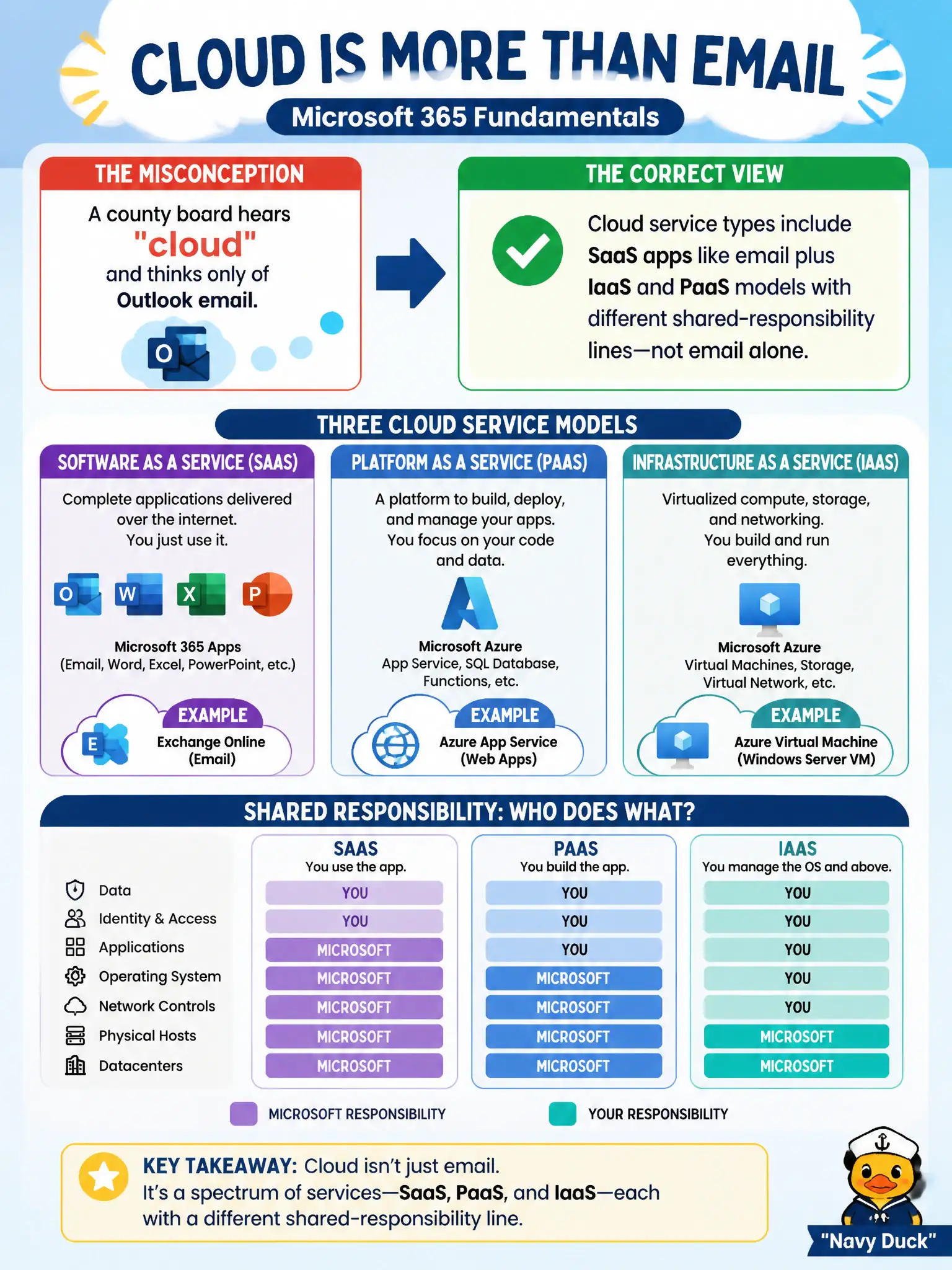
A county board hears "cloud" and thinks only of Outlook email. Which statement best corrects that view at Microsoft 365 fundamentals depth?
Select an answer to reveal the explanation.
Short Explanation
Outlook in the cloud is one SaaS story, not the whole library. Cloud also covers renting infrastructure (IaaS) and managed app platforms (PaaS). Email is a familiar example—not the definition of everything "cloud."
Full Explanation
At Microsoft 365 fundamentals depth, “cloud” is a family of service models—SaaS, IaaS, and PaaS—each with a different shared-responsibility boundary. Outlook email in the cloud is a familiar SaaS example for counties, but it is not the entire definition. IaaS covers rented infrastructure such as virtual machines, and PaaS covers managed application platforms. Correcting the board means teaching that breadth rather than equating cloud solely with inbox delivery.
Saying cloud means only Outlook Online fails because it erases IaaS and PaaS as recognized cloud service types. Claiming cloud always forces perpetual desktop Office purchases fails because modern Microsoft 365 productivity is commonly subscription SaaS, not a CapEx-only perpetual box model. Limiting “cloud” to on-premises Exchange in a basement fails conceptually: that posture is traditional on-premises ownership, not provider-operated cloud services.
Exam caveat: fundamentals questions reward recognizing service-type vocabulary; deeper Azure architecture detail is usually out of scope unless the stem asks for it. Operational check: when briefing elected officials, present a one-page map—SaaS examples (Exchange Online, Teams), IaaS examples (VMs for legacy apps), PaaS examples (managed web apps)—so “cloud” stops meaning “just email.”