
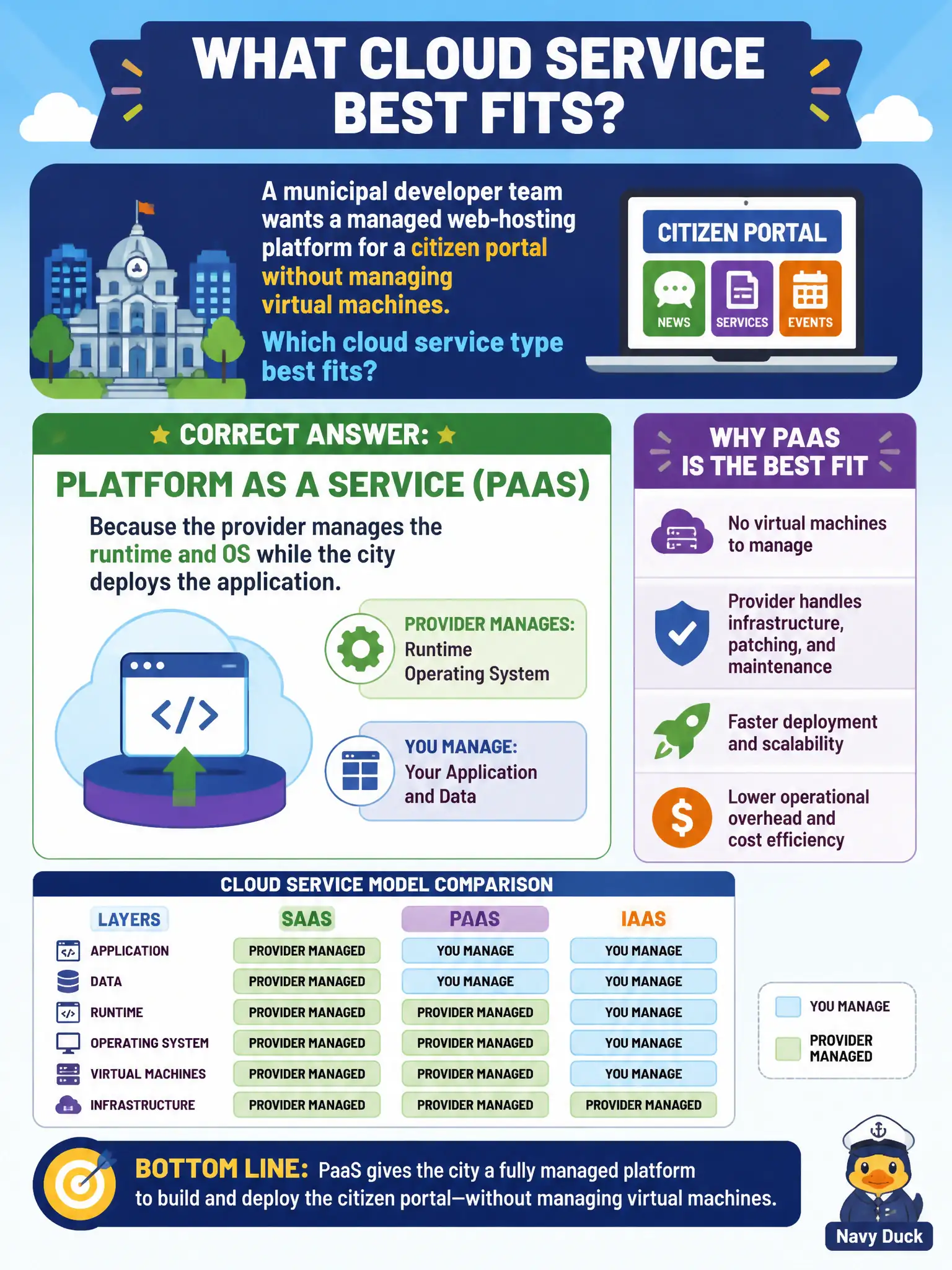
A municipal developer team wants a managed web-hosting platform for a citizen portal without managing virtual machines. Which cloud service type best fits?
Select an answer to reveal the explanation.
Short Explanation
PaaS is like a managed kitchen: the city brings the recipes (code), and the provider keeps the ovens, power, and utensils running. You skip babysitting VMs and focus on the citizen portal app itself.
Full Explanation
Platform as a service provides a managed application hosting environment—runtime, operating system, and platform services—so developers deploy and run application code without babysitting virtual machines. A municipal developer team building a citizen portal fits PaaS when they want to push web code and APIs while the provider maintains the underlying host OS and platform fabric. That responsibility split is why PaaS is the best match.
IaaS fails for this stated goal because IaaS still requires the city to patch guest OS images and VM baselines, which is the operational burden the team wants to escape. SaaS fails because SaaS delivers finished products such as Word Online; it does not mean “any web presence equals Word.” Private cloud colocation fails conceptually: managed PaaS offerings routinely host custom portal code on provider-operated platforms; requiring colocation confuses deployment preference with service-type capability.
Exam caveat: PaaS reduces OS chores but does not eliminate secure coding, secrets management, identity integration, or application-level monitoring for the citizen portal. Operational check: choose a managed web/app platform SKU, confirm CI/CD deploys without VM login rights for developers, and verify logging, TLS, and Entra ID authentication are configured before go-live.