
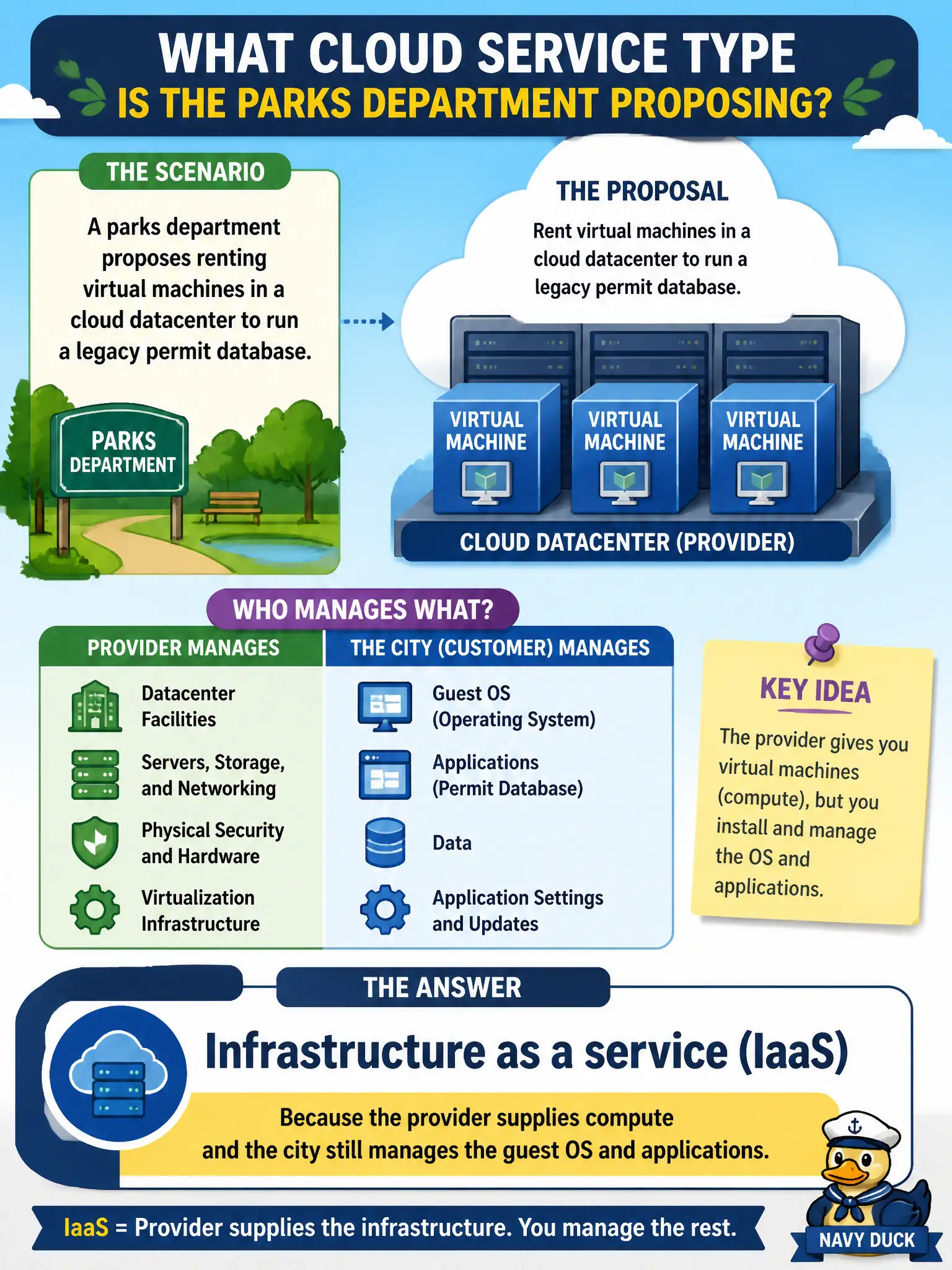
A parks department proposes renting virtual machines in a cloud datacenter to run a legacy permit database. Which cloud service type describes that proposal?
Select an answer to reveal the explanation.
Short Explanation
Think of IaaS like renting the empty warehouse and the power—then you still stock the shelves. The cloud gives you VMs, storage, and network; the parks team still installs and patches the OS and that legacy permit database.
Full Explanation
Infrastructure as a service means the cloud provider supplies compute, storage, and networking while the customer retains responsibility for the guest operating system, runtime, and applications. A parks department that rents virtual machines to host a legacy permit database is deliberately choosing that control-and-responsibility split: Microsoft (or another IaaS provider) offers the VM fabric, and city admins still patch Windows or Linux, the database engine, and the permit application. That is why IaaS correctly describes the proposal.
Calling any cloud-hosted database SaaS fails because SaaS implies a finished, provider-operated application experience—not a customer-managed database on rented VMs. Treating rented VMs as PaaS fails because PaaS removes or abstracts guest-OS management so teams deploy code to a managed platform; VMs keep OS duties with the city. Framing the idea as hybrid-work licensing fails conceptually: hybrid work describes where people work, not how virtual machines are consumed as a cloud service type.
Exam caveat: IaaS elasticity does not remove patching, backup, monitoring, or secure-configuration duties on the guest OS—those remain municipal operational risks. Operational check: inventory who owns OS hardening and database patching for the permit VMs, map those tasks to change windows, and verify backups and network controls before production traffic moves to the rented hosts.