
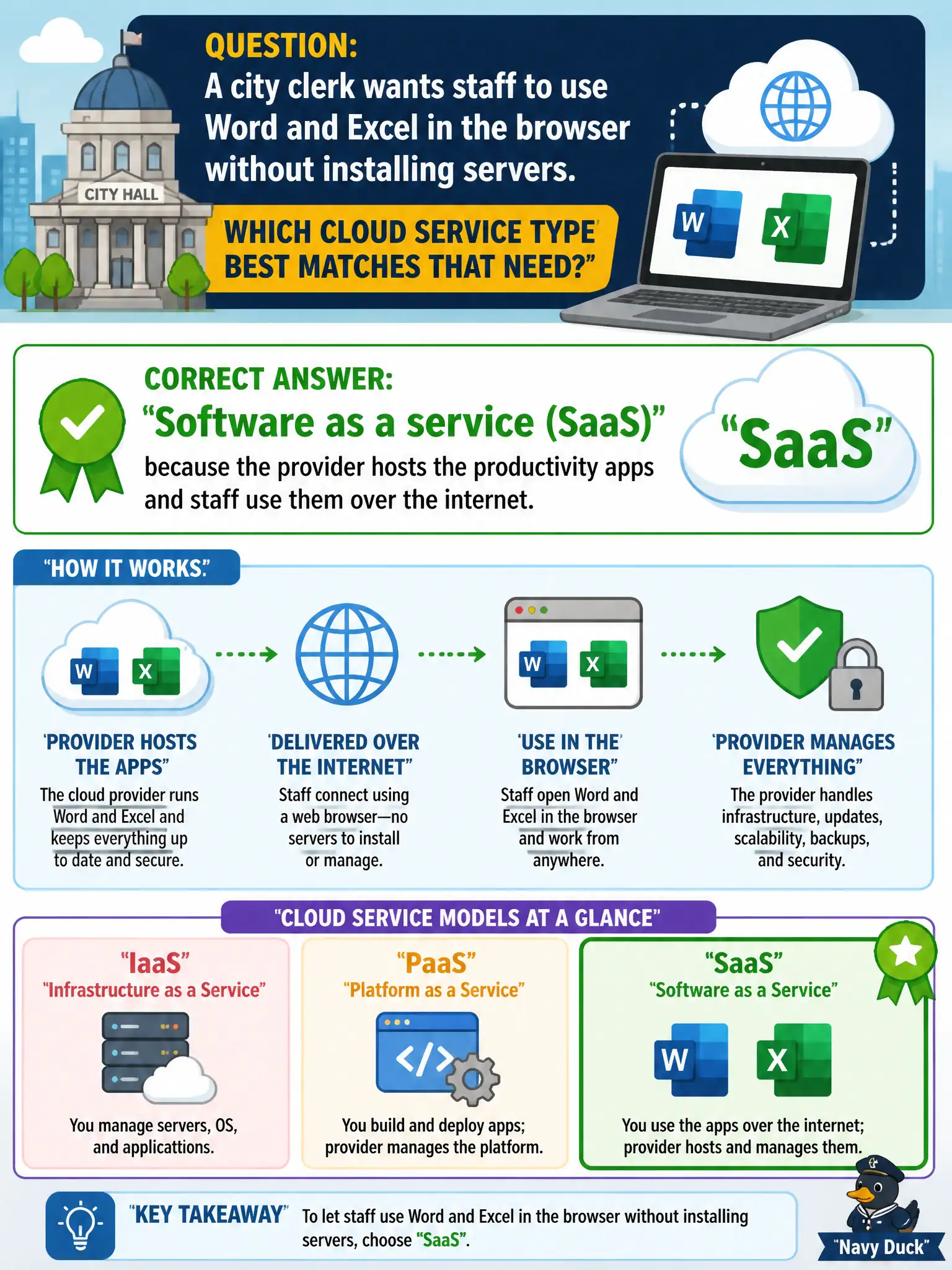
A city clerk wants staff to use Word and Excel in the browser without installing servers. Which cloud service type best matches that need?
Select an answer to reveal the explanation.
Short Explanation
Picture renting the finished office suite instead of building the office. With SaaS, Microsoft hosts Word and Excel; staff just open a browser. The city is not standing up servers or patching an app stack for those tools.
Full Explanation
Software as a service delivers finished applications that the provider hosts, patches, and operates so municipal staff consume them over the internet without standing up application servers. Browser Word and Excel for a city clerk’s office match that model: Microsoft runs the productivity stack, and staff simply authenticate and work. That shared-responsibility line is why SaaS is the correct service type for ready-made office apps in civic settings.
Infrastructure as a service fails here because IaaS supplies virtual machines and related infrastructure while the city still hardens the guest operating system, middleware, and applications—exactly the server work the clerk wants to avoid. Platform as a service fails because PaaS is for deploying custom application code onto a managed runtime; ordinance-drafting staff need Word and Excel, not a custom app platform. Claiming only a private cloud can run browser Word and Excel fails conceptually because Microsoft 365 productivity apps commonly run as multi-tenant public-cloud SaaS; private cloud is a deployment model about dedicated resources, not a requirement for browser Office.
Exam caveat: SaaS still leaves the municipality responsible for identity hygiene, licensing, data classification, and acceptable-use policy even when Microsoft patches the app. Operational check: confirm staff reach Word and Excel from browsers or installed Microsoft 365 Apps against the city’s tenant, verify Conditional Access and MFA apply, and document that no local application servers were deployed for this productivity workload.