
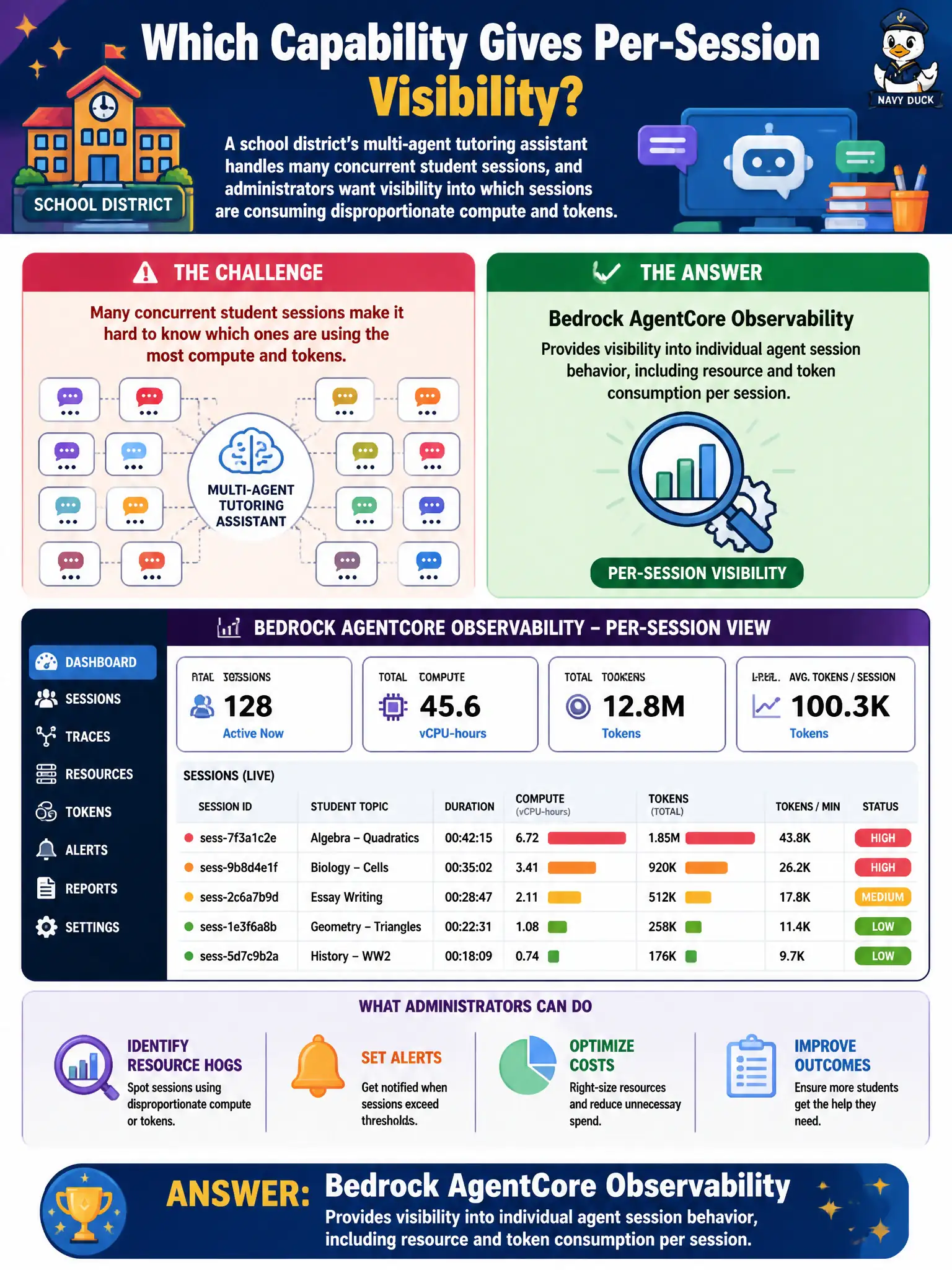
A school district's multi-agent tutoring assistant handles many concurrent student sessions, and administrators want visibility into which sessions are consuming disproportionate compute and tokens. Which capability gives them that per-session view?
Select an answer to reveal the explanation.
Short Explanation
An account-wide total tells you the bill is high, but not which student session is the reason why. Bedrock AgentCore Observability is built to break that down to the session level, showing which individual sessions are consuming disproportionate compute and tokens. That's the difference between knowing spend went up and knowing exactly where it went.
Full Explanation
Bedrock AgentCore Observability surfaces per-session behavior for agent workloads, including resource and token consumption tied to an individual session, letting administrators identify specifically which concurrent student sessions are consuming disproportionate resources rather than seeing an aggregate figure. A single account-wide billing total reflects overall spend but collapses every session into one number, making it impossible to identify an outlier session from that view alone. A fixed account-level daily token alarm fires once total usage crosses a threshold across all sessions combined, which could miss a single expensive session buried among many normal ones, or fire without indicating which session caused it. Manually exporting and parsing application logs to reconstruct per-session usage is technically possible but slow, error-prone, and doesn't scale to a classroom's worth of concurrent sessions happening in real time. Scope caveat: per-session observability data still needs a defined threshold for what counts as disproportionate, since normal sessions vary naturally in length and complexity. A concrete operational check: review the per-session breakdown for a recent high-cost day and confirm whether a small number of sessions account for a large share of total token usage.