
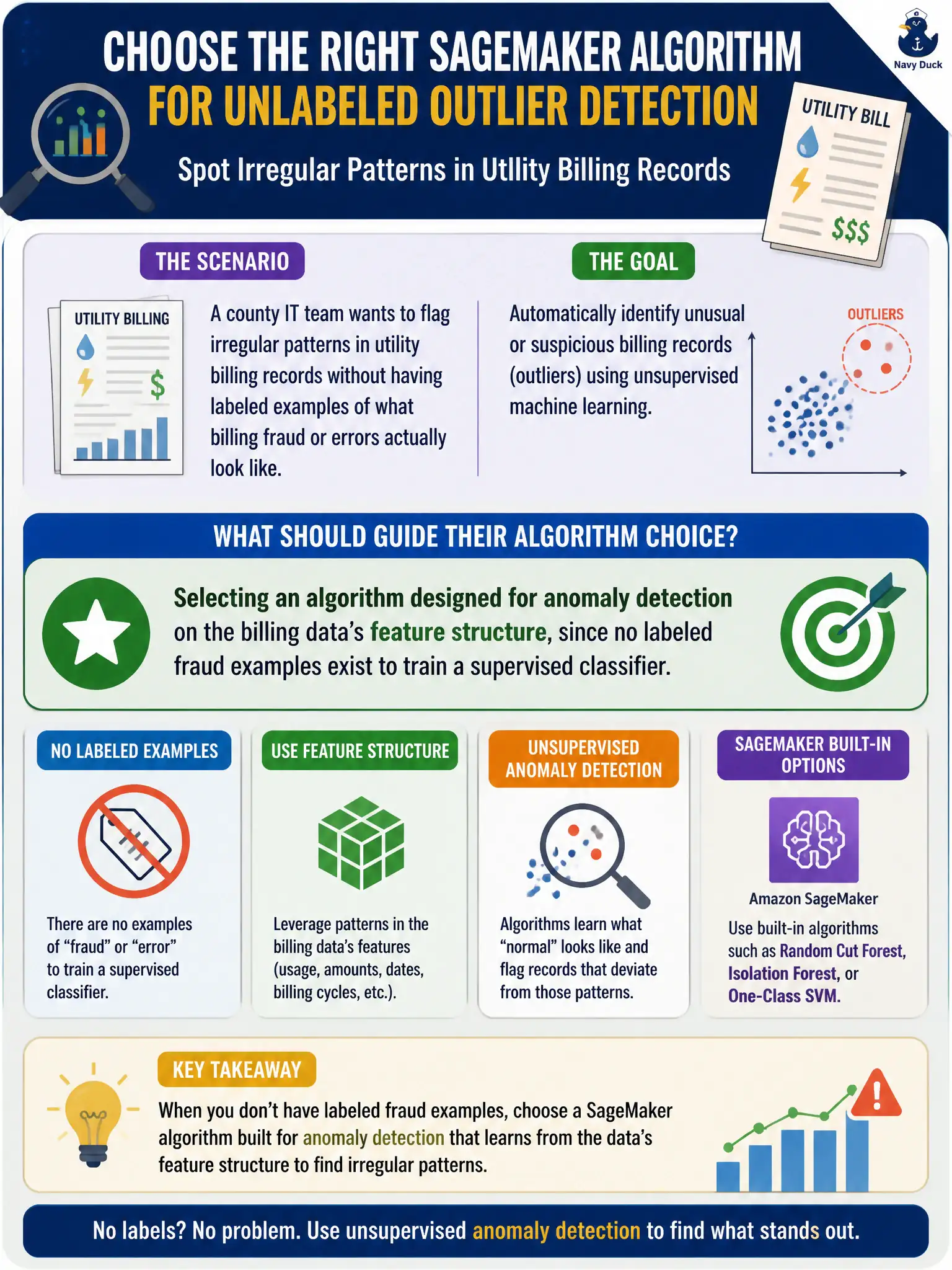
A county IT team wants to flag irregular patterns in utility billing records without having labeled examples of what billing fraud or errors actually look like. They plan to use a SageMaker built-in algorithm suited to this kind of unsupervised outlier detection. Which consideration should most directly guide their algorithm choice?
Select an answer to reveal the explanation.
Short Explanation
Think of trying to teach someone to spot a fake bill without ever showing them one — you can't train a supervised model on examples of fraud you don't have labeled. What you can do is teach it what "normal" billing looks like and flag whatever deviates. That's why an anomaly-detection algorithm matched to the data's structure is the right starting point here, not a classifier that needs labels it doesn't have.
Full Explanation
Anomaly detection algorithms are designed to learn the normal distribution of a dataset without requiring labeled examples of the anomalies themselves, which fits this scenario exactly: the county has no labeled fraud or error examples, only the raw billing records to learn from. Choosing an algorithm suited to the data's feature structure, whether it is numeric usage patterns, categorical account attributes, or a mix, ensures the anomaly scoring actually reflects meaningful deviations rather than noise from mismatched assumptions. Choosing a supervised classifier and labeling a sample afterward inverts the correct order of operations; supervised algorithms require labels during training to learn the distinction between classes, and labeling after the fact does not retroactively train the model correctly. Prioritizing the fastest training time over fit-for-purpose selection ignores that algorithm choice directly affects whether the flagged anomalies are meaningful, and speed differences matter far less than getting usable results from an unlabeled dataset. Choosing a time-series forecasting algorithm targets a different problem, predicting future values along a timeline, rather than identifying which existing records deviate from the norm, so a recurring billing cycle alone does not make forecasting the right tool. Scope note: unsupervised anomaly scores still need a human review step, since a statistical outlier is not automatically confirmed fraud. Operational check: validate a sample of the algorithm's flagged outliers against known past billing corrections before relying on it for wider rollout.