
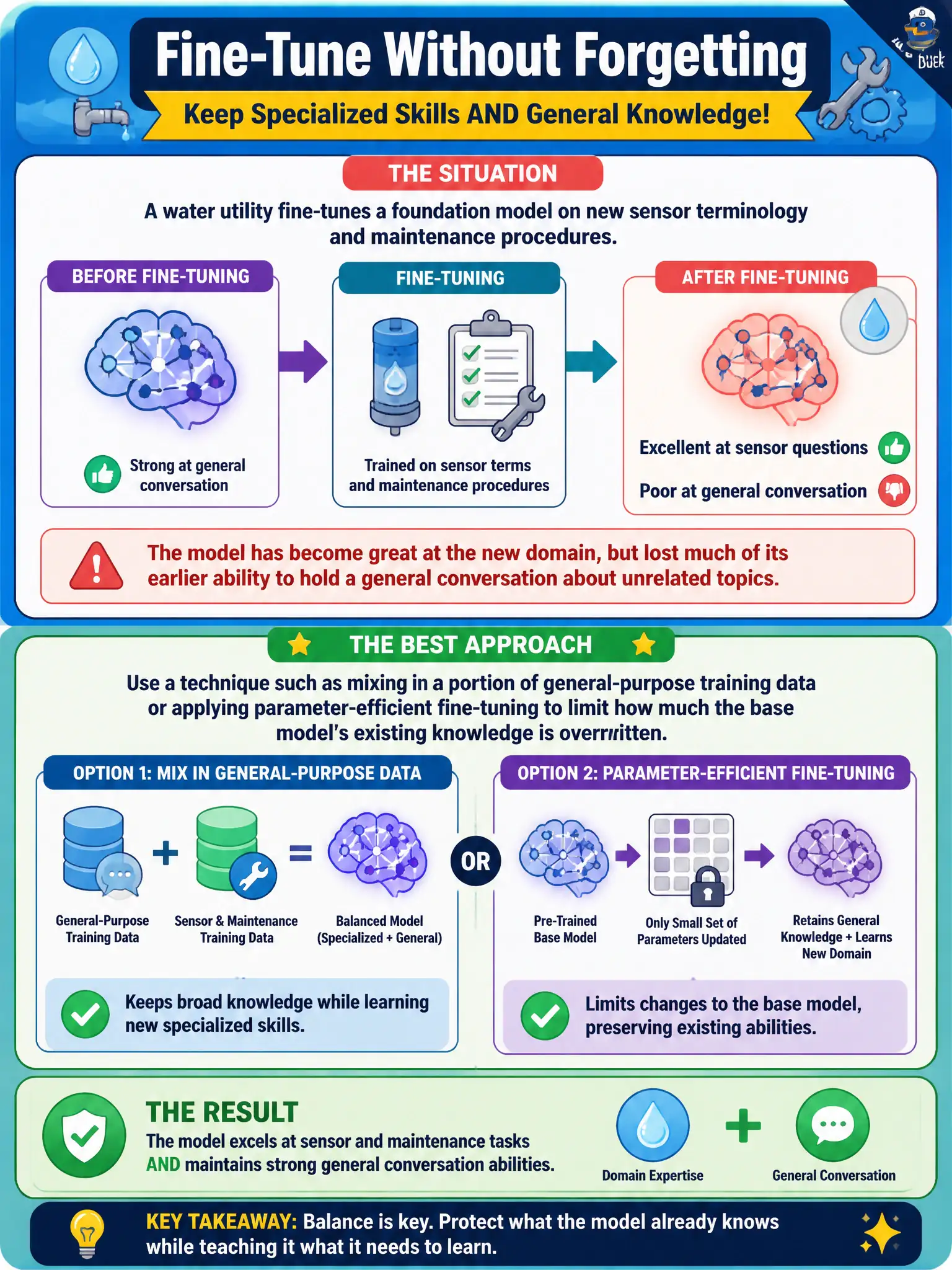
A water utility fine-tunes a foundation model on new sensor terminology and maintenance procedures. After fine-tuning, staff notice the model has become excellent at sensor questions but has lost much of its earlier ability to hold a general conversation about unrelated topics. Which approach best mitigates this pattern?
Select an answer to reveal the explanation.
Short Explanation
Think of catastrophic forgetting like cramming so hard for one exam that you blank on last semester's material — the new learning overwrites the old. Mitigating it means training gently enough, or narrowly enough, that the model can pick up sensor terminology without erasing what it already knew. Blending in general data or fine-tuning only a small slice of the model's parameters both protect that original knowledge.
Full Explanation
Catastrophic forgetting occurs when fine-tuning on a narrow, specialized dataset causes a model's weights to shift so much toward the new task that previously learned general capabilities degrade or disappear. Mitigations include mixing a portion of general-purpose data into the fine-tuning set so the model keeps rehearsing broader capabilities alongside the new domain, or using parameter-efficient fine-tuning approaches that update a limited subset of parameters rather than the full model, which constrains how much of the original knowledge can be overwritten. Reducing the diversity of the sensor-terminology data does not address the forgetting mechanism at all; it only changes what the model learns about sensors, not how much of its prior general knowledge is being displaced. Retraining from scratch on only general-conversation data discards the useful sensor-domain adaptation entirely, trading one narrow model for another rather than achieving both capabilities together. Increasing the learning rate makes the forgetting problem worse, not better, since a higher learning rate causes larger weight updates that overwrite existing knowledge more aggressively. Scope note: some forgetting is often an acceptable tradeoff when the deployed use case truly is narrow, so the fix should match how much general capability is actually needed. Operational check: after applying a mitigation, test the fine-tuned model on a sample of general, non-sensor conversation prompts to confirm the earlier capability was retained, not just the sensor-domain accuracy.