
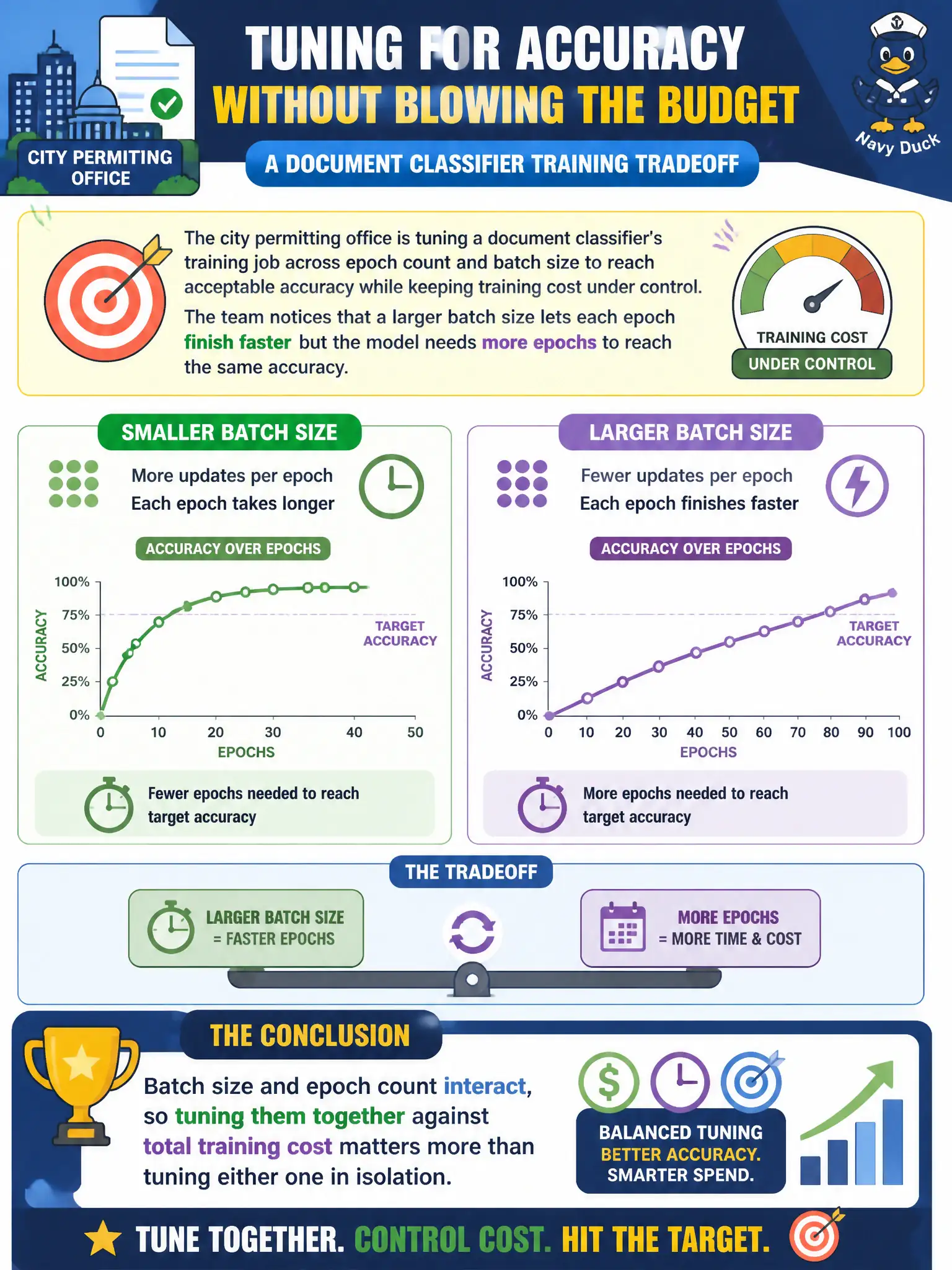
A city permitting office is tuning a document classifier's training job across epoch count and batch size to reach acceptable accuracy while keeping training cost under control. The team notices that a larger batch size lets each epoch finish faster but the model needs more epochs to reach the same accuracy. Which conclusion best fits this tradeoff?
Select an answer to reveal the explanation.
Short Explanation
Think of it like carrying groceries in fewer, bigger trips versus more, smaller ones — bigger trips look efficient per trip, but if you end up needing extra trips overall, the total effort can be about the same or worse. Batch size and epoch count trade off against each other, so the number that matters is total compute across the whole run, not either setting judged alone. Tuning them as a pair against overall cost is what actually controls the budget.
Full Explanation
Batch size and epoch count are core hyperparameters that interact rather than operate independently: a larger batch size typically produces fewer, noisier gradient updates per epoch, which can require more epochs to reach a comparable accuracy, while a smaller batch size gives more frequent updates per epoch but each epoch takes longer to process the same data volume at a per-step level. This means the total training cost, epochs multiplied by per-epoch time, is what should be optimized, not one setting evaluated on its own. The option limiting batch size's effect to memory usage ignores its well-established influence on gradient noise and convergence behavior, treating a training-dynamics parameter as purely a resource-allocation one. The option claiming epoch count is fixed by dataset size confuses dataset size, which affects how much data exists, with epoch count, which is a tunable choice about how many times the model passes over that data. The option claiming larger batch size guarantees lower total cost contradicts the scenario itself, where the extra epochs needed can offset or exceed the per-epoch time savings. Scope note: the ideal batch size also depends on available instance memory and gradient stability. Operational check: compare total wall-clock training cost across a few batch-size and epoch-count combinations rather than judging any single run in isolation.