
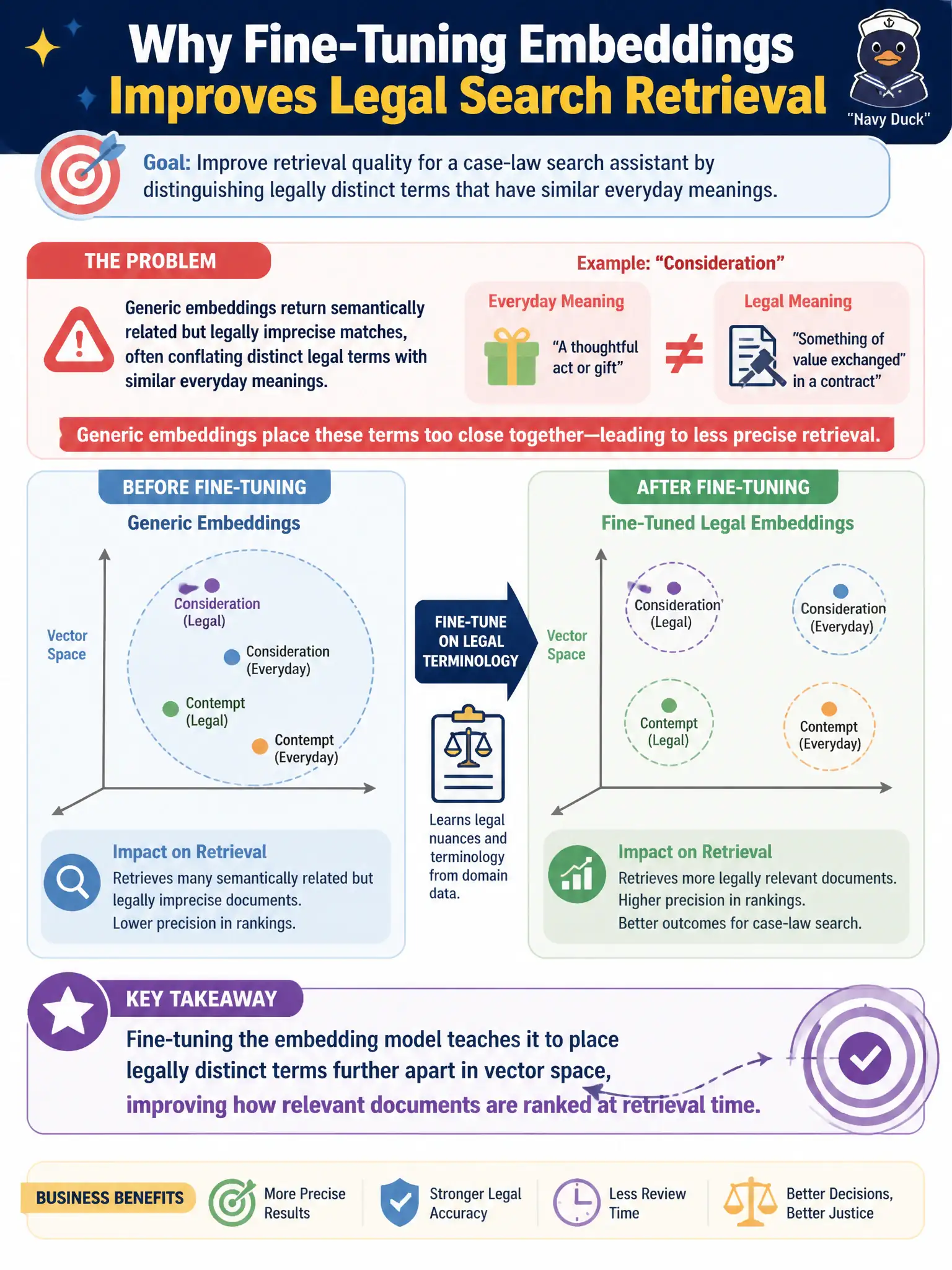
A county courts department wants to improve retrieval quality for a case-law search assistant. Generic embeddings return semantically related but legally imprecise matches, often conflating distinct legal terms with similar everyday meanings. The team decides to fine-tune the embedding model on legal terminology. Why is this the appropriate lever for this problem?
Select an answer to reveal the explanation.
Short Explanation
Think of a generic embedding model like a tourist's phrasebook — it knows the everyday meaning of words but not the specialized legal sense that changes everything. Fine-tuning the embedding model on legal terminology teaches it to separate terms a general model would lump together, so the vectors it produces actually reflect legal distinctions. That's why it's the right lever, not the generator that writes the final answer.
Full Explanation
Retrieval quality in a RAG system depends on the embedding model placing semantically and domain-relevant documents close together in vector space; when a generic embedding model conflates legally distinct terms because they share everyday meanings, the retrieval step returns documents ranked by the wrong notion of similarity before generation ever happens. Fine-tuning the embedding model on domain-specific legal text and terminology directly adjusts that vector space so legally meaningful distinctions are preserved, which improves which documents get retrieved and how they are ranked. Fine-tuning the generative model instead addresses a different stage of the pipeline; a better writer working from poorly retrieved source documents still produces answers grounded in the wrong material, since generation quality cannot compensate for retrieval failures. Increasing chunk size changes how documents are segmented for retrieval but does not touch the semantic representation problem causing imprecise matches; a court could just as easily get imprecise matches on larger chunks. Abandoning embeddings for keyword search trades one problem for another, since exact keyword matching misses the paraphrasing and semantic-relation cases embeddings are meant to catch, and does not address the actual domain-terminology gap. Scope note: embedding fine-tuning requires representative labeled query-document pairs from the legal domain to be effective. Operational check: measure retrieval precision on a held-out set of legal queries before and after fine-tuning to confirm the ranking actually improved.