
An emergency management agency combines predictions from several independently trained flood-risk models by averaging their outputs, aiming to make forecasts more reliable heading into storm season. Which statement best explains why this ensembling approach tends to improve reliability?
Select an answer to reveal the explanation.
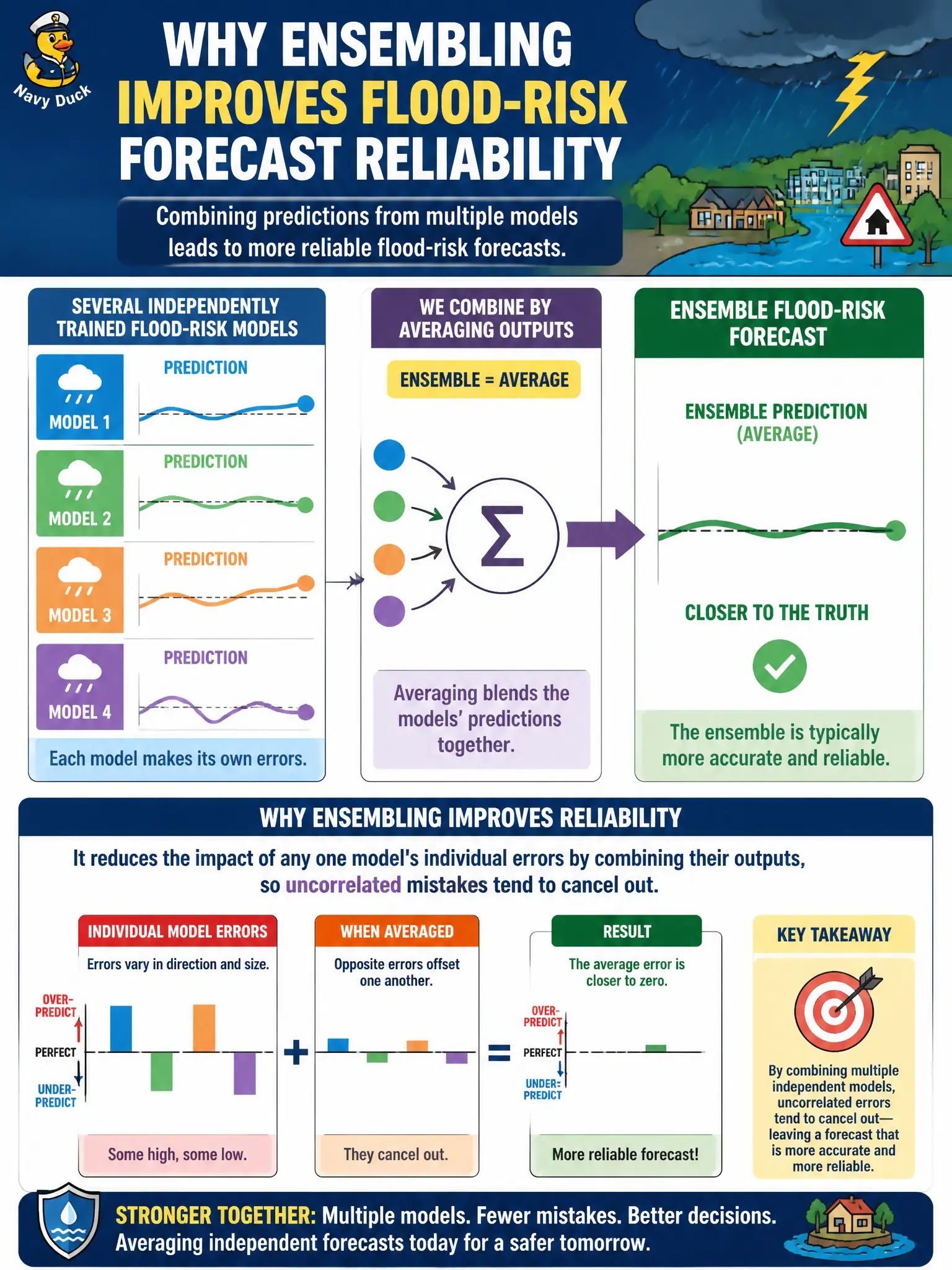
Short Explanation
Think of asking five forecasters for their storm predictions instead of trusting just one — if their mistakes aren't all in the same direction, averaging them smooths out the noise and leaves a steadier signal. That's the core idea behind ensembling: uncorrelated errors partly cancel when you combine outputs, which is why a well-built ensemble tends to be more reliable than any single member.
Full Explanation
Ensembling improves reliability because when individual models make errors that are not perfectly correlated with each other, combining their predictions through averaging or voting causes some of those errors to offset, producing a smoother and often more accurate aggregate forecast than any single model alone would give. This works best when the underlying models differ meaningfully, whether through different algorithms, training data subsets, or random initialization, since ensembling near-identical models with correlated mistakes yields little benefit. The option claiming guaranteed outperformance on every future event overstates what ensembling delivers; it improves expected reliability on average, not a guarantee against any single bad forecast. The option suggesting averaging substitutes for individually tuning each model misunderstands the mechanism: an ensemble of poorly trained models still tends to produce poor combined predictions, since averaging cancels noise, not systematic bias shared across all members. The option describing weight-combination into one retrained model describes something closer to model merging or federated averaging of parameters, not the output-level ensembling described in the scenario. Scope note: ensembles add inference cost and complexity, since multiple models must run per prediction. Operational check: before deploying, confirm the individual models' errors are not highly correlated by comparing their disagreement rate on a held-out storm-event sample.