
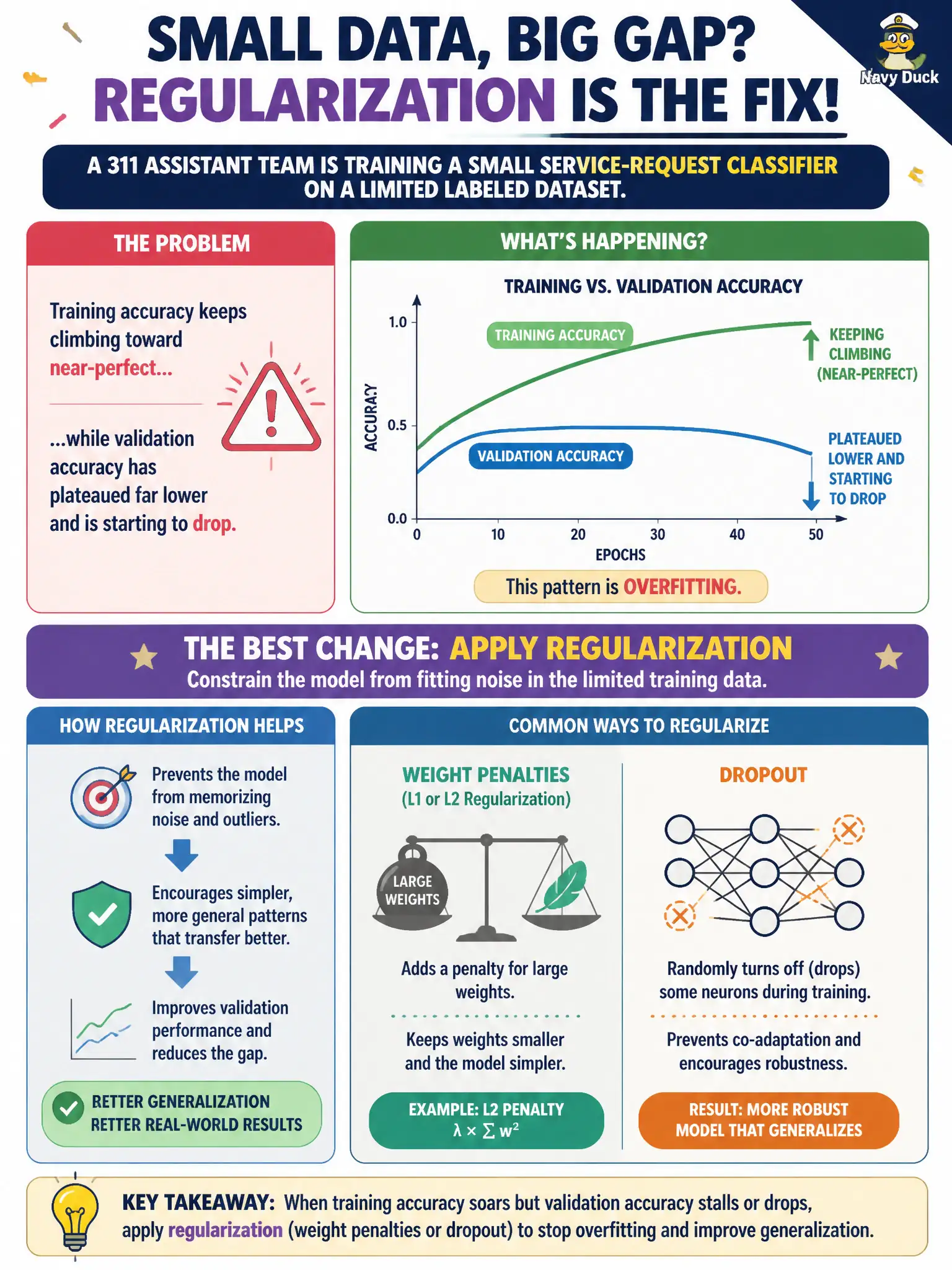
A 311 assistant team is training a small service-request classifier on a limited labeled dataset. Training accuracy keeps climbing toward near-perfect while validation accuracy has plateaued far lower and is starting to drop. Which change best addresses this pattern?
Select an answer to reveal the explanation.
Short Explanation
Think of a student who memorizes yesterday's practice quiz word-for-word instead of learning the underlying material — they'll ace that exact quiz and flounder on anything new. That gap between soaring training accuracy and a stalled validation score is the classic overfitting signature. Regularization reins the model in, nudging it toward patterns that generalize instead of ones it can just memorize.
Full Explanation
Overfitting happens when a model has enough capacity relative to a limited dataset that it starts fitting noise and idiosyncrasies specific to the training examples rather than the underlying signal, which produces exactly this pattern: rising training accuracy paired with a plateaued or worsening validation score. Regularization techniques such as L2 weight penalties or dropout constrain the model during training, discouraging it from relying too heavily on any single feature or memorizing specific examples, which narrows the train-validation gap. Training for more epochs on the same small dataset deepens the memorization rather than fixing it, since the model keeps getting more chances to fit training-set noise. Removing the validation split treats a diagnostic signal as a nuisance rather than the tool that revealed the problem; without it the team would have no way to detect overfitting at all going forward. Adding more parameters increases capacity in the wrong direction, giving the model even more room to memorize a dataset that is already too small for the capacity it has. Scope note: on very small datasets, regularization alone may not be enough and augmentation or additional labeled data should be considered. Operational check: after applying regularization, confirm the train-validation accuracy gap has narrowed on a re-run, not just that overall accuracy changed.