
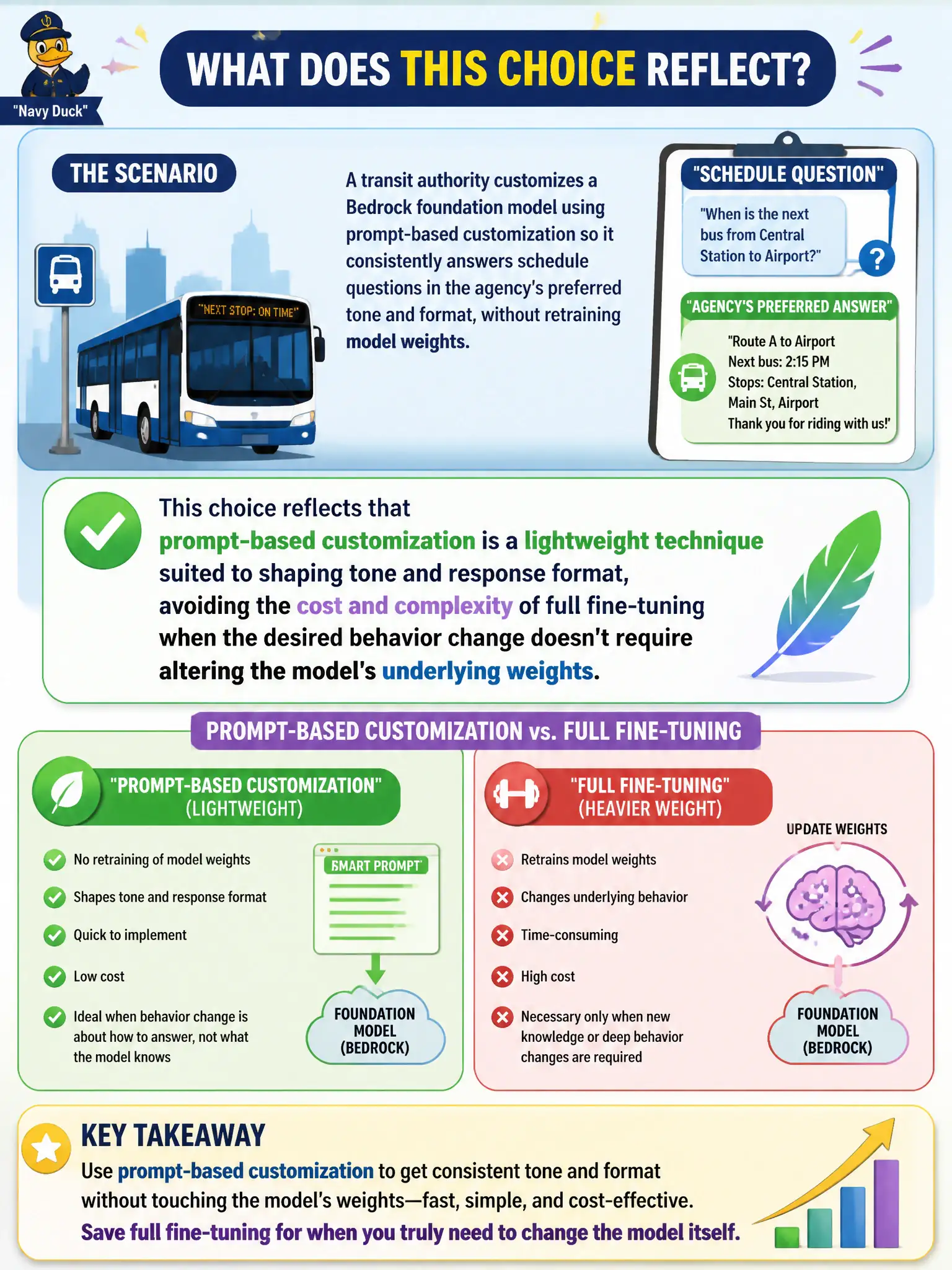
A transit authority customizes a Bedrock foundation model using prompt-based customization so it consistently answers schedule questions in the agency's preferred tone and format, without retraining model weights. What does this choice reflect?
Select an answer to reveal the explanation.
Short Explanation
Shaping how a model talks — its tone, its format — doesn't always require touching what it knows at the weight level. Prompt-based customization steers behavior through instructions the model reads at query time, which is a much lighter lift than a full fine-tune when the ask is really just 'say it this way.' It's the right-sized tool when the gap is style, not underlying weights.
Full Explanation
Prompt-based customization shapes a model's behavior — tone, format, response structure — through carefully constructed instructions and examples fed in at query time, without altering the model's underlying weights, which makes it a lightweight technique well suited to behavior shaping when the desired change doesn't require deeper knowledge modification. Claiming it permanently updates model weights the way full fine-tuning does misstates the mechanism entirely — that's the defining difference between the two techniques, and conflating them erases the distinction the question is testing. Claiming full fine-tuning would have been the better option because prompt-based techniques can't reliably influence tone or format gets the tradeoff backwards — tone and format shaping is precisely the kind of surface-level behavior change prompt-based techniques handle well, while full fine-tuning is typically reserved for deeper changes that do require weight updates. Claiming prompt-based customization requires retraining on a labeled question-and-answer dataset describes fine-tuning's data requirements, not prompt-based customization's — the whole appeal of the prompt-based approach is that it avoids a labeled training dataset and a retraining cycle. Scope caveat: prompt-based customization is generally less durable for deeply ingrained behavior changes and can be more sensitive to prompt drift over time than a fine-tuned model. Operational check: test the customized prompt against a representative sample of schedule questions and confirm tone and format stay consistent across varied phrasing.