
A county housing agency needs to score housing-assistance eligibility using its own custom feature engineering logic that doesn't match any SageMaker built-in algorithm's expected input format. The team writes a custom SageMaker script-mode training job. What does this decision reflect?
Select an answer to reveal the explanation.
Short Explanation
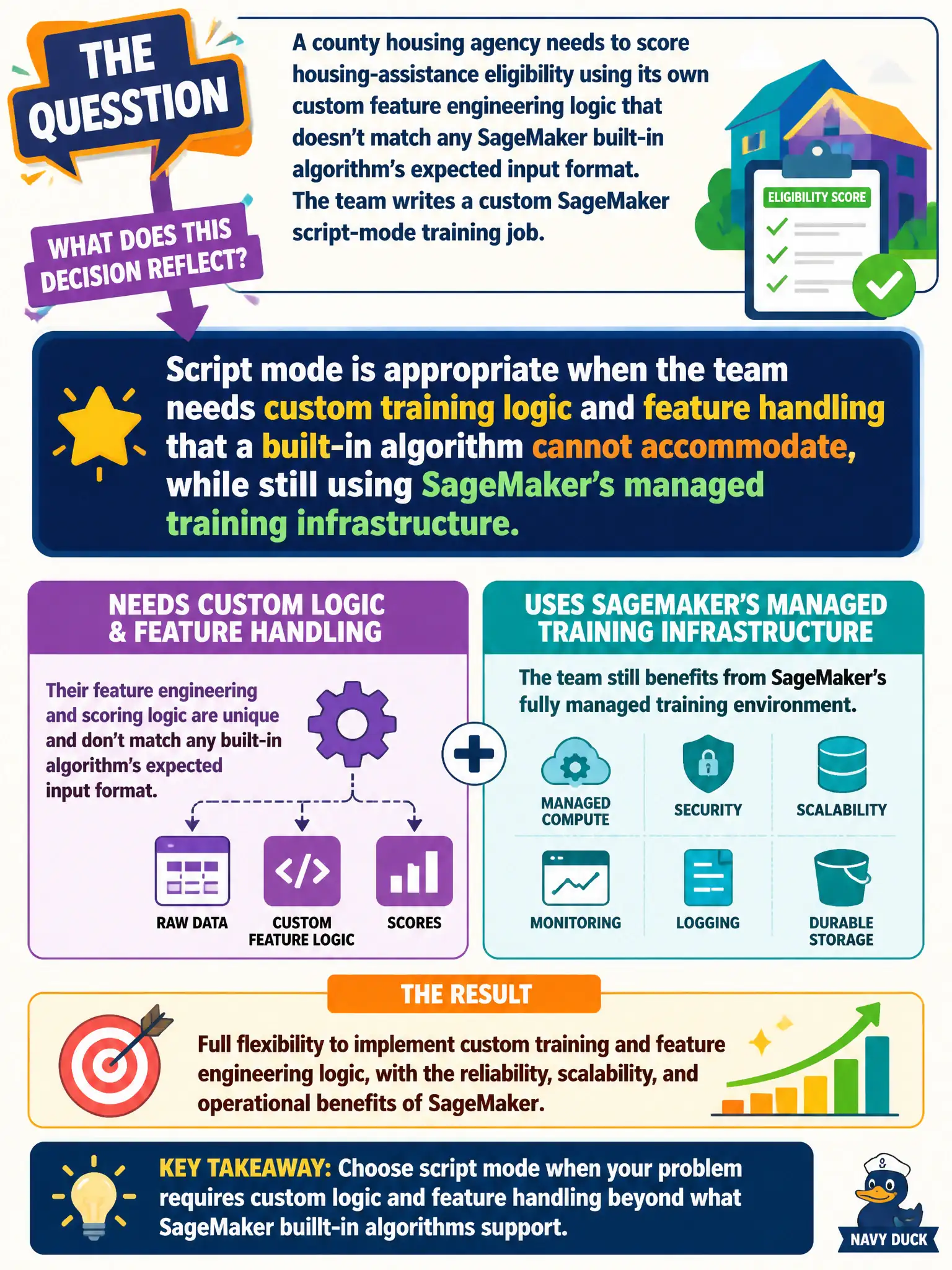
Script mode is what you reach for when your own feature-engineering logic just doesn't fit the shape a built-in algorithm expects — you bring your own training code, and SageMaker still handles the managed infrastructure underneath it. It's not a regional workaround and it's not proof built-ins can't do tabular work; it's simply the right tool when the logic itself is custom. The infrastructure story stays the same either way — SageMaker manages the compute regardless of which mode you choose.
Full Explanation
Understanding script mode means recognizing what problem it actually solves: it lets a team supply their own training code — including custom feature engineering and input handling — while still running on SageMaker's managed training infrastructure, which is exactly the situation here where the agency's feature logic doesn't fit a built-in algorithm's expected input format. Framing script mode as a Region-availability workaround misattributes the decision — script mode is chosen based on whether the training logic itself is custom, not based on which built-in algorithms happen to be available in a given Region. Claiming built-in algorithms are incapable of tabular eligibility-scoring tasks is inaccurate in general — SageMaker built-ins handle plenty of tabular classification and scoring problems; the actual reason for script mode here is the custom feature-engineering logic, not a categorical limitation of built-ins on tabular data. Claiming script mode eliminates infrastructure management, unlike built-in algorithms which require manual server provisioning, misdescribes both options — both script mode and built-in algorithm training run on SageMaker's managed training infrastructure, so neither requires the team to manually provision servers. Scope caveat: script mode does put more responsibility on the team for correctly implementing training and evaluation logic that a built-in algorithm would otherwise handle. Operational check: validate the script-mode job's output format and evaluation metrics against a small known-answer subset before running it against the full eligibility dataset.