
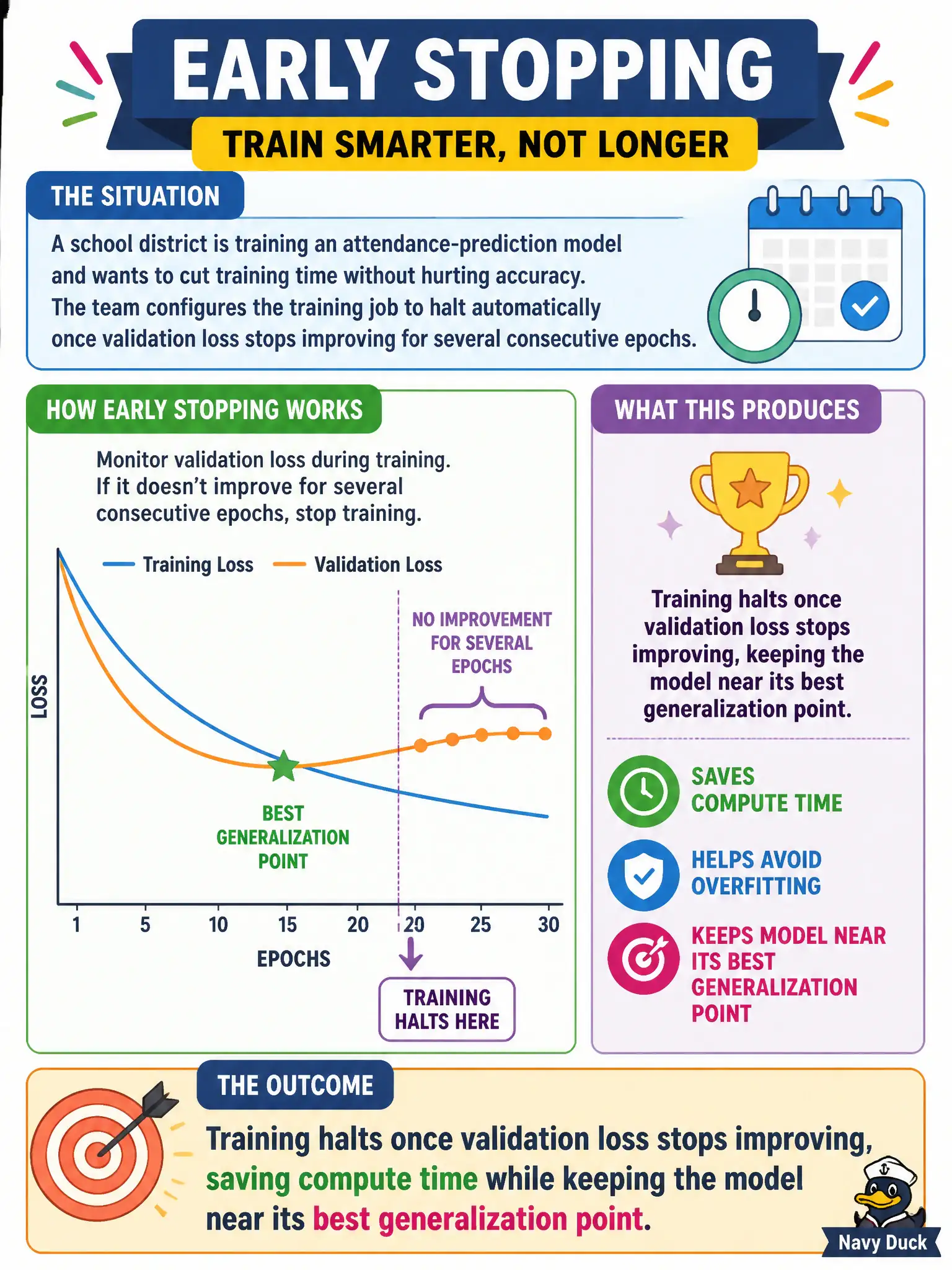
A school district is training an attendance-prediction model and wants to cut training time without hurting accuracy. The team configures the training job to halt automatically once validation loss stops improving for several consecutive epochs. Which outcome does this early-stopping configuration most directly produce?
Select an answer to reveal the explanation.
Short Explanation
Picture a runner who stops the race the moment their pace stops improving instead of pushing until they collapse. Early stopping watches validation loss, not training loss, and once that stops getting better for a set number of rounds it cuts the run short and keeps the best checkpoint. That's how you save compute without training an overfit model past its peak.
Full Explanation
Early stopping works by monitoring a held-out validation metric during training and terminating the job once that metric fails to improve across a defined patience window, which stops the run near the point where the model generalizes best rather than continuing until it overfits the training data. It directly reduces wall-clock training time and cost because compute stops being spent once returns flatten out. The distractor claiming full-epoch training with a relabeled checkpoint describes fixed-length training, the opposite of what early stopping changes: it alters when the job ends, not just what gets recorded afterward. The option built on training-set loss mistakes the signal source; training loss keeps dropping as a model memorizes examples, so watching it alone cannot detect the overfitting point and does not remove the need for a validation split. The option equating a single training-loss uptick with validation monitoring conflates two different signals and reacts to noisy short-term fluctuations rather than a sustained validation trend. Scope note: patience and the minimum-improvement threshold still need tuning per dataset. Operational check: confirm the job logs show the checkpoint saved matches the epoch where validation loss was lowest, not the final epoch.