
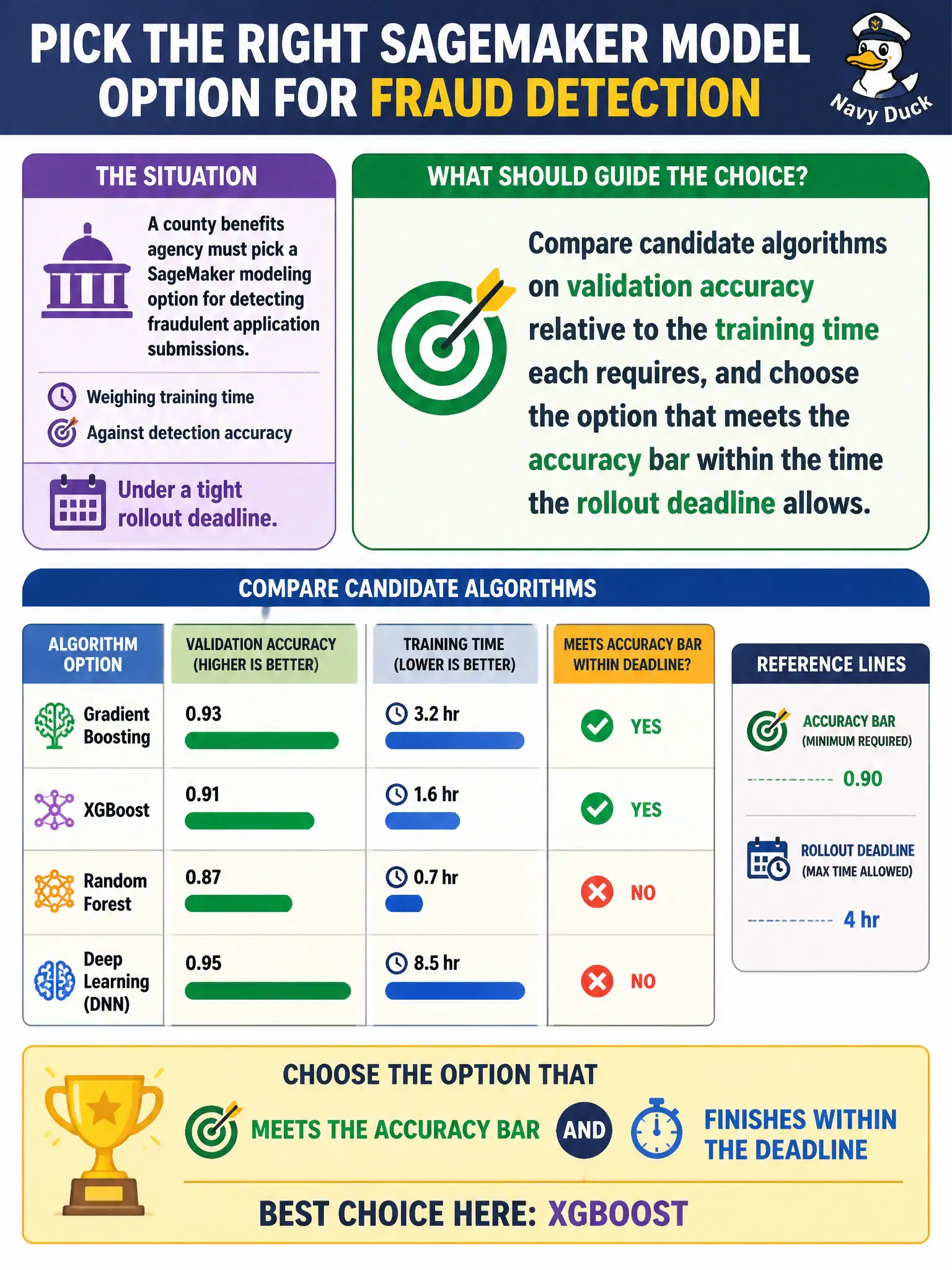
A county benefits agency must pick a SageMaker modeling option for detecting fraudulent application submissions, weighing training time against detection accuracy under a tight rollout deadline. What should guide the choice?
Select an answer to reveal the explanation.
Short Explanation
Training time and accuracy aren't the same dial — a fast-training algorithm can still miss fraud patterns, and a slow one isn't automatically the sharpest detector. The real move is comparing candidates on accuracy relative to how much training time each actually costs, then picking whichever clears the accuracy bar inside the deadline you've got. Neither speed nor accuracy alone tells the whole story on its own.
Full Explanation
Balancing training time against accuracy under a deadline means evaluating both dimensions together, not optimizing either one in isolation: comparing candidate algorithms on validation accuracy relative to their training time identifies which options can hit an acceptable accuracy bar within the time the rollout schedule allows. Assuming training time determines accuracy conflates two independent properties — a quick-training algorithm isn't automatically more or less accurate; the relationship between the two depends on the algorithm and the data, not a fixed rule. Assuming a published benchmark's accuracy transfers directly to the agency's own application data ignores that benchmark datasets differ from a county's specific fraud patterns, features, and class balance, so benchmark rankings don't reliably predict performance on this agency's real submissions. Defaulting to whatever algorithm a previous project used, on the assumption that switching necessarily extends the deadline, treats algorithm continuity as a hard constraint rather than a factor to weigh — a different algorithm might actually train faster or reach the accuracy bar sooner, and the previous project's choice may not even fit this dataset's characteristics. Scope caveat: this comparison should use validation data representative of the current fraud patterns, since older validation sets may not reflect evolving submission tactics. Operational check: run each shortlisted algorithm through SageMaker Automatic Model Tuning on a fixed time budget and compare the resulting validation accuracy before committing to a rollout candidate.