
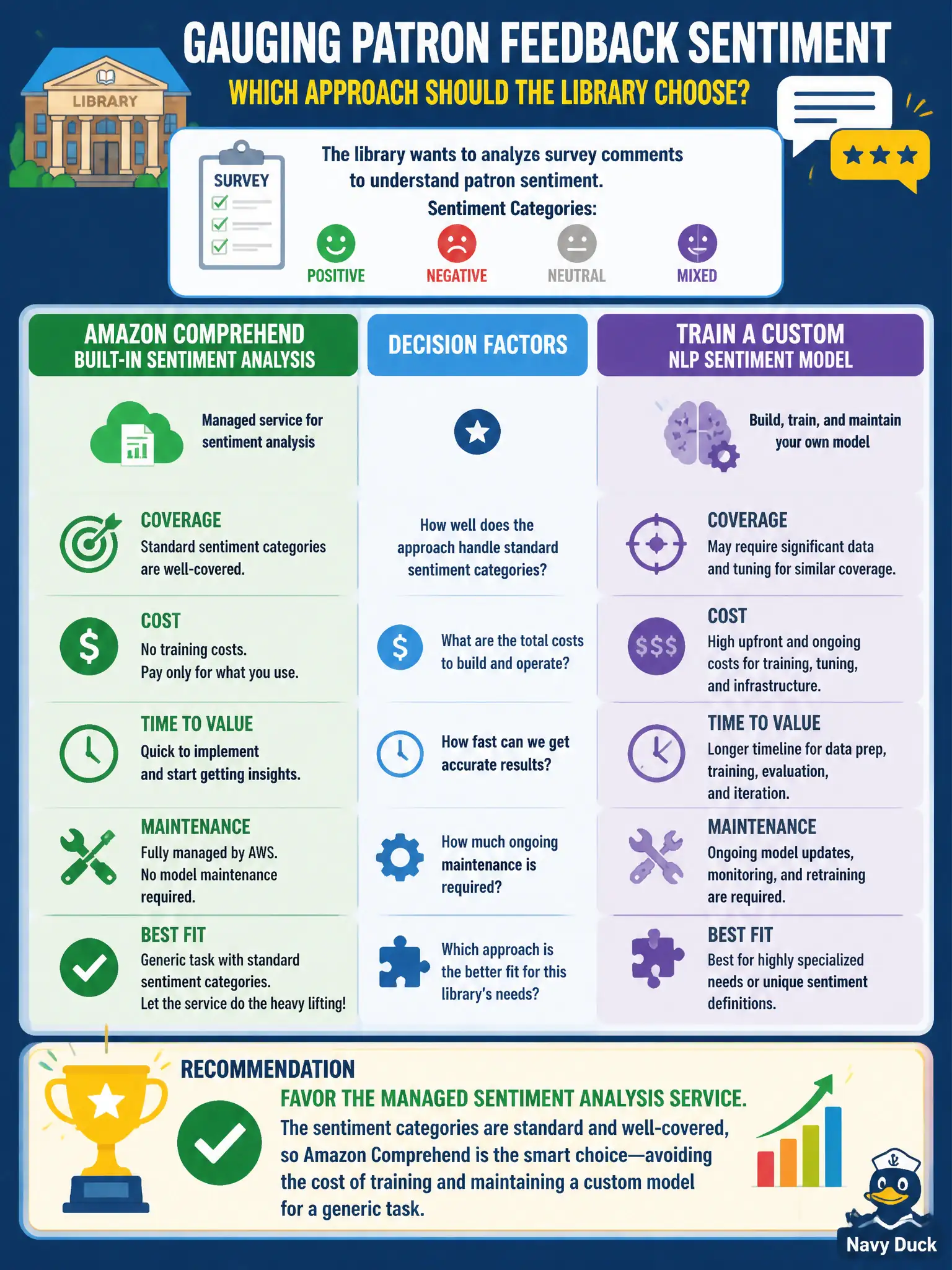
A public library system wants to gauge patron feedback sentiment from survey comments and is deciding between Amazon Comprehend's built-in sentiment analysis and training a custom NLP sentiment model. The sentiment categories are the standard positive, negative, neutral, and mixed classes. What should guide the decision?
Select an answer to reveal the explanation.
Short Explanation
Positive, negative, neutral, and mixed is about as standard as sentiment analysis gets — that's the exact job a managed sentiment service was built for, no library-specific customization needed. Reaching for a custom model here means building and maintaining something to solve a problem a generic service already handles well. Save the custom build for when the categories stop being generic.
Full Explanation
Justifying a managed AI service over custom modeling for a generic, well-covered NLP task comes down to whether the task's categories match what the service already handles: standard positive, negative, neutral, and mixed sentiment classes are precisely what a managed sentiment analysis service is built to classify, so using it avoids the time and ongoing maintenance cost of training a custom model for a task that isn't specialized. Claiming the managed service is designed specifically for product reviews narrows its actual scope incorrectly — sentiment analysis services are generally trained to handle sentiment across varied text sources, not restricted to one content type, and patron survey comments fall well within that general scope. Claiming a custom model will outperform the managed service on standard classes without needing additional training data is internally contradictory — building a custom model that performs well requires labeled training data by definition; the claim assumes an advantage while ignoring the very cost the managed service is meant to avoid. Requiring the managed service to first be trained on labeled examples of what 'positive' and 'negative' mean misunderstands what 'built-in' means — the service already ships with these general categories defined and modeled; a district doesn't need to teach it these standard concepts before using it. Scope caveat: if library-specific sentiment nuances (e.g., sarcasm about wait times) start driving misclassifications, revisiting custom modeling becomes reasonable. Operational check: run a sample of real patron comments through the managed service and compare its sentiment labels against a manually reviewed sample before adopting it broadly.