
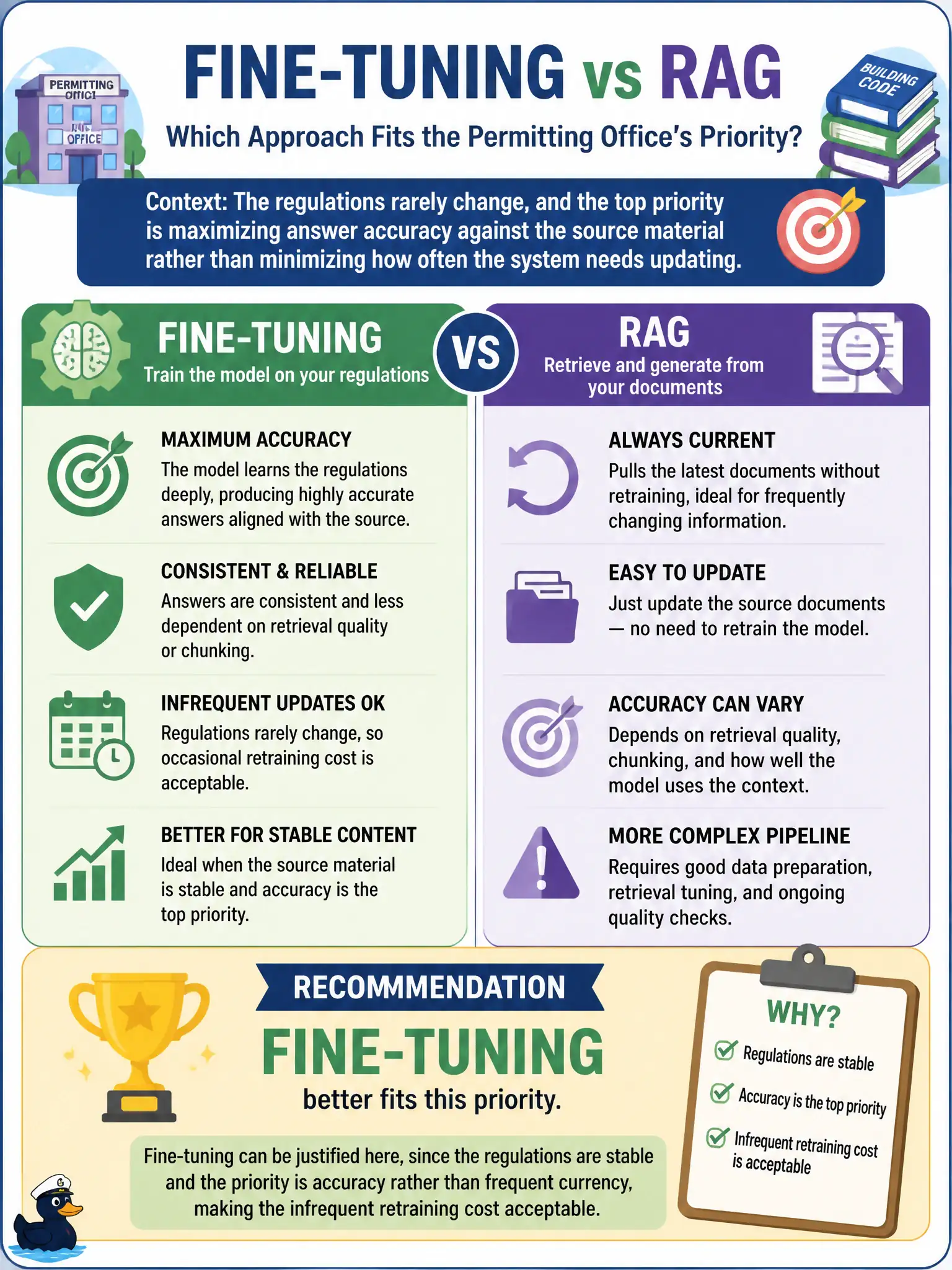
A permitting office is deciding between fine-tuning and RAG for a building-code compliance assistant. The relevant regulations rarely change, and the office's top priority is maximizing answer accuracy against the source material rather than minimizing how often the system needs updating. Which approach better fits this priority?
Select an answer to reveal the explanation.
Short Explanation
When source material barely moves, the usual argument for RAG — staying current without retraining — loses most of its force. That flips the calculus: if the priority is squeezing out accuracy on genuinely stable regulations, fine-tuning's one-time training cost becomes a price worth paying rather than a liability. Match the approach to what the office actually prioritizes here.
Full Explanation
Choosing between fine-tuning and RAG should weigh their respective strengths against what the office actually prioritizes: when source regulations are stable and the goal is maximizing accuracy rather than minimizing update frequency, fine-tuning's main drawback — the cost of retraining when facts change — becomes far less relevant, making it a reasonable, sometimes preferable, choice for deeply embedding stable regulatory knowledge into the model's responses. Claiming RAG is inherently more accurate than fine-tuning on stable material overstates RAG's advantage; RAG's main strength is currency without retraining, not an intrinsic accuracy edge, and a well-executed fine-tune on stable, well-curated source material can perform comparably or better on the specific domain it was trained on. Claiming fine-tuning is incapable of representing regulatory text with adequate precision is an overreach — fine-tuning has been used successfully on precise, technical domains; the real constraint is that it doesn't handle frequently changing facts well, which isn't the situation described here. Requiring the regulations to change monthly before fine-tuning is justified inverts the actual logic — frequent change is the scenario that favors RAG, not fine-tuning; the stem explicitly describes rarely changing regulations, which is the condition that makes fine-tuning viable, not disqualifying. Scope caveat: 'rarely changes' still means occasional updates happen, so the office needs a retraining cadence plan even under this approach. Operational check: establish a review trigger tied to actual regulatory amendment announcements, not a fixed calendar, to decide when retraining is warranted.