
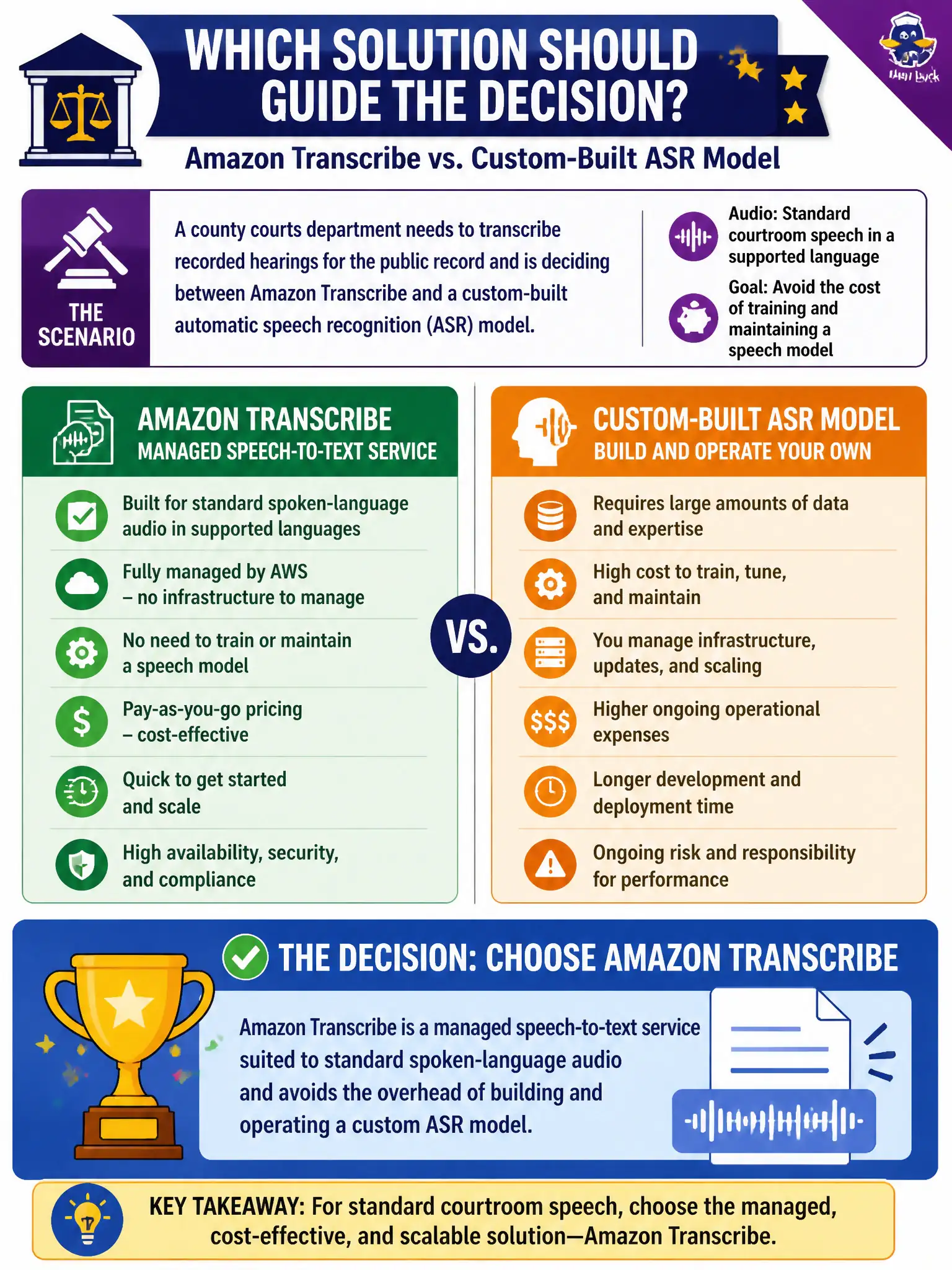
A county courts department needs to transcribe recorded hearings for the public record and is deciding between Amazon Transcribe and a custom-built automatic speech recognition model. The audio is standard courtroom speech in a supported language, and the department wants to avoid the cost of training and maintaining a speech model. What should guide the decision?
Select an answer to reveal the explanation.
Short Explanation
When the audio is standard speech in a language the service already supports, that's exactly the job a managed transcription service was built for — no reason to build and babysit a custom speech model to do the same thing slower. Amazon Transcribe handles ordinary recorded speech without needing a priming step first. Save the custom-build effort for audio that genuinely falls outside what a managed service covers.
Full Explanation
Selecting the right AWS AI service for a speech-to-text task starts with matching audio characteristics to what the managed service handles: standard courtroom speech in a supported language is a well-covered use case for Amazon Transcribe, which avoids the substantial cost of training, validating, and operating a custom ASR pipeline. The claim that Transcribe can't process recordings longer than a typical office meeting is a fabricated limitation not grounded in how managed transcription services are designed to handle recordings of varying length. The claim that managed transcription is limited to studio-quality audio misrepresents the service's intended use — everyday recorded speech, including courtroom and meeting audio, is precisely the kind of real-world audio these services are built to transcribe, not a narrow best-case scenario. Requiring a custom acoustic model be trained first to 'prime' the managed service misunderstands the service model — a managed ASR service doesn't require the customer to pre-train an acoustic model before use; that requirement describes building a custom pipeline, which is the option being weighed against, not a prerequisite for the managed one. Scope caveat: heavily accented, overlapping, or highly technical legal speech may still need post-transcription human review for the official record. Operational check: transcribe a sample of past hearing recordings and compare against a human-verified transcript to measure word accuracy before adopting the service for official records.