
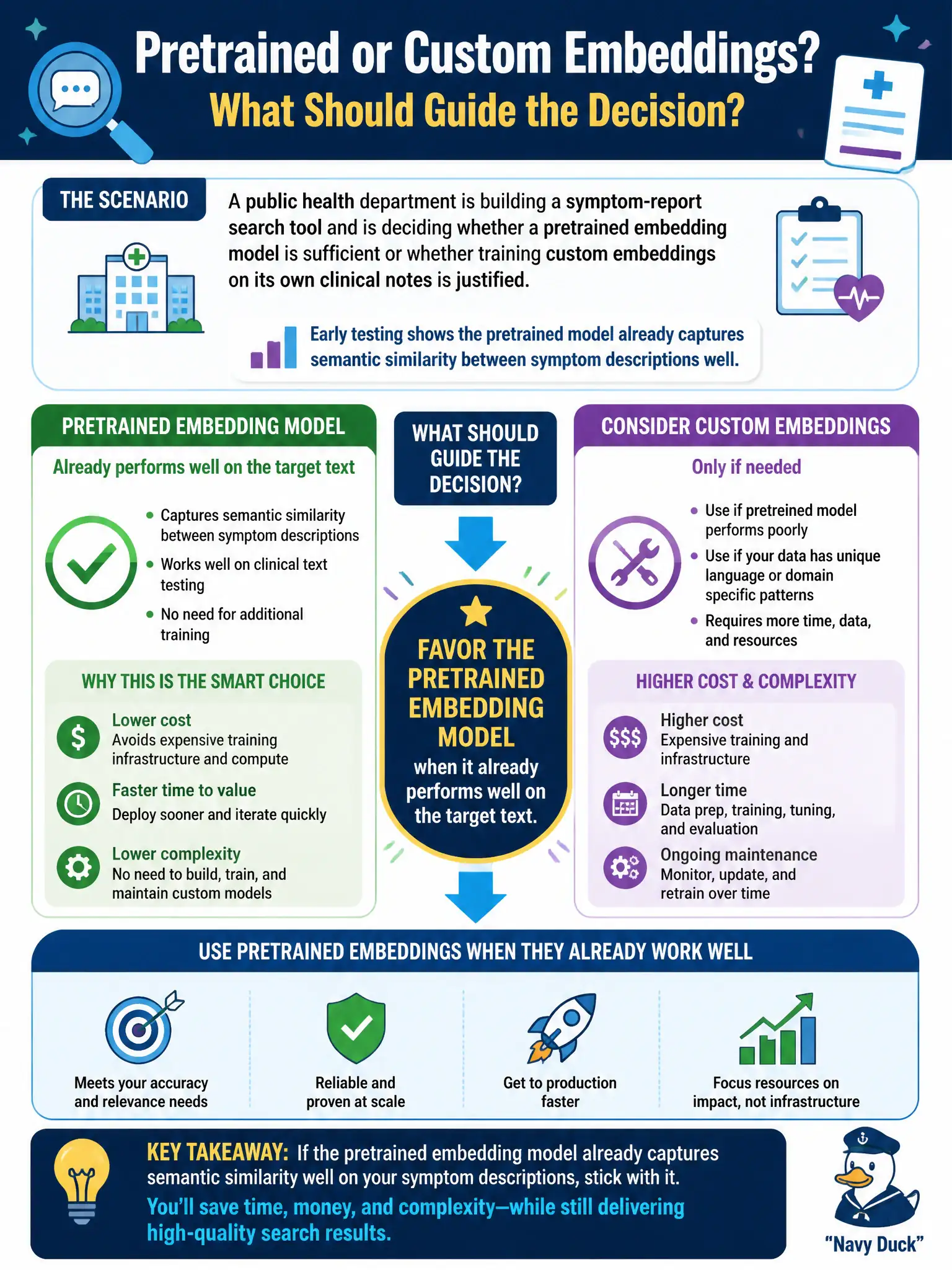
A public health department is building a symptom-report search tool and is deciding whether a pretrained embedding model is sufficient or whether training custom embeddings on its own clinical notes is justified. Early testing shows the pretrained model already captures semantic similarity between symptom descriptions well. What should guide the decision?
Select an answer to reveal the explanation.
Short Explanation
If the pretrained model is already finding the right symptom descriptions close together in embedding space, that's the evidence you need — no sense training your own embeddings from scratch to solve a problem that isn't actually there. Custom embedding training earns its cost when the off-the-shelf model demonstrably falls short on your domain, not as a default step. Let the early test results, not habit, decide.
Full Explanation
Deciding whether a pretrained embedding model is sufficient hinges on evidence of actual performance on the target text: when early testing already shows strong semantic similarity capture on symptom descriptions, that's a direct signal the pretrained model is adequate, and training custom embeddings would add cost and ongoing maintenance without a demonstrated accuracy problem to solve. Claiming a pretrained embedding model is entirely unable to represent domain-specific clinical text contradicts the premise itself, which states the pretrained model is already performing well — the claim describes a hypothetical failure mode, not the situation given. Claiming embedding models must always be retrained for each new application, even when performance is already strong, treats retraining as a procedural requirement rather than a response to a measured gap; if there's no gap, there's nothing for retraining to fix. Fine-tuning the pretrained model on an unrelated dataset from a different domain would actively work against the goal — it risks degrading the very symptom-description performance testing already validated, rather than preserving or improving it. Scope caveat: this reasoning holds only as long as ongoing evaluation confirms performance stays strong as new symptom terminology or slang enters the data; a future drop in retrieval quality would reopen the custom-training question. Operational check: track retrieval precision on a held-out set of real symptom reports over time and revisit the decision only if performance measurably degrades.