
A 311 assistant team finds their foundation model doesn't reliably recognize municipal-specific vocabulary and department names used across the city's service catalog, even though it already follows instructions well. The team is deciding between instruction fine-tuning and continued pre-training as the customization strategy. Which should they choose?
Select an answer to reveal the explanation.
Short Explanation
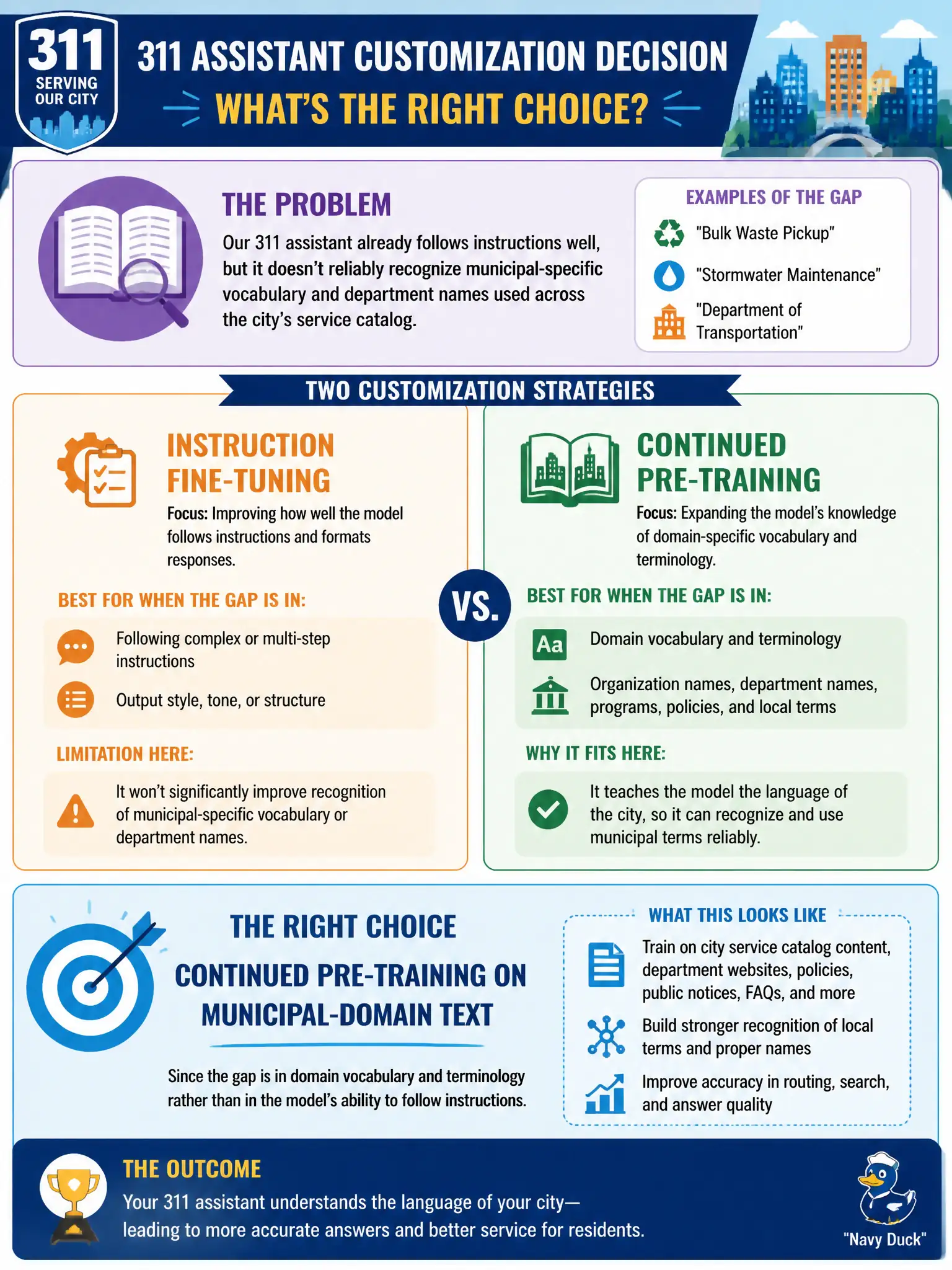
Instruction fine-tuning teaches a model how to behave when you ask it something; continued pre-training teaches it what the words even mean in this world. Since the assistant already follows instructions fine but stumbles on the city's own vocabulary and department names, the gap is knowledge, not behavior — that's continued pre-training's job. Picking the wrong one here means polishing a skill the model already has while the actual gap stays open.
Full Explanation
The two customization strategies target different gaps: instruction fine-tuning shapes how a model responds to instructions (format, tone, task-following behavior), while continued pre-training exposes the model to more domain text so it absorbs new vocabulary, entities, and terminology patterns. Here the model already follows instructions well, so the described gap is squarely a vocabulary and terminology one, which is what continued pre-training on municipal-domain text is designed to close. Choosing instruction fine-tuning because 'instruction-following needs improvement' misdiagnoses the problem — the stem explicitly states instruction-following isn't the issue, so applying a fix aimed at that dimension won't touch the actual vocabulary gap. Believing instruction fine-tuning directly teaches new vocabulary through labeled pairs overstates what a comparatively small set of instruction-response examples can accomplish; it's not the mechanism designed for broad terminology acquisition the way exposure to a larger corpus of domain text is. Restricting continued pre-training to the same instruction-response pairs used for fine-tuning defeats its purpose — continued pre-training benefits from broader, unlabeled domain text (department names, service catalogs, municipal jargon in context), not a narrow labeled instruction set. Scope caveat: continued pre-training requires enough representative municipal text to be effective; a handful of documents won't move the needle. Operational check: after continued pre-training, test the model against a list of known department names and municipal terms it previously missed.