
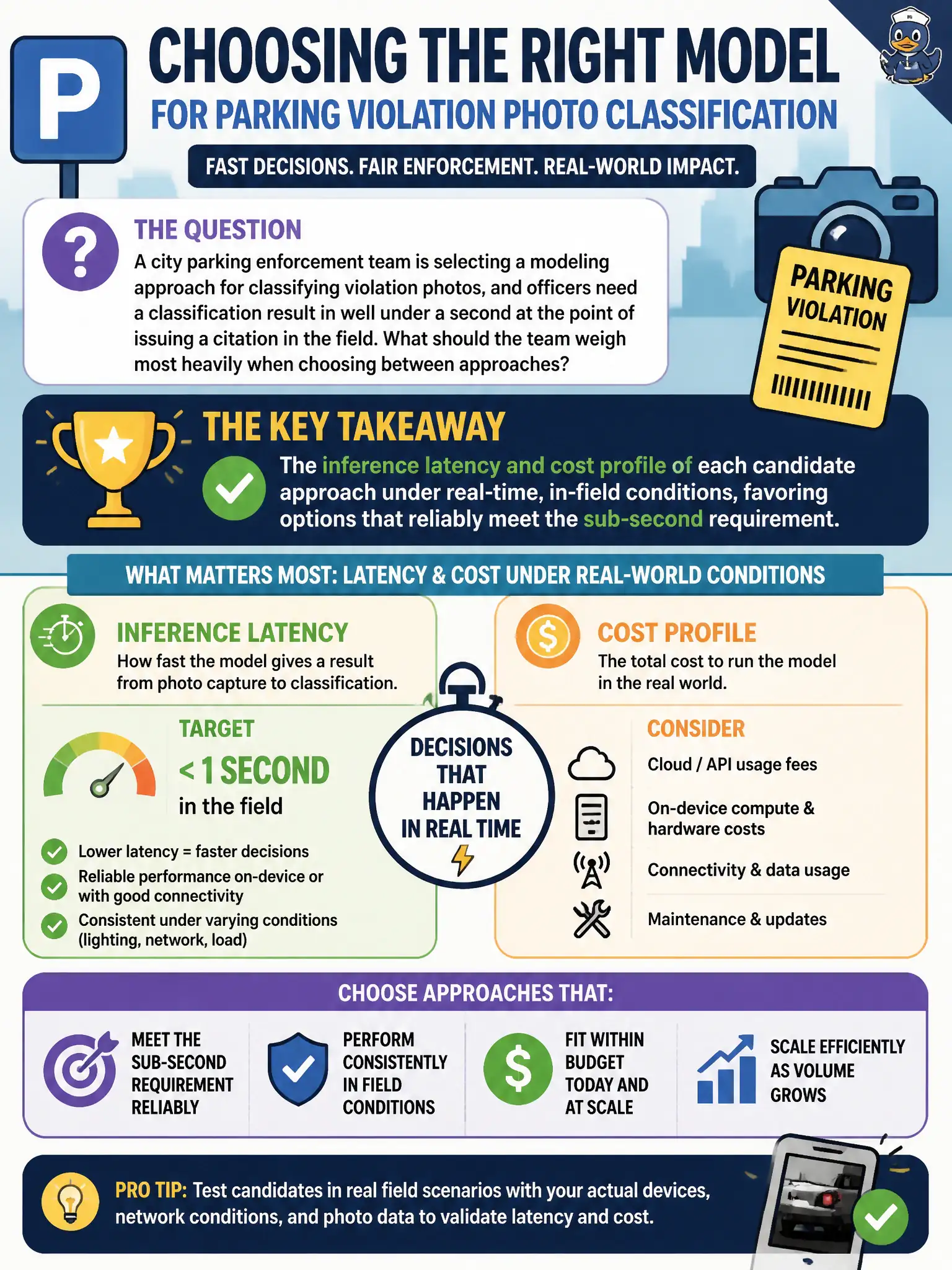
A city parking enforcement team is selecting a modeling approach for classifying violation photos, and officers need a classification result in well under a second at the point of issuing a citation in the field. What should the team weigh most heavily when choosing between approaches?
Select an answer to reveal the explanation.
Short Explanation
An officer standing at a car with a citation pad doesn't care how the model was trained — they care whether the answer shows up before they've finished writing. That's a latency and cost question, measured under the real conditions the model will actually run in, not a question about training-set size or how many categories it can juggle. What worked fine for another city's setup still has to prove itself against this team's actual field conditions.
Full Explanation
When sub-second, in-field response time is a hard requirement, the deciding factor is each candidate approach's real-time inference latency and its cost profile at that latency, evaluated under conditions that resemble actual field deployment — network constraints, device hardware, and concurrent load included. Training dataset size affects how well a model learns patterns, but it has no direct, guaranteed relationship to inference speed; a model trained on a huge dataset can still be architecturally slow to score at inference time. The number of violation categories a model can classify is a capability question, not a latency question, and larger label spaces can sometimes increase inference time depending on the model's output layer — but the core claim that deployment method doesn't affect latency is simply wrong, since deployment choices (edge versus centralized, instance type, batching) directly shape response time. Assuming another agency's successful deployment removes the need to measure latency locally ignores that latency depends on the specific deployment environment, device constraints, and network conditions this team will actually operate under, which can differ meaningfully from another agency's setup. Scope caveat: meeting a latency target in a lab test doesn't guarantee it holds under real field network variability, so pilot testing matters. Operational check: measure end-to-end latency from photo capture to classification result under actual field network conditions before rollout.