
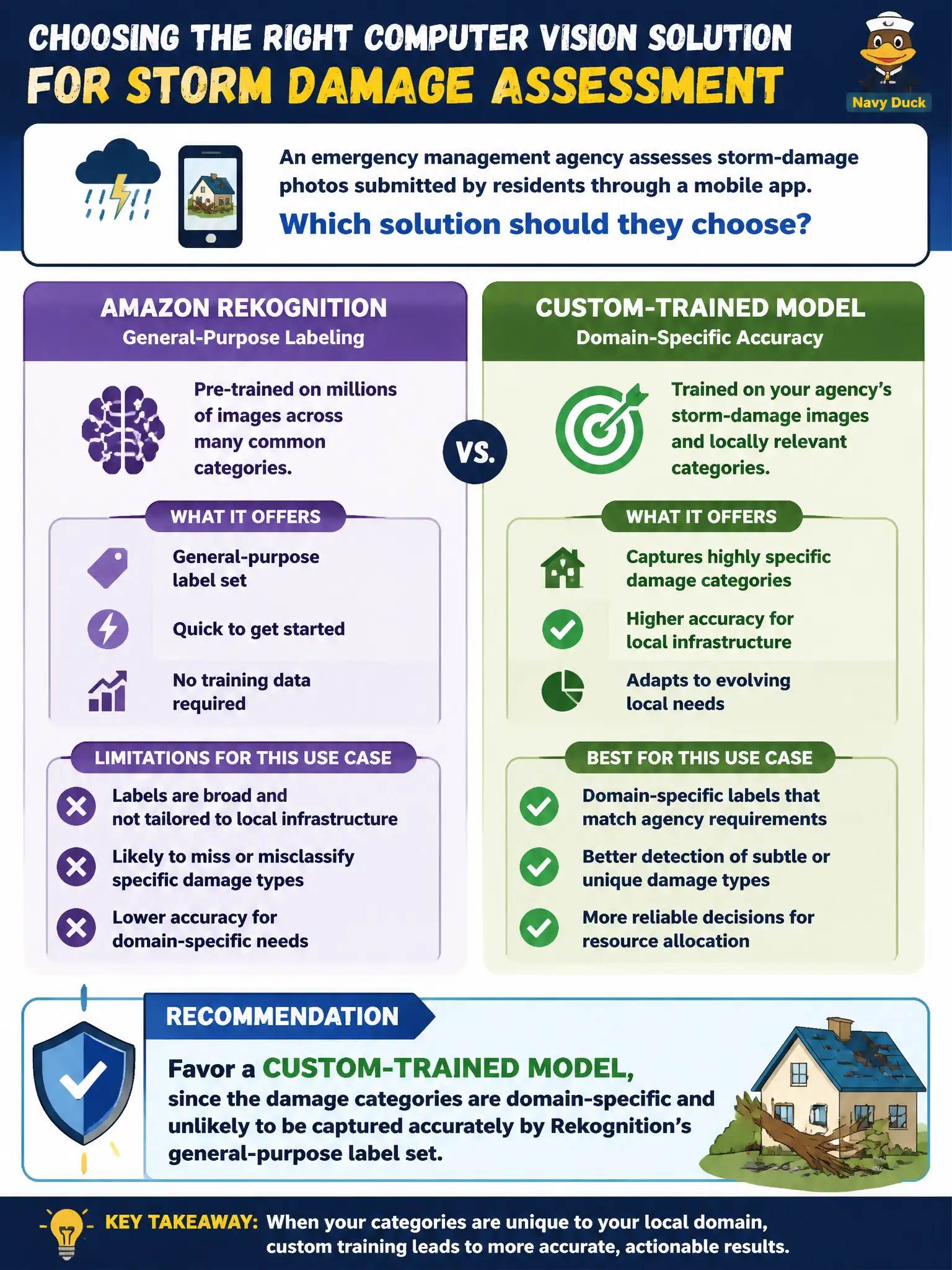
An emergency management agency assessing storm-damage photos submitted by residents through a mobile app must choose between Amazon Rekognition and a custom-trained computer vision model. The damage categories are highly specific to the agency's local infrastructure and don't map to Rekognition's general-purpose labels. What should guide the decision?
Select an answer to reveal the explanation.
Short Explanation
A general-purpose vision service is trained to recognize common, broad categories, and 'downed transformer on Elm Street' isn't one of them. When the categories you actually need are this specific to your own infrastructure, a custom-trained model is what closes that gap, not a support ticket asking a managed service to somehow already know your city's assets. Match the tool's design to how specialized the task really is.
Full Explanation
Evaluating a pretrained managed vision service against custom development means asking whether the target categories fall inside what the service was trained to recognize: when damage categories are tied to the agency's own local infrastructure and don't map onto Rekognition's general-purpose labels, a custom-trained model is justified because it can be trained specifically on the agency's own damage taxonomy and imagery. Claiming Rekognition's general labels already cover locally specific infrastructure categories contradicts the premise — general-purpose label sets are built for broad, common object and scene recognition, not an individual agency's asset inventory. Claiming custom-trained models can't be deployed for emergency-response workloads is a false constraint; custom models are routinely deployed for domain-specific operational use cases, including public-safety applications, once properly trained and validated. Treating Rekognition's built-in labels as something to 'exhaust' via a support request misunderstands the service — its label set isn't something support tickets expand for a single customer's local categories; a genuine domain gap calls for a different modeling approach, not an appeal process. Scope caveat: a hybrid approach — Rekognition for generic scene context plus a custom model for the specific damage taxonomy — may outperform either alone, so the choice isn't always strictly binary. Operational check: test candidate approaches against a labeled sample of the agency's own storm-damage photos and measure classification accuracy against its actual damage categories.