
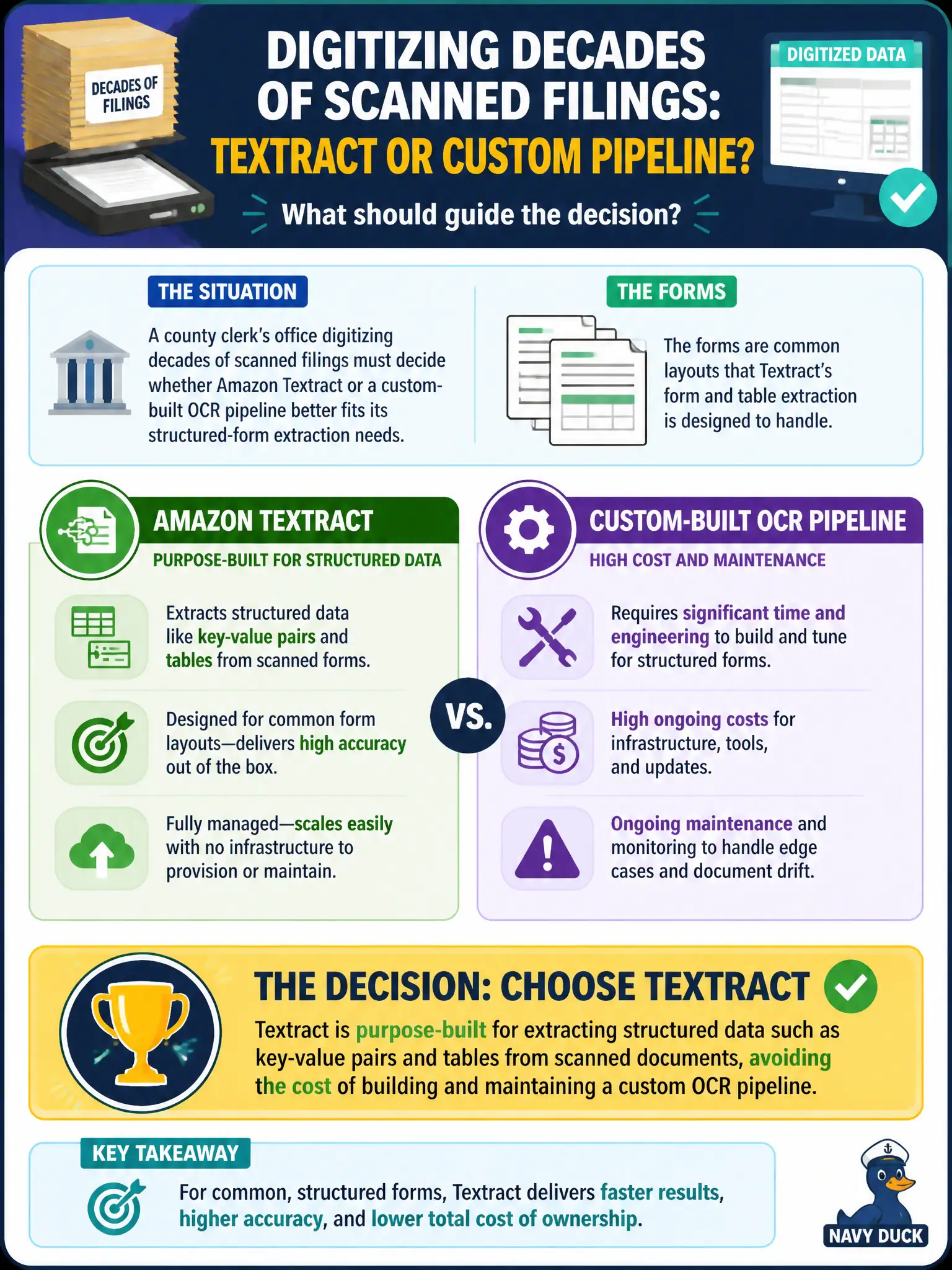
A county clerk's office digitizing decades of scanned filings must decide whether Amazon Textract or a custom-built OCR pipeline better fits its structured-form extraction needs. The forms are common layouts that Textract's form and table extraction is designed to handle. What should guide the decision?
Select an answer to reveal the explanation.
Short Explanation
When a service is built to pull key-value pairs and tables out of exactly the kind of scanned form sitting on your desk, that's a strong hint you've found your tool. Textract exists so a county clerk doesn't have to reinvent structured-document extraction from scratch. Save the custom-build effort for the filings that genuinely break the standard-form mold.
Full Explanation
Justifying a purpose-built AWS AI service over custom development comes down to matching the service's design intent to the task: Textract is engineered specifically to pull structured data — form fields, key-value pairs, tables — out of scanned documents, which is exactly the extraction problem described here, and using it avoids months of custom OCR development and ongoing model maintenance. The claim that Textract only works on born-digital PDFs misrepresents its scope — extracting structured content from scanned paper documents is a core supported use case, not an edge case it excludes. The claim that a purpose-built service can't integrate into an existing workflow confuses a technical capability question with an architecture question; managed extraction services are designed to be called from a pipeline and their output can be fed into whatever downstream records system the office already runs. Building a custom pipeline solely to validate Textract's results duplicates the very effort choosing Textract was meant to avoid, and turns a service-adoption decision into building two solutions instead of one. Scope caveat: highly nonstandard historical filings with degraded handwriting or unusual layouts may still need supplemental review, so the decision shouldn't assume zero manual QA. Operational check: run a representative sample of the county's scanned filings through Textract and measure field-extraction accuracy against manually verified values before full rollout.