
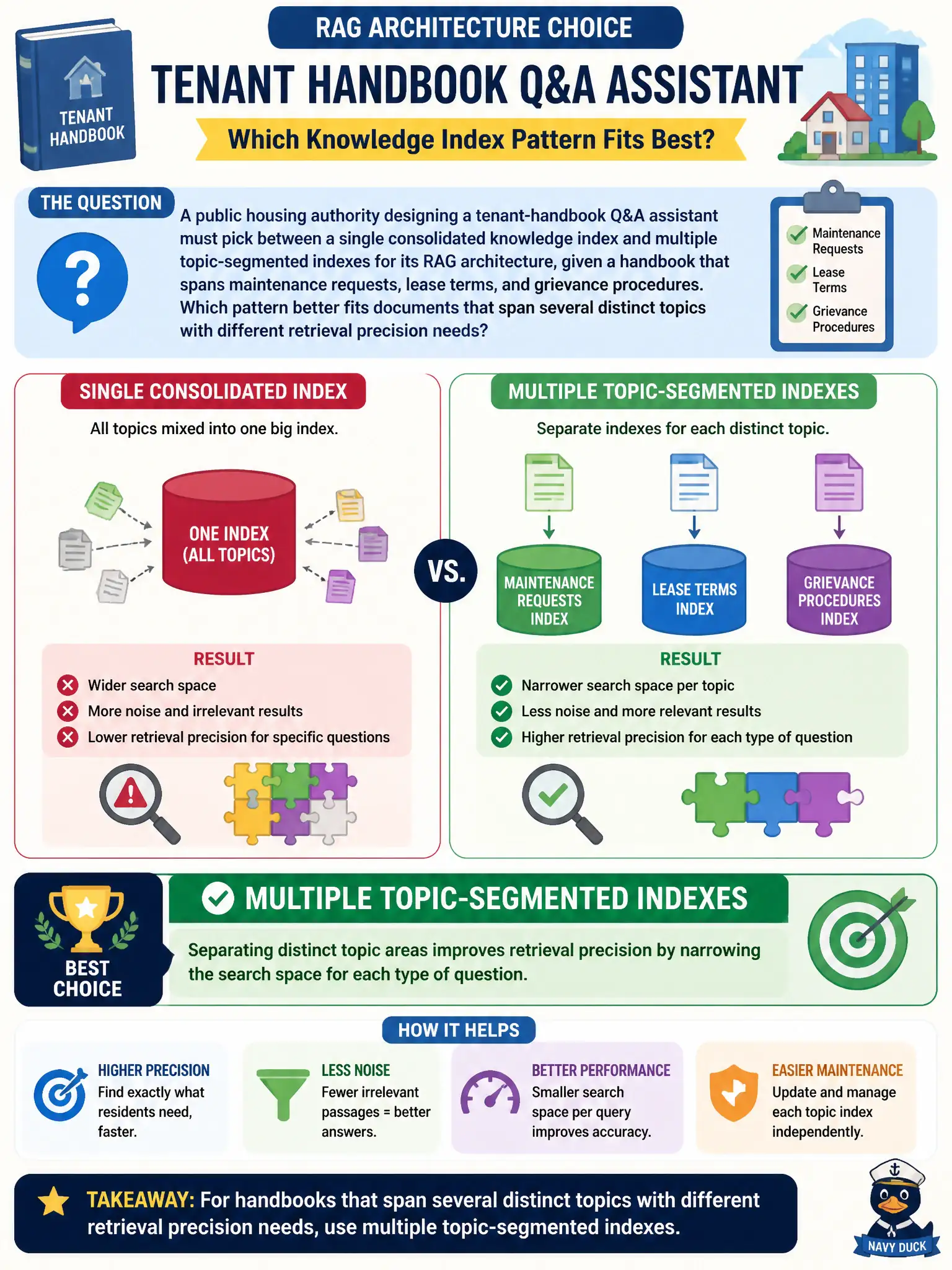
A public housing authority designing a tenant-handbook Q&A assistant must pick between a single consolidated knowledge index and multiple topic-segmented indexes for its RAG architecture, given a handbook that spans maintenance requests, lease terms, and grievance procedures. Which pattern better fits documents that span several distinct topics with different retrieval precision needs?
Select an answer to reveal the explanation.
Short Explanation
Searching one giant index for a lease-terms answer is like digging through every drawer in the house for a single sock — technically possible, just messier than having a dedicated drawer. Topic-segmented indexes narrow the search space, so a maintenance question retrieves maintenance content instead of grievance procedures that happen to share a keyword.
Full Explanation
RAG architecture selection should match the source material's structure: when a handbook covers genuinely distinct topics like maintenance, lease terms, and grievances, topic-segmented indexes narrow retrieval to the relevant section, reducing the chance that semantically similar but topically wrong chunks get pulled into context. Claiming retrieval quality depends only on the embedding model ignores that index structure itself shapes what candidate chunks even get compared — a good embedding model still has to search across a noisier space in a consolidated index. Favoring a single index for easier synchronization trades a retrieval-precision cost for an operational convenience; handbook updates can be routed to the correct topic index with a bit of upfront pipeline design, which is a solvable engineering problem rather than a reason to sacrifice precision. Requiring identical chunking across every topic ignores that different content types benefit from different chunk sizes — lease clauses may need larger chunks to preserve legal context, while grievance-procedure steps may chunk well at a finer granularity. Scope caveat: over-segmenting into too many narrow indexes can hurt recall for questions that legitimately span topics, so segmentation should follow natural topic boundaries, not be maximized. Operational check: run representative cross-topic and single-topic questions against the segmented indexes and confirm retrieval precision improves without a meaningful drop in recall.