
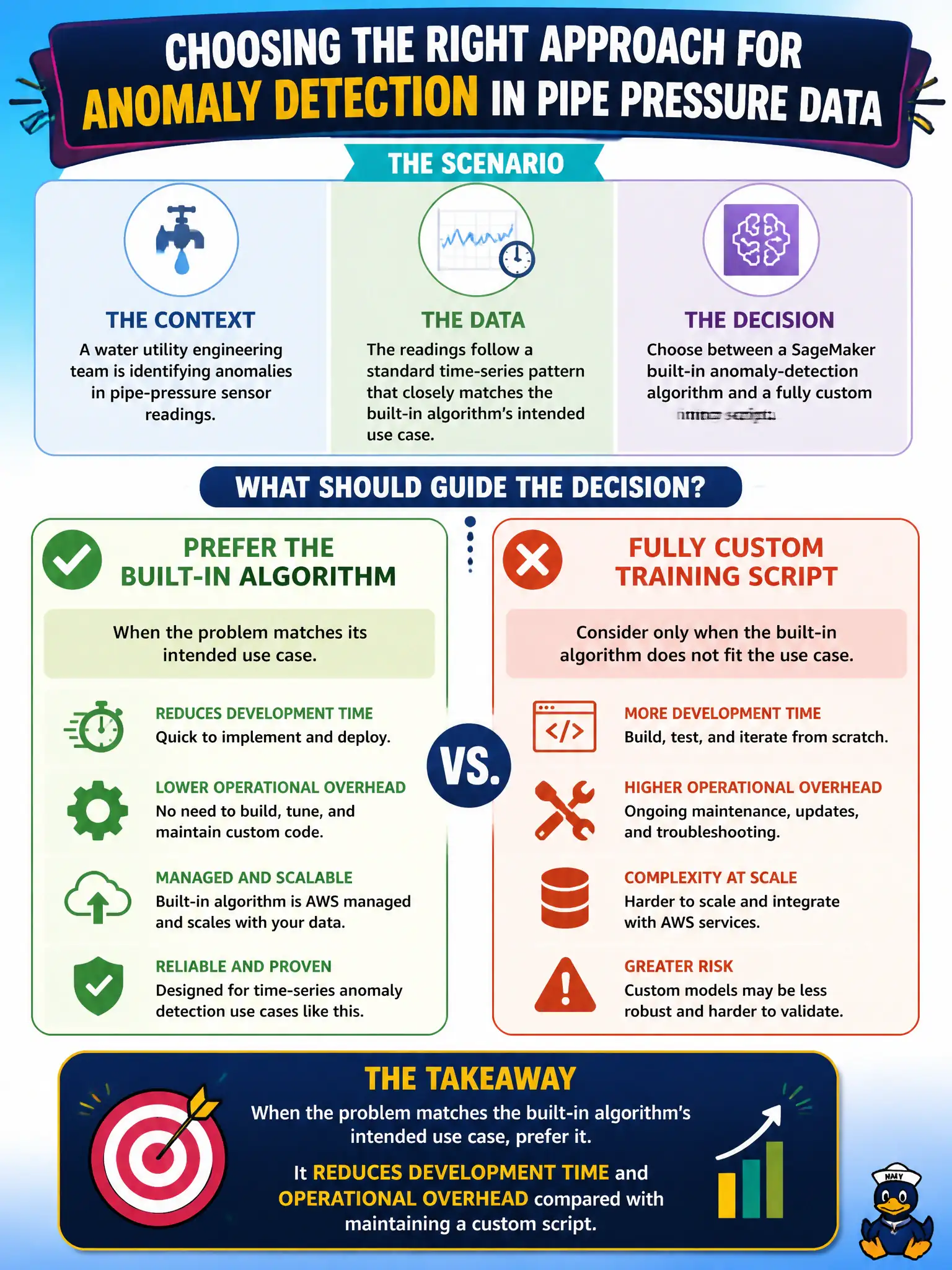
A water utility engineering team is choosing between a SageMaker built-in anomaly-detection algorithm and a fully custom training script for identifying anomalies in pipe-pressure sensor readings. The readings follow a standard time-series pattern that closely matches the built-in algorithm's intended use case. What should guide the decision?
Select an answer to reveal the explanation.
Short Explanation
When a built-in tool is literally designed for the pattern sitting in front of you, reaching past it for a custom script is like hand-carving a wheel that's already sitting in the shed. Built-in algorithms exist precisely so a well-matched problem doesn't need custom engineering time and upkeep. Save the custom-script effort for the anomalies that actually don't fit the standard mold.
Full Explanation
Choosing between a built-in algorithm and a custom script hinges on fit: when sensor readings follow a standard time-series pattern the built-in anomaly-detection algorithm was designed for, using it minimizes development time and shifts maintenance burden onto the managed algorithm rather than a hand-written script. The claim that built-in algorithms only handle tabular classification is inaccurate scope-wise — SageMaker's built-in algorithm catalog includes options purpose-built for time-series anomaly detection, which is exactly the readings described here. The belief that any hyperparameter tuning requires a custom script confuses tuning with implementation; built-in algorithms expose their own tunable hyperparameters and can be tuned through SageMaker's managed tuning tooling without writing custom training code. Writing a custom script solely to double-check a well-matched built-in algorithm's output duplicates effort without a clear justification — it treats validation as requiring an entirely separate modeling approach rather than a smaller-scale accuracy check. Scope caveat: if the pressure readings later show irregular, multivariate, or highly domain-specific anomaly patterns the built-in algorithm wasn't designed for, revisiting a custom script becomes reasonable. Operational check: evaluate the built-in algorithm's anomaly flags against a labeled sample of known historical pipe-pressure incidents before deploying it.