
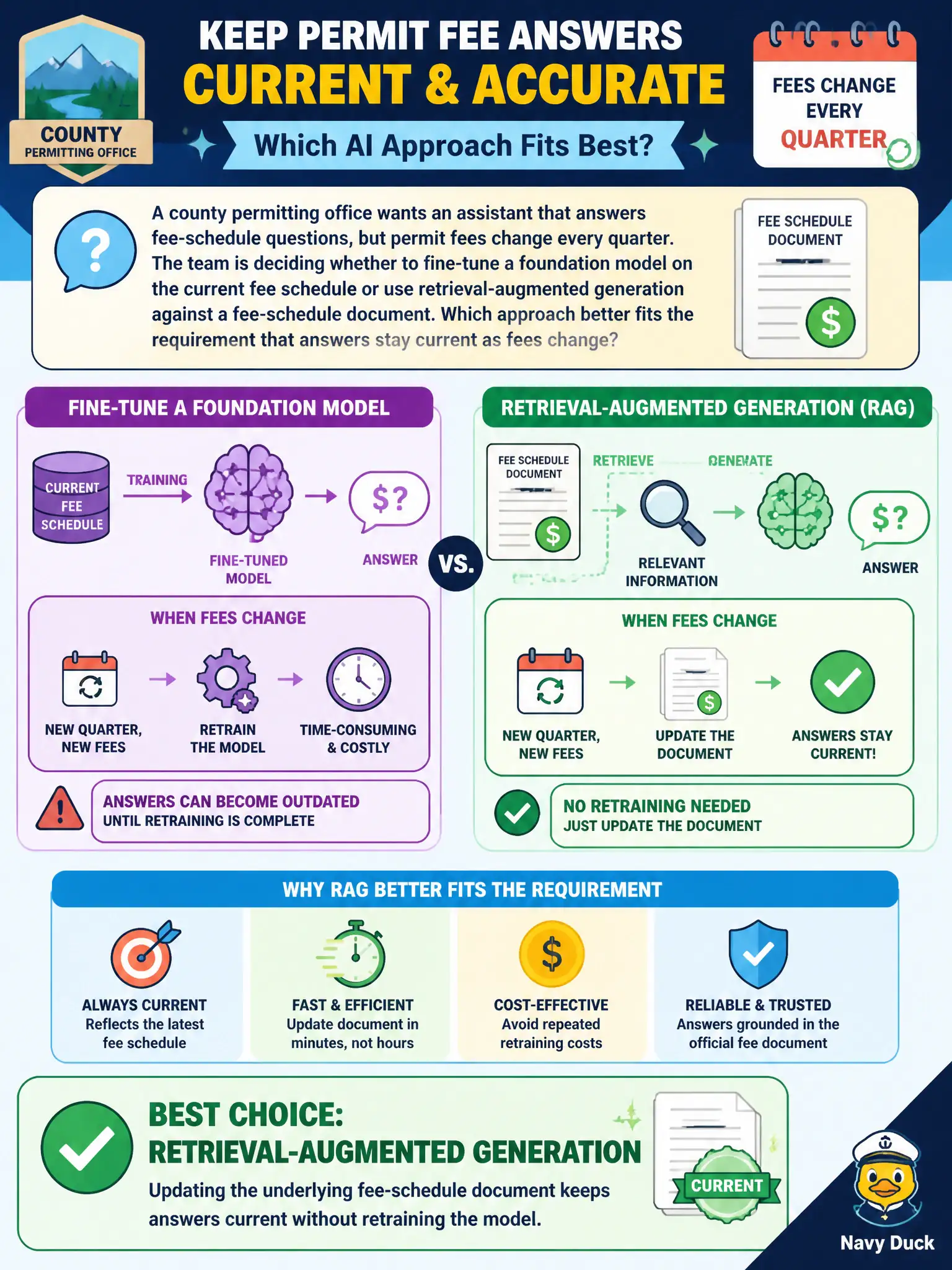
A county permitting office wants an assistant that answers fee-schedule questions, but permit fees change every quarter. The team is deciding whether to fine-tune a foundation model on the current fee schedule or use retrieval-augmented generation against a fee-schedule document. Which approach better fits the requirement that answers stay current as fees change?
Select an answer to reveal the explanation.
Short Explanation
Think of fine-tuning like printing fee amounts directly onto a poster — it's accurate the day you print it and wrong the moment fees change. RAG is more like pointing the assistant at a filing cabinet you can swap documents into, so an updated fee sheet is all it takes for answers to stay current. That's exactly why RAG wins when the underlying facts move on a schedule the model can't keep up with on its own.
Full Explanation
RAG separates the model's language ability from the facts it retrieves, so updating a source document — the fee schedule — immediately changes what the assistant can answer, with no retraining step required. Fine-tuning bakes specific fee amounts into the model's weights at a point in time; those amounts become stale the moment fees change next quarter, and the model has no way to know that on its own, since weights don't update themselves after training ends. The claim that fine-tuned models automatically detect source changes misunderstands what fine-tuning does — it's a one-time weight update from a training run, not a live connection to changing data. Requiring a full retrain every quarter to keep RAG current misreads the architecture entirely: RAG's entire advantage is that document updates don't require retraining, so pairing it with mandatory quarterly retraining discards the benefit RAG was chosen for. Scope caveat: RAG's currency depends on someone actually updating the source document promptly when fees change, so it still needs a content-ownership process. Operational check: after a quarterly fee update, query the assistant with a known changed fee and confirm the retrieved answer reflects the new amount.