
A transit authority needs to forecast daily bus ridership from years of structured, numeric ridership history. A data scientist is deciding between a traditional gradient-boosted model and a foundation-model-based approach. Which consideration should drive the decision?
Select an answer to reveal the explanation.
Short Explanation
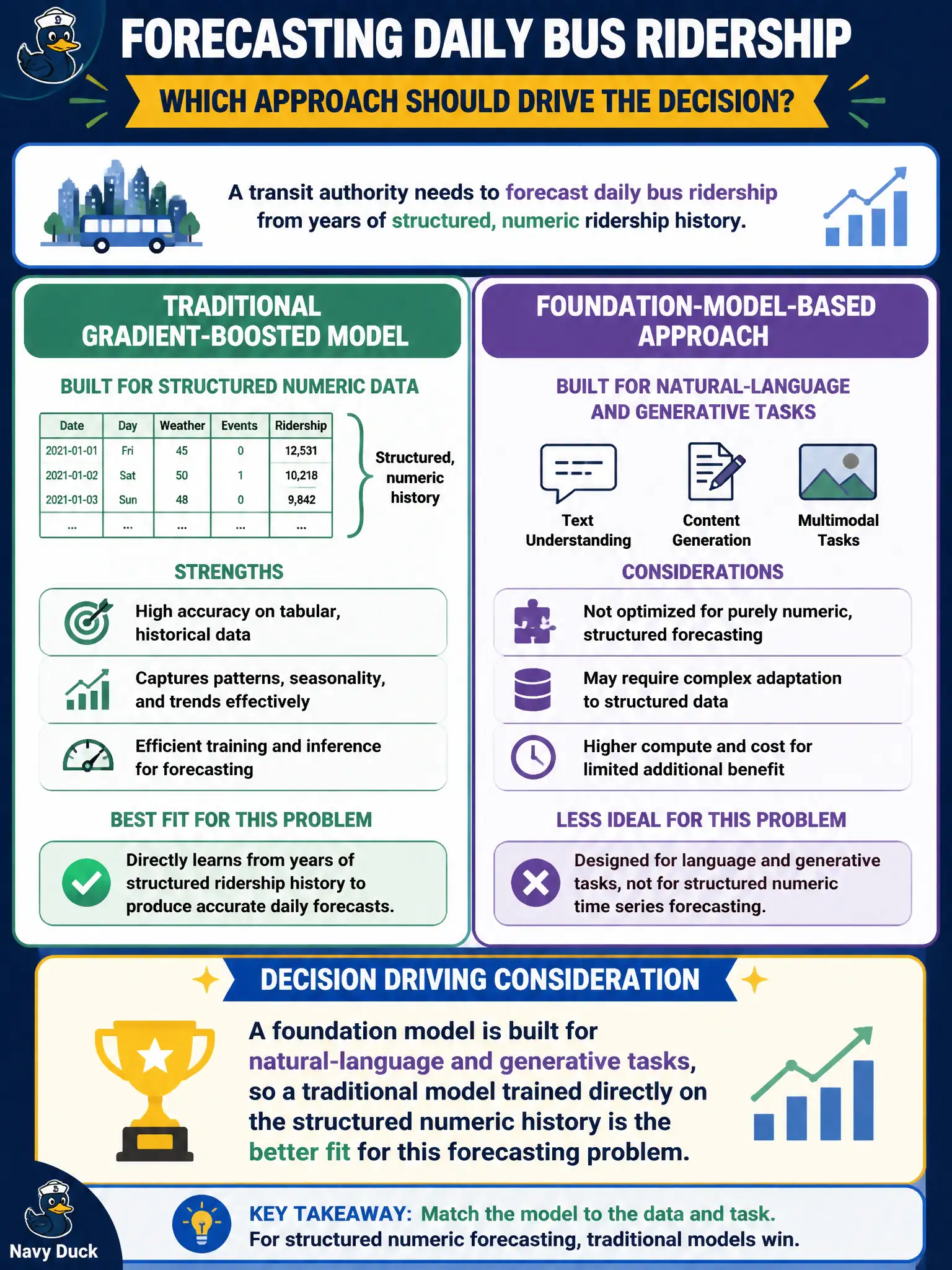
A foundation model is a language specialist, and daily ridership counts aren't a language problem — they're rows of numbers with seasonal patterns a gradient-boosted model is built to chew through. Reaching for an FM here is like hiring a translator to balance a spreadsheet: impressive skill, wrong job. Match the tool to what the data actually is, not to which tool is getting the most attention lately.
Full Explanation
Choosing a modeling approach starts with matching the problem's data shape to what the approach was designed for: structured, numeric time-series forecasting is squarely traditional ML territory, where gradient-boosted trees handle tabular seasonality and trend patterns efficiently and with well-understood tuning knobs. Foundation models are trained primarily on language (and increasingly other modalities), and applying one to pure numeric forecasting means forcing a generative architecture to do a job it wasn't optimized for, typically at higher cost and without a clear accuracy benefit. The claim that FMs are inherently more explainable is backwards — traditional tree-based models like gradient boosting generally offer clearer feature-importance and decision-path explainability than a generative FM's output. The claim that FMs generally outperform traditional ML on structured numeric forecasting isn't supported for this kind of task; performance depends on data shape, and tabular time series is where traditional ML remains the stronger fit. Treating the decision as purely a compute-budget question skips the more basic question of task fit, which matters before cost even enters the comparison. Scope caveat: this doesn't rule out an FM assisting with narrative summaries of ridership trends — it rules it out as the forecasting engine itself. Operational check: benchmark forecast accuracy (e.g., MAPE) of the gradient-boosted model against a naive baseline before considering any FM-based alternative.