
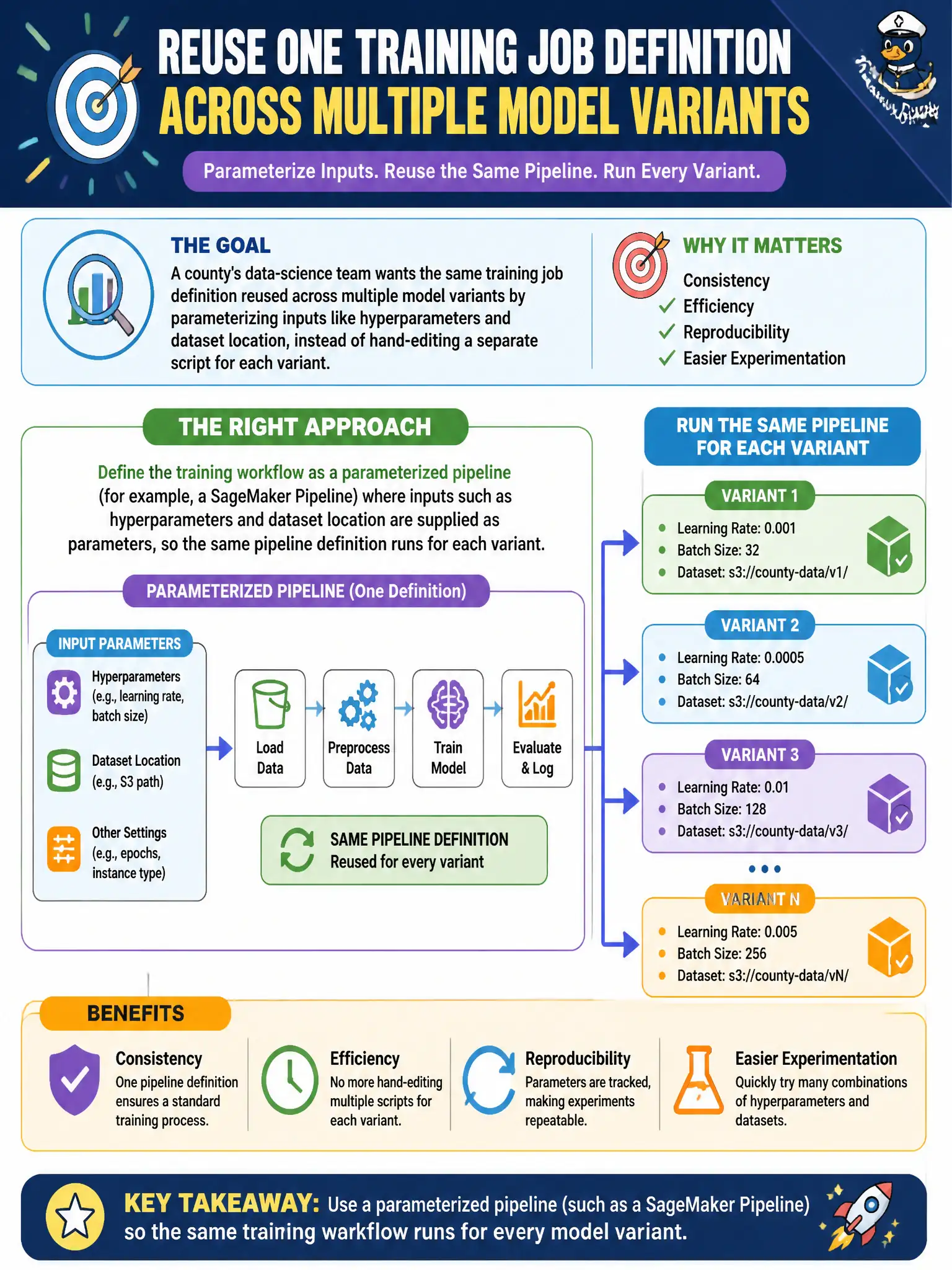
A county's data-science team wants the same training job definition reused across multiple model variants by parameterizing inputs like hyperparameters and dataset location, instead of hand-editing a separate script for each variant. Which approach fits this goal?
Select an answer to reveal the explanation.
Short Explanation
Copy-pasting a training script for every new variant is how small inconsistencies creep in — someone tweaks one script and forgets to make the same fix in the other five. Defining the workflow as one parameterized pipeline, where hyperparameters and dataset location are just inputs you supply, means every variant runs the exact same well-tested definition instead of a slightly different hand-edited copy.
Full Explanation
A parameterized pipeline separates the training workflow's logic (the steps and their order) from the values that change between runs (hyperparameters, dataset location), so the same pipeline definition can be invoked repeatedly with different parameter values to produce each model variant, which is exactly the reuse the county's team is after. Maintaining separate hand-edited scripts per variant means every bug fix or logic change has to be manually propagated across every copy, and copies drift out of sync over time even when no one intends that to happen. Hard-coding hyperparameters and dataset paths inside the script forces a new script (or a risky in-place edit) for every variant, which is the very pattern parameterization is meant to eliminate. A spreadsheet a person reads and manually applies before each run reintroduces human error into the process and provides no guarantee the values actually used match what's recorded, since the script itself has no awareness of the spreadsheet. Scope caveat: parameterized pipelines still need each parameter's valid range or type documented, since a plausible-looking but invalid parameter combination can otherwise fail deep inside a run rather than at submission. Operational check: run the same pipeline definition twice with two different parameter sets and confirm each execution produces a model corresponding correctly to its own parameters.