
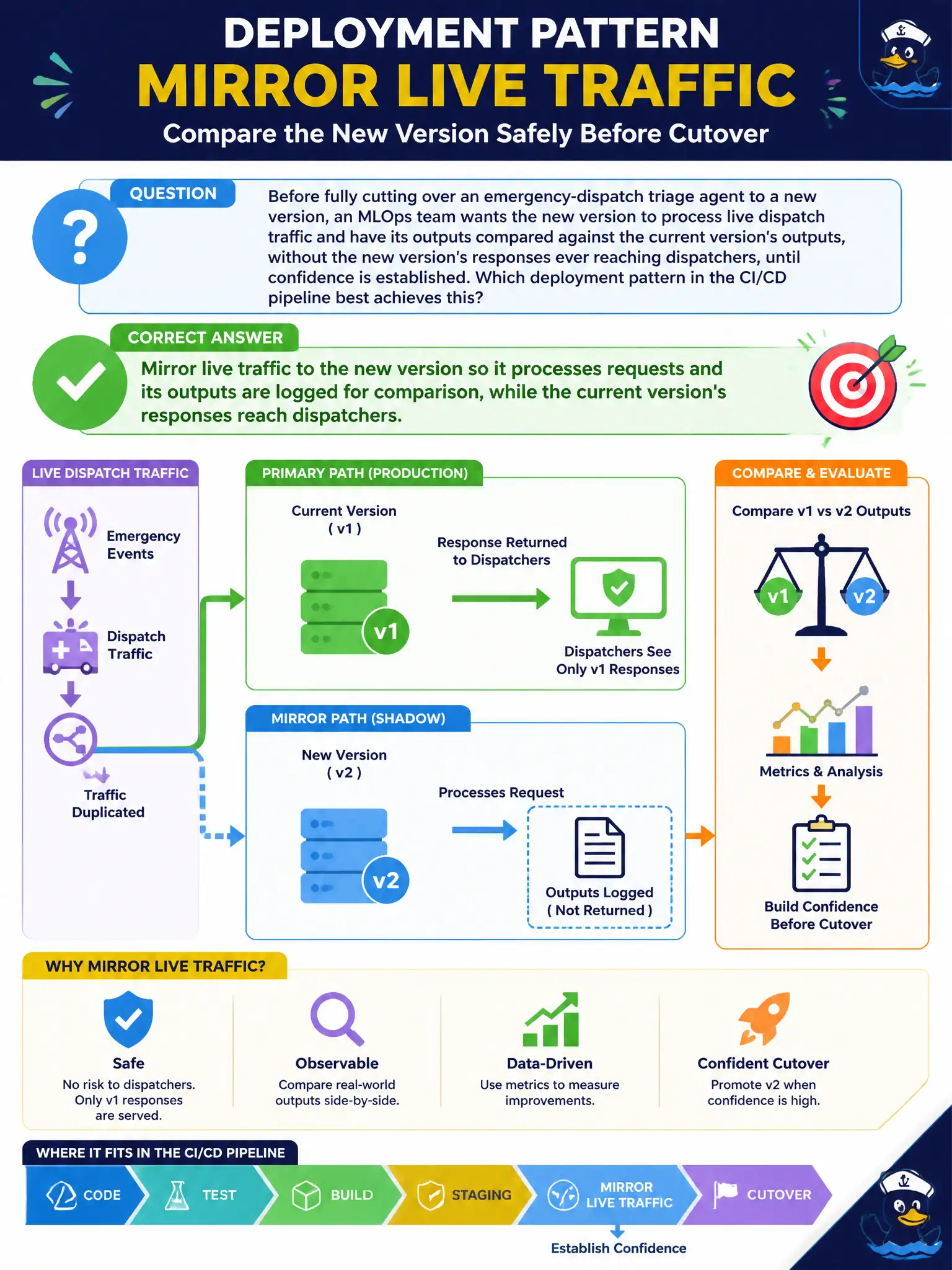
Before fully cutting over an emergency-dispatch triage agent to a new version, an MLOps team wants the new version to process live dispatch traffic and have its outputs compared against the current version's outputs, without the new version's responses ever reaching dispatchers, until confidence is established. Which deployment pattern in the CI/CD pipeline best achieves this?
Select an answer to reveal the explanation.
Short Explanation
Think of shadow deployment like a co-pilot who watches every flight but never touches the controls. The new agent version processes real traffic and its answers get logged and compared, but dispatchers still see the current version's replies. That's how you build confidence in a new version without risking a live emergency response on unproven output.
Full Explanation
Shadow deployment (sometimes called dark launch or parallel run) sends a copy of live production traffic to the candidate version so it computes real responses, but those responses are logged for comparison rather than returned to end users; the current production version's output is what reaches dispatchers. This lets a team validate correctness, latency, and failure modes under real traffic patterns with essentially zero user-facing risk, which matters enormously for an emergency-dispatch workload where a bad answer has real consequences. Canary release is a related but different technique: it exposes a slice of real users to the new version's actual responses, which is appropriate once a team already trusts the new version's behavior, not before. A blind production cutover skips comparison and relies on after-the-fact complaints, far too slow for a safety-critical system. Split-traffic rating with dispatchers exposes live users to unvalidated output and depends on subjective, manual review rather than automated comparison. Scope caveat: shadow traffic still costs compute, since the candidate version must process every mirrored request, so budget for that during the comparison window. A concrete operational check: confirm the pipeline logs both versions' outputs against the same request IDs so a divergence report can be generated automatically before promotion.