
A housing-authority eligibility system requires a feature-transformation step and a scoring step to run in strict sequence for every request. What deployment architecture should the team use to chain these two steps reliably behind one prediction call?
Select an answer to reveal the explanation.
Short Explanation
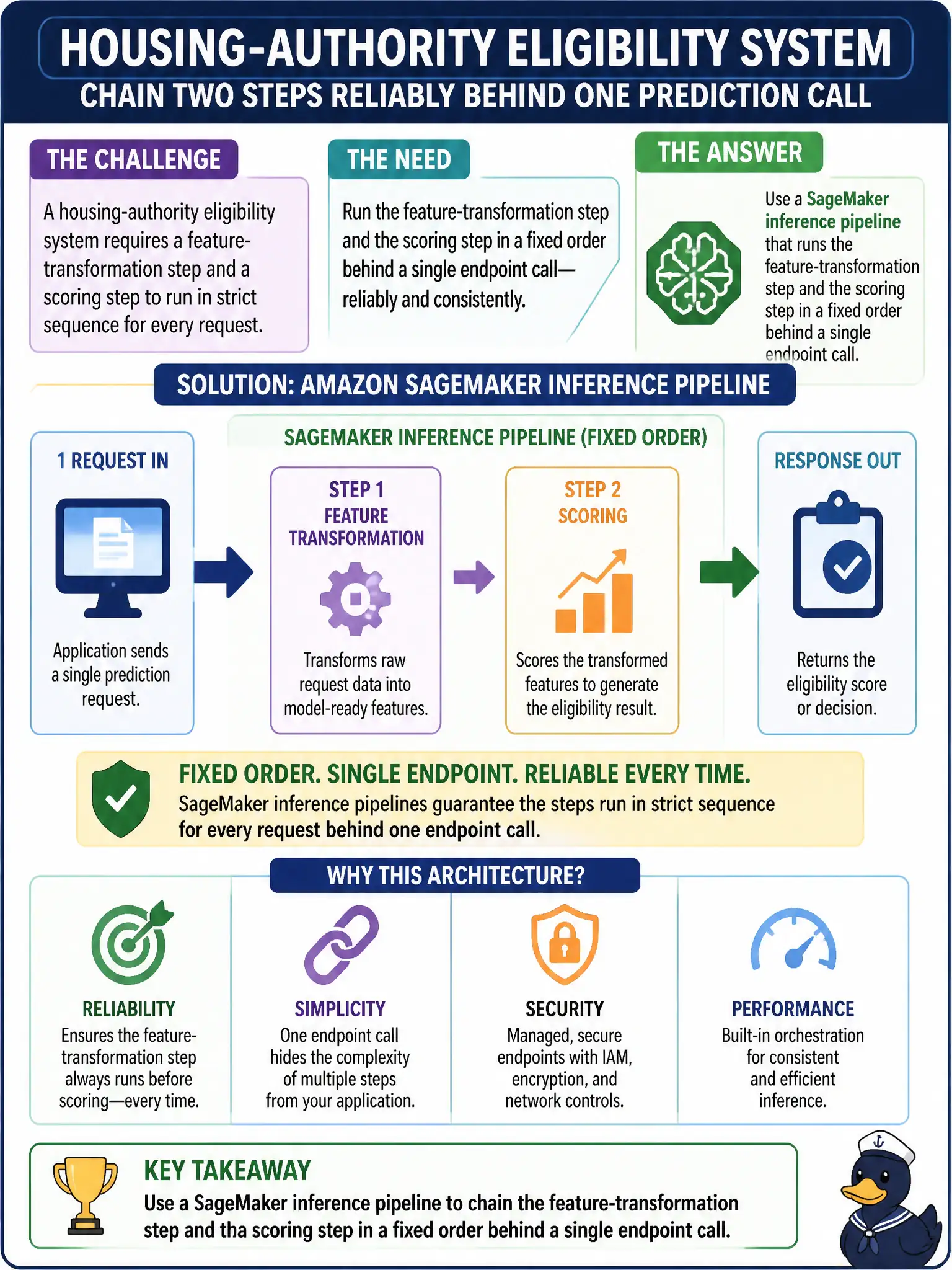
When two steps always have to happen in the same order, on every request, the cleanest fix is chaining them behind one call rather than making the caller remember the sequence. A SageMaker inference pipeline runs feature transformation straight into scoring behind a single endpoint invocation. One request in, the finished, transformed prediction comes back out.
Full Explanation
A SageMaker inference pipeline runs a defined sequence of steps — here, feature transformation followed by scoring — behind one endpoint, passing each step's output directly to the next, which gives the housing authority a reliable, single-call way to enforce that strict order on every request. SageMaker Pipelines is a workflow orchestration tool built primarily for training and processing jobs (data prep, training, evaluation) run on a schedule or trigger, not a mechanism for chaining steps inside a live inference call, so reaching for it here confuses build-time orchestration with request-time serving. Two separate endpoints invoked in order by the calling application pushes sequencing and error handling into client code and adds a network round-trip between the two steps, which is more fragile and slower than chaining them inside one pipeline. Embedding both steps into a single undivided container works but discards the benefit of keeping transformation and scoring as separable components, making it harder to update, test, or reuse either step independently — the county loses modularity for no real gain over an inference pipeline. Scope note: every step in the pipeline shares the endpoint's provisioned resources, so size the instance for the combined workload of both steps. Operational check: verify the transformed feature output matches expectations at the pipeline's internal boundary before trusting the final eligibility score.