
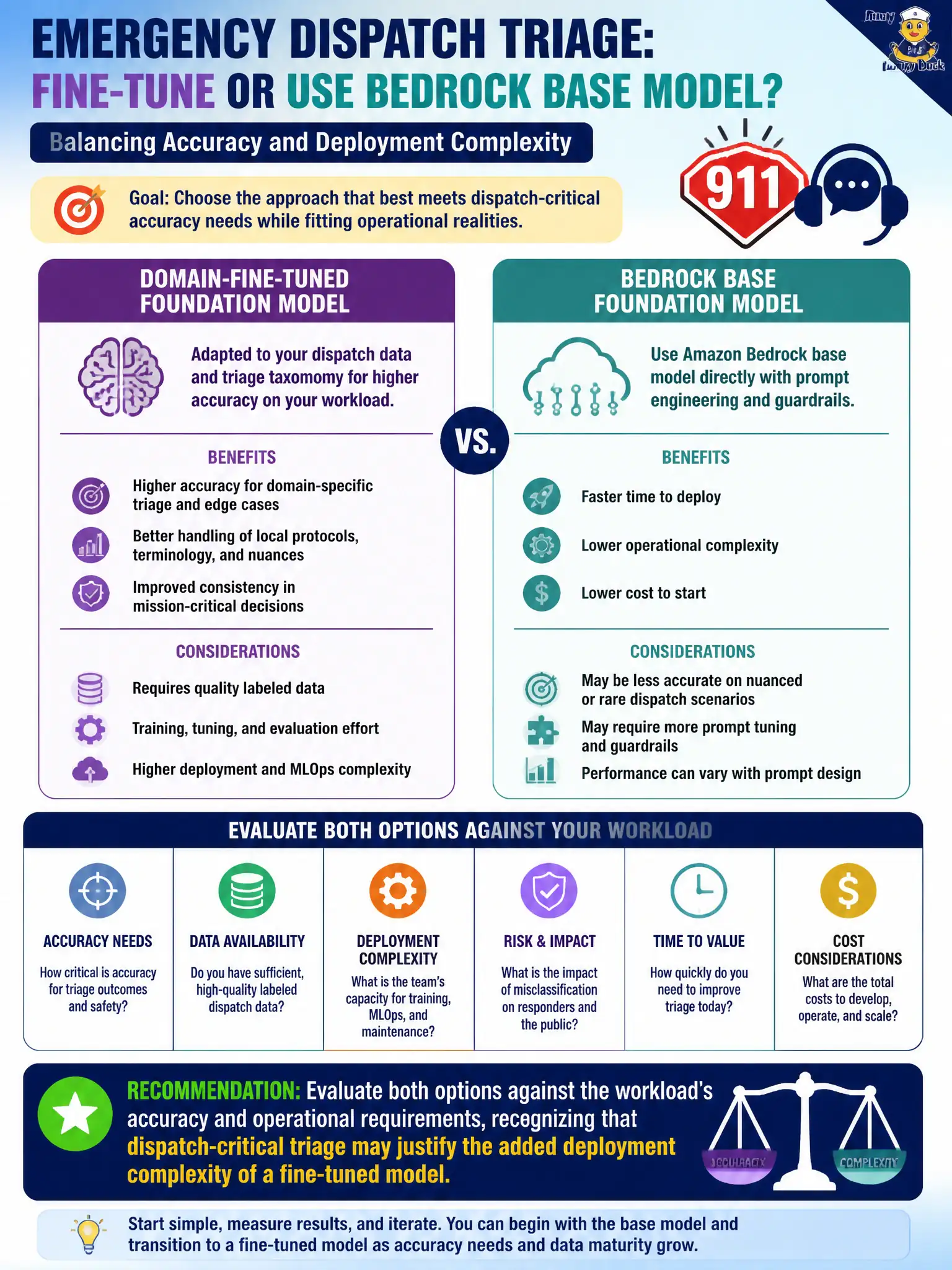
An emergency-dispatch office is deciding whether to deploy a domain-fine-tuned foundation model for triage classification or invoke a Bedrock base foundation model directly, weighing accuracy against deployment complexity. How should the team approach this decision?
Select an answer to reveal the explanation.
Short Explanation
Picking the simpler option and picking the right option aren't the same decision here. A base FM is easier to stand up, but if it misreads dispatch-specific triage language, that ease isn't worth much. Weigh what each option actually costs against what this particular workload needs, and let the stakes of triage accuracy drive the call.
Full Explanation
Evaluating an FM deployment option means comparing what each choice delivers against what the workload actually requires: a fine-tuned FM typically costs more in setup, maintenance, and versioning overhead, but can better capture dispatch-specific terminology and triage patterns than a general base FM, and for a workload where a missed or misclassified triage signal has real safety consequences, that accuracy gain can justify the added complexity. Choosing purely on configuration simplicity treats deployment effort as the only variable that matters, ignoring that a dispatch-critical classification task carries real cost when accuracy suffers, which is precisely the kind of workload where cutting corners on customization is riskiest. Weighing overhead against accuracy gain only in the abstract, without tying the tradeoff back to this workload's actual accuracy and operational requirements, names the two forces without ever deciding whether either one applies here. Running the fine-tuned model only after unspecified production proof, with the base FM standing in indefinitely, defers the actual evaluation rather than doing it, and risks running the weaker option for an unbounded period on a safety-relevant task. Scope note: this decision should be revisited if dispatch call patterns shift meaningfully, since a fine-tuned model's edge can erode as language drifts. Operational check: run both options against a held-out set of real historical dispatch transcripts and compare triage accuracy before committing.