
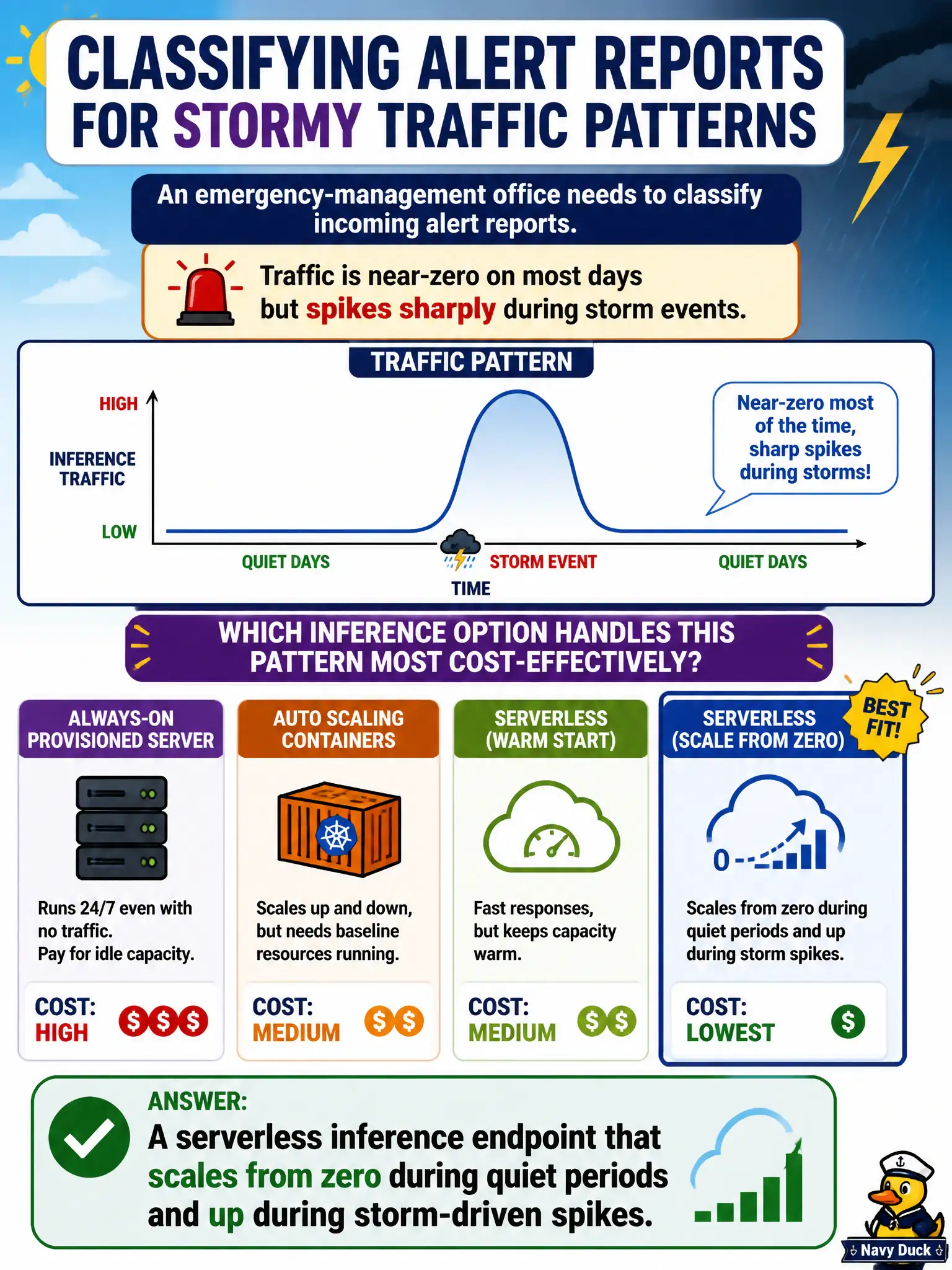
An emergency-management office needs to classify incoming alert reports. Traffic is near-zero on most days but spikes sharply during storm events. Which inference option handles this pattern most cost-effectively?
Select an answer to reveal the explanation.
Short Explanation
Most days this classifier has nothing to do, then a storm hits and it's suddenly busy. That near-zero-to-spike pattern is what serverless inference scales for — nothing provisioned during the quiet stretch, capacity spun up the moment reports start pouring in. Pay for the storm, not for the calm.
Full Explanation
Serverless inference scales compute automatically with incoming request volume, costing essentially nothing during near-zero traffic and scaling up as alert reports spike during a storm event, which matches this workload's extreme swing between idle and busy far more efficiently than infrastructure sized for one state or the other. Daily batch transform processes reports on a fixed schedule regardless of actual event timing, which means classification during an active, fast-moving storm would wait for the next scheduled run instead of happening as reports arrive — a serious gap for a workload tied to emergency response timing. A real-time endpoint provisioned for the worst storm on record stays sized at that peak capacity every single day, including the many quiet days with near-zero traffic, which is the exact idle-capacity cost the office is trying to avoid. A multi-model endpoint reduces cost by sharing one endpoint across several models, but bundling this classifier with unrelated models doesn't address its bursty traffic pattern, and the endpoint underneath is still an always-on real-time endpoint rather than one that scales to zero. Scope note: serverless cold starts add latency on the first request after quiet periods, which is usually acceptable for alert classification but worth confirming against response-time expectations. Operational check: review invocation and scaling metrics after a storm season to confirm the endpoint scaled promptly as report volume rose.