
A permitting-regulations assistant retrieves too many marginally relevant chunks from its knowledge base, diluting answer quality. The team wants to improve relevance ordering without changing the underlying embedding model. What should they add?
Select an answer to reveal the explanation.
Short Explanation
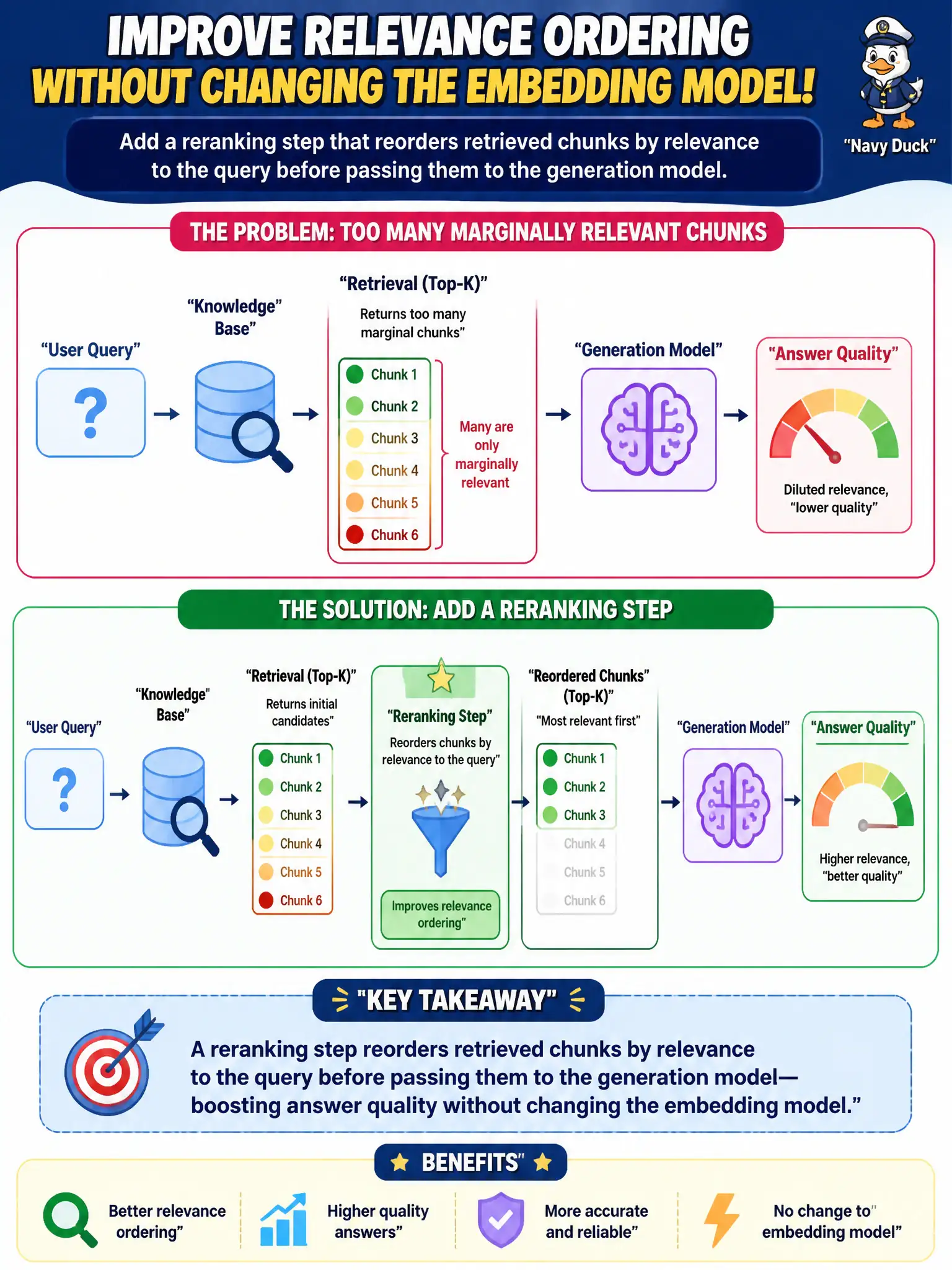
Pulling back a pile of loosely related chunks and hoping the generation model sorts out which ones matter is asking it to do a job retrieval should've already done. A reranking step reorders what got retrieved so the most relevant chunks land at the top before generation even starts. It's a sorting fix, not an embedding fix.
Full Explanation
Reranking takes the set of chunks an initial retrieval pass already pulled back and reorders them by a finer-grained relevance score against the specific query, pushing the genuinely useful passages to the top before the generation model ever sees them — which directly targets a relevance-ordering problem without touching how embeddings are produced. Increasing top-k retrieval count returns even more chunks, which worsens rather than fixes the dilution the team is trying to solve, since it feeds the generation model a larger pool without improving which ones are prioritized. Fine-tuning the embedding model could eventually improve relevance, but it's a heavier, slower change that the team explicitly wants to avoid, and it addresses how vectors are computed rather than how already-retrieved results get ordered. Swapping vector database products changes the infrastructure storing and searching the embeddings, not the ranking logic applied to what comes back, so a different database with the same embedding model and retrieval count would reproduce the same relevance problem. Scope note: reranking adds a processing step and some latency per query, so weigh that against the relevance gain for latency-sensitive use cases. Operational check: compare answer relevance on a sample query set before and after reranking to confirm the reordering measurably improves results.