
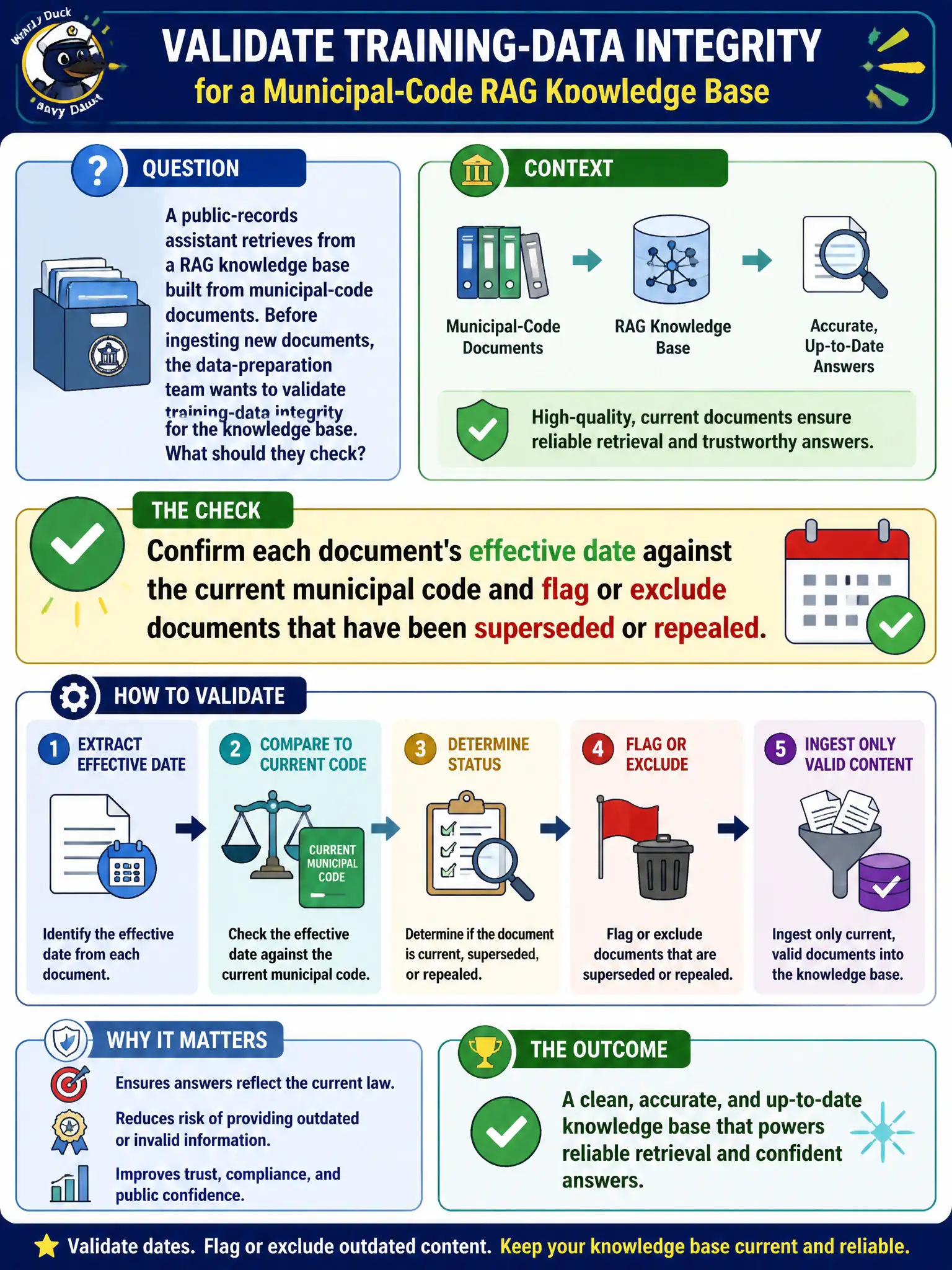
A public-records assistant retrieves from a RAG knowledge base built from municipal-code documents. Before ingesting new documents, the data-preparation team wants to validate training-data integrity for the knowledge base. What should they check?
Select an answer to reveal the explanation.
Short Explanation
An outdated ordinance sitting in your knowledge base is like a stale phone book — the assistant will confidently hand out a number that no longer works. Checking a document's effective date against the current code catches that before it becomes a wrong answer to a resident. That's what training-data integrity means here: it's about whether the facts are still true, not what file format they're saved in.
Full Explanation
For a RAG source corpus, training-data integrity centers on whether the retrievable content is accurate and current, because the assistant treats every retrieved chunk as authoritative. Checking effective dates and flagging superseded or repealed sections directly targets staleness, the failure mode most likely to produce a confidently wrong answer about municipal code. File format (PDF versus plain text) is a storage or parsing concern, not an integrity concern — a perfectly formatted document can still be legally obsolete. Requiring embedded images conflates multimodal capability with document trustworthiness; most municipal-code text has no meaningful image content, and demanding one adds noise without improving accuracy. Mandating translation into every supported language before ingestion is a localization task, unrelated to whether the underlying legal content is current or correct, and would needlessly block ingestion of valid source-language documents. Scope caveat: date validation catches supersession but not internal contradictions between sections, so pair it with a periodic legal review. Operational check: run automated version comparisons against the city's official code repository and quarantine any document whose effective date predates the latest amendment.