
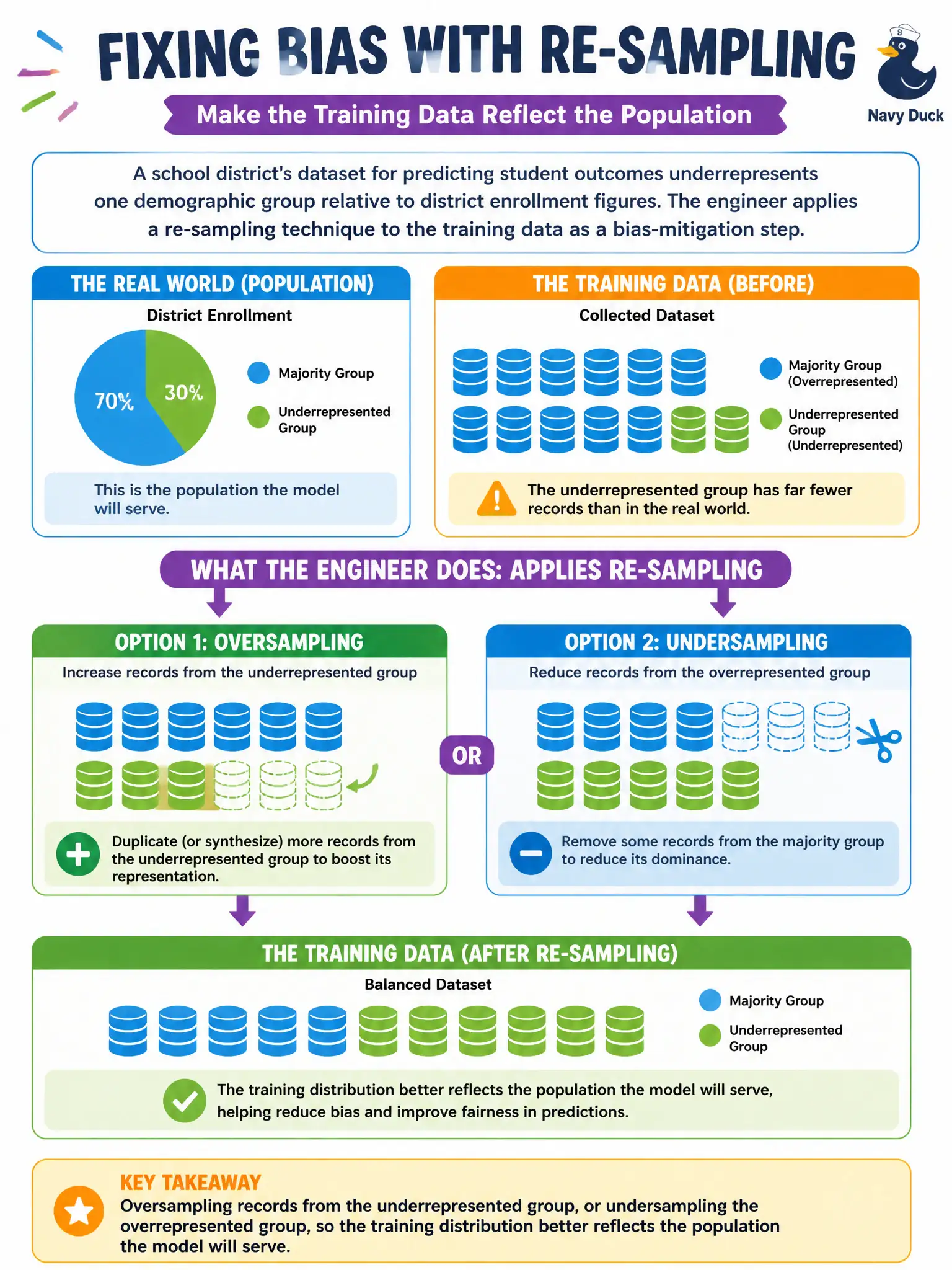
A school district's dataset for predicting student outcomes underrepresents one demographic group relative to district enrollment figures. The engineer applies a re-sampling technique to the training data as a bias-mitigation step. What is the engineer most likely doing?
Select an answer to reveal the explanation.
Short Explanation
Re-sampling is basically adjusting the guest list so the room actually looks like the district it's supposed to represent — you either invite more of the underrepresented group or trim back the overrepresented one. It's a change to which rows the model trains on, not a change to how training runs. Swapping in an entirely different district's data, or just shrinking the feature list, doesn't touch the actual representation gap.
Full Explanation
Re-sampling techniques — oversampling the minority group, undersampling the majority group, or a combination — directly adjust the composition of the training set so its demographic proportions align with the population the model is meant to serve, which is the standard mitigation for representation-based bias. Pulling in data from an entirely different school district changes the population being represented rather than correcting representation within the target district, so it solves a different problem than the one described. Reducing the feature count is a form of feature selection aimed at limiting how much a model can lean on proxy variables for a sensitive attribute; it doesn't change how many examples from each group appear in training and leaves the underlying imbalance untouched. Increasing batch size is a training-loop hyperparameter that affects gradient estimation stability, not which examples exist in the dataset — a larger batch drawn from a skewed dataset is still skewed. Scope caveat: re-sampling corrects representation but can amplify noise in a small minority group if oversampling duplicates too aggressively, so pair it with synthetic augmentation where appropriate. Operational check: compare the resampled training set's group proportions against district enrollment figures to confirm the gap has closed.