
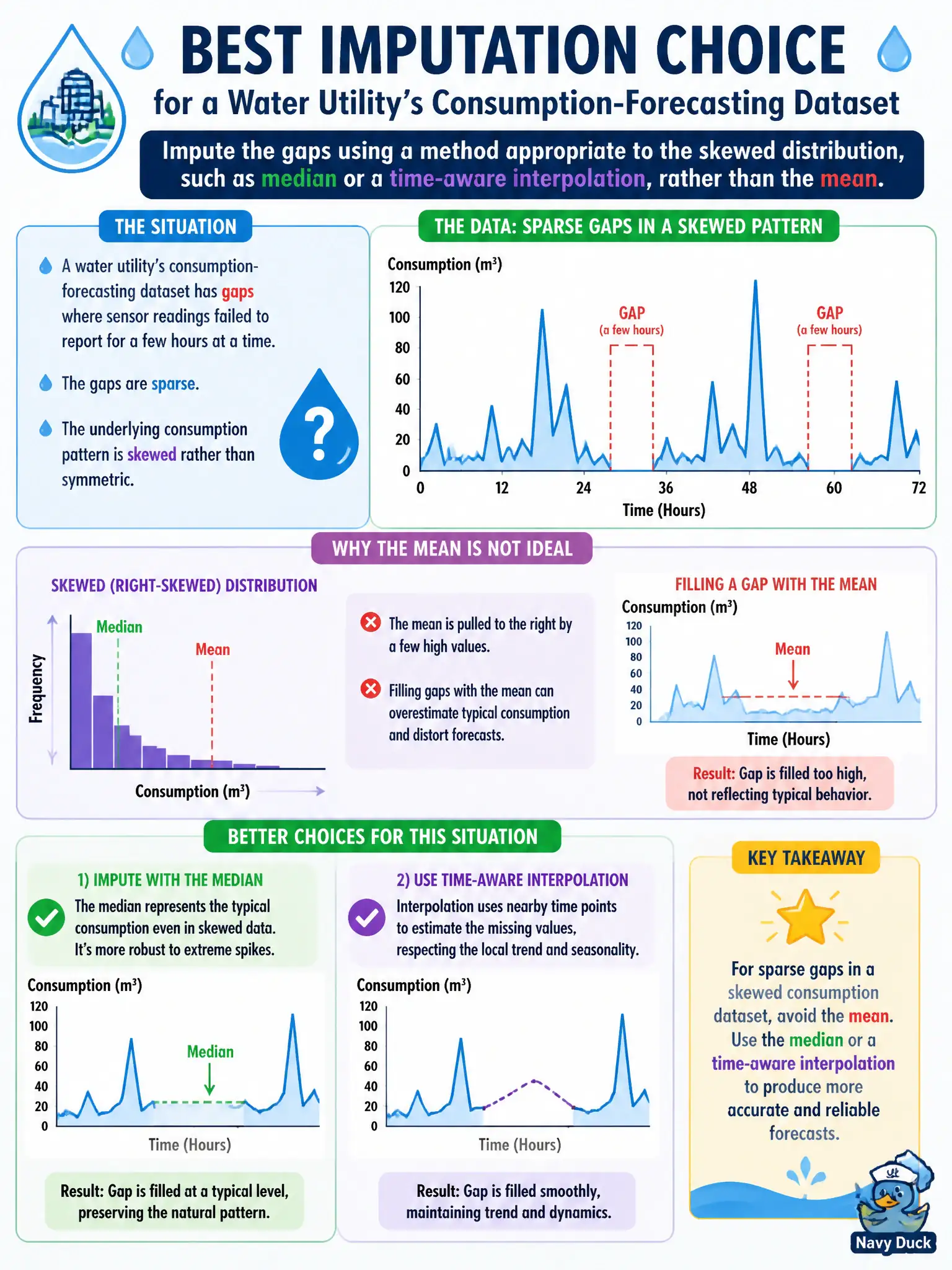
A water utility's consumption-forecasting dataset has gaps where sensor readings failed to report for a few hours at a time. The gaps are sparse and the underlying consumption pattern is skewed rather than symmetric. Which imputation choice best fits this situation?
Select an answer to reveal the explanation.
Short Explanation
Filling a gap with the average makes sense on a bell curve, but a skewed distribution has a long tail that drags the mean away from where most values actually sit. A median-based or time-aware fill respects that shape instead of smearing outliers across the gaps.
Full Explanation
Mechanism: for a skewed distribution, the median or a time-aware interpolation (using neighboring timestamps to estimate a plausible value) better represents the typical consumption pattern than the mean, which gets pulled toward extreme values in the tail, so imputing with a skew-appropriate method keeps the filled gaps consistent with the true underlying pattern rather than introducing systematic bias. Why the wrong options fail by concept: dropping every row with any missing reading, when the gaps are sparse, discards usable surrounding data unnecessarily and can shrink the training set enough to hurt the model's ability to learn temporal patterns. Imputing with the overall historical mean ignores the skew entirely, in a right-skewed consumption pattern the mean sits above where most actual readings cluster, so mean imputation systematically overstates typical consumption during the gap. Replacing gaps with zero asserts that no consumption occurred, which is a strong and likely false assumption, a sensor failing to report is not the same as consumption actually stopping, and this would inject fabricated low-consumption signal into the training data. Scope caveat: time-aware interpolation works best for short, isolated gaps, a mechanism outage spanning many consecutive hours may need a different strategy, such as excluding that stretch entirely rather than interpolating across it. Operational check: compare the distribution of imputed values against the distribution of neighboring known readings to confirm the imputation didn't introduce a systematic shift.