
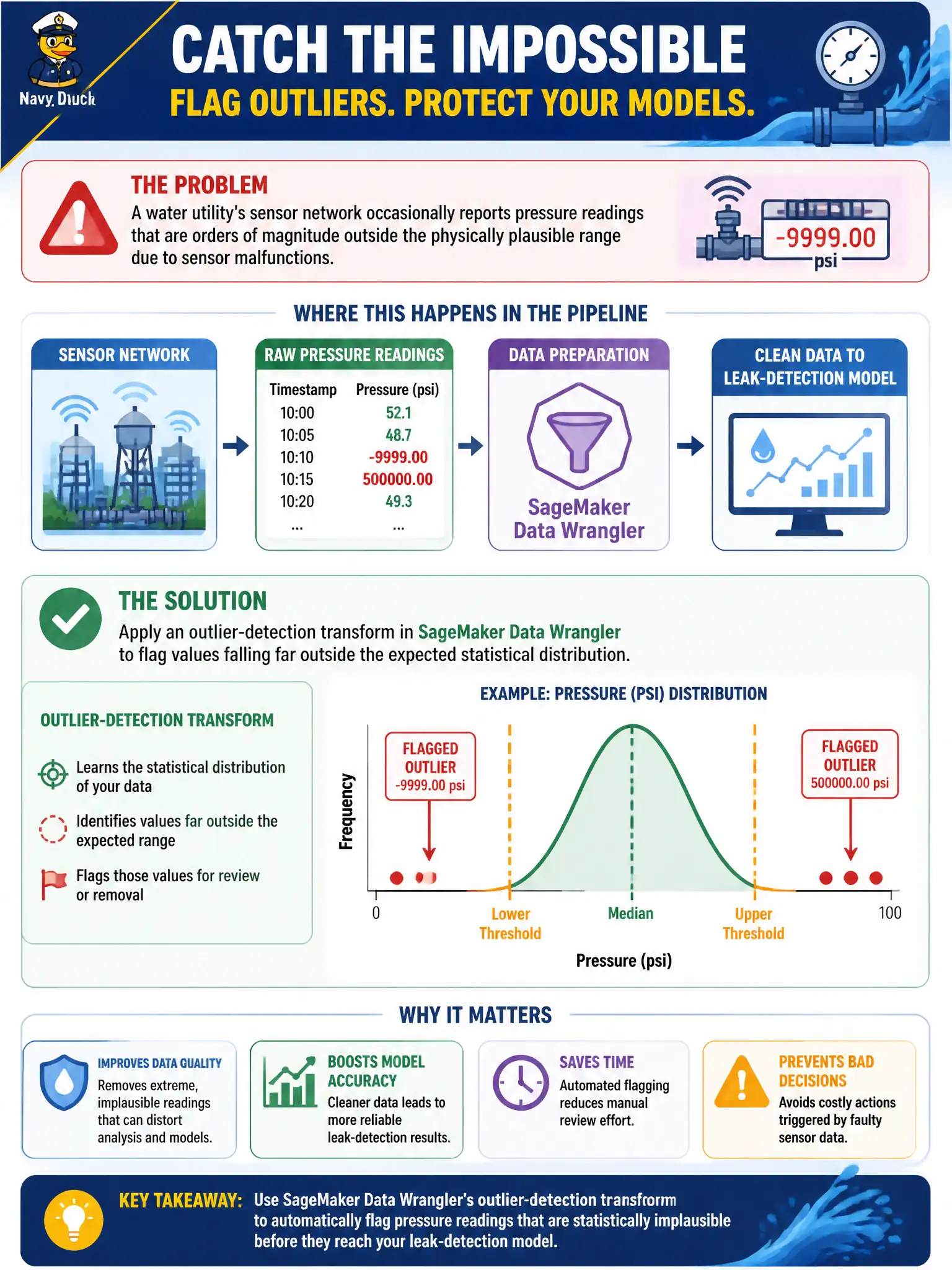
A water utility's sensor network occasionally reports pressure readings that are orders of magnitude outside the physically plausible range due to sensor malfunctions. Before these readings feed a leak-detection model, the team wants to automatically flag statistically implausible values. Which approach addresses this during data preparation?
Select an answer to reveal the explanation.
Short Explanation
A pressure gauge that suddenly reads a thousand times normal is a broken gauge, not a new kind of leak, and you want that flagged before it ever reaches training. An outlier-detection transform catches those statistically implausible readings so they don't quietly poison the dataset.
Full Explanation
Mechanism: an outlier-detection transform in Data Wrangler evaluates each reading against the expected statistical distribution of the feature, flagging values that fall far outside plausible bounds so the team can review, cap, or exclude them before they enter training, catching sensor malfunctions at the source rather than letting them pass through as valid signal. Why the wrong options fail by concept: assuming the model will learn to ignore implausible values misunderstands how training works, extreme outliers can distort learned weights and degrade the model's sensitivity to genuine leak signals, they don't get automatically filtered out. Converting readings to categorical bins as a first step discards the continuous magnitude information the model needs to detect subtle pressure anomalies, and it doesn't address the malfunction problem, implausible readings just land in whichever bin their broken value falls into. Increasing reporting frequency generates more data points but does nothing to identify which existing readings are unreliable, it compounds the volume of a problem without diagnosing it. Scope caveat: outlier thresholds must be tuned to the physical plausibility of the sensor type, a threshold copied from a different sensor network could either miss real malfunctions or flag legitimate extreme readings during an actual event. Operational check: review a sample of flagged readings against known sensor-maintenance logs to confirm the flagged values correspond to actual malfunction periods.