
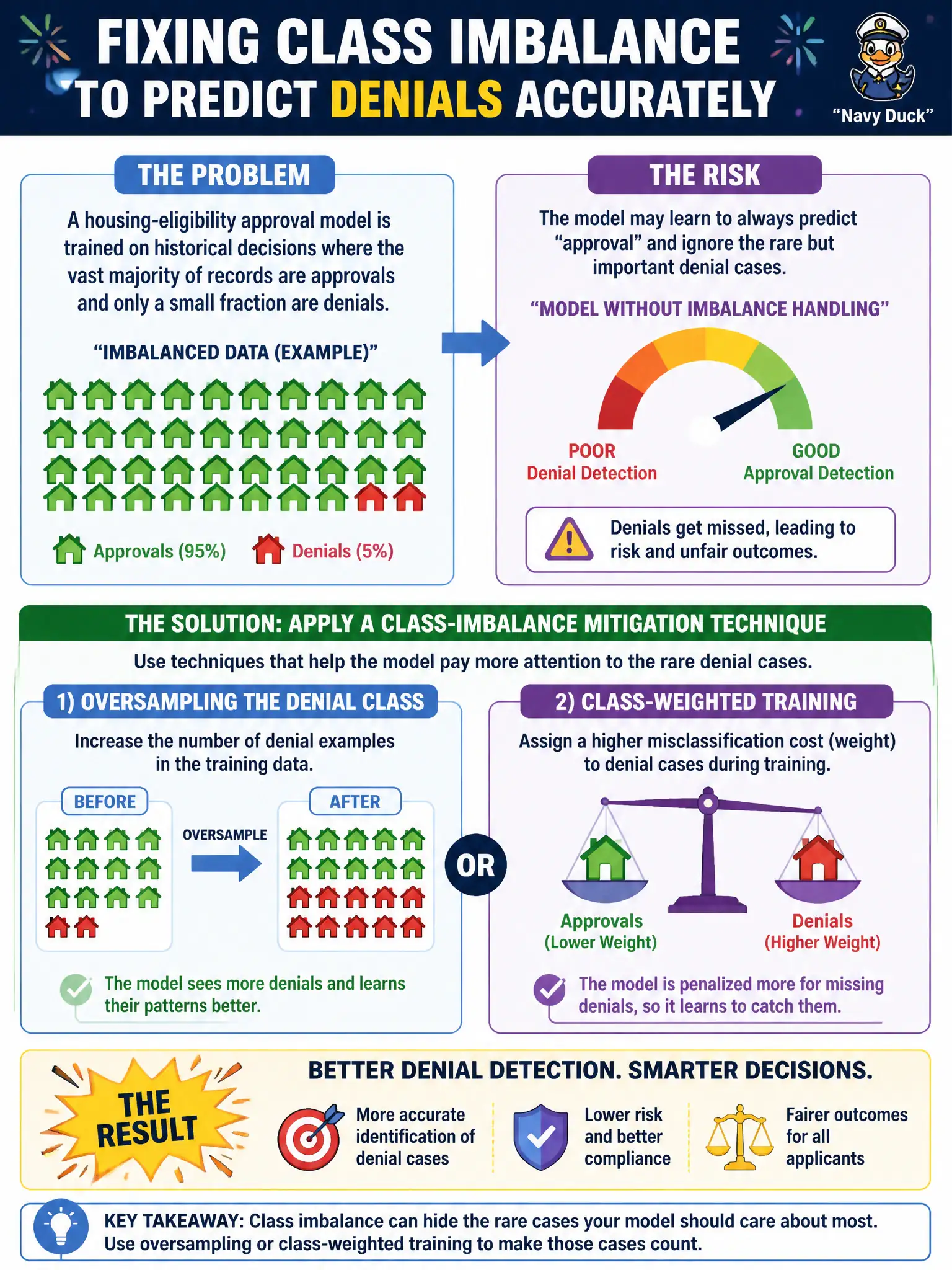
A housing-eligibility approval model is trained on historical decisions where the vast majority of records are approvals and only a small fraction are denials. The engineer wants the model to learn to recognize denial cases accurately rather than ignoring them. Which strategy most directly addresses this class imbalance?
Select an answer to reveal the explanation.
Short Explanation
Picture a classroom where one topic gets ten times more practice problems than another, the rare topic needs extra weight or extra examples or it never really sinks in. Oversampling denials or weighting them more heavily gives the model that extra practice.
Full Explanation
Mechanism: class-imbalance mitigation techniques like oversampling the minority denial class, undersampling the majority approval class, or applying class weights during training push the model to pay meaningful attention to the underrepresented denial pattern, instead of learning a shortcut that predicts approval by default and still scores well on raw accuracy despite missing nearly every denial. Why the wrong options fail by concept: chunk size and overlap are RAG document-preparation concepts for embedding text passages, they have no connection to a tabular classification model's label distribution. Standardizing and scaling numeric fields addresses differing feature ranges, a legitimate step elsewhere in the pipeline, but it does nothing to rebalance how many denial versus approval examples the model actually sees during training. Deduplicating identical approval records could marginally shift the ratio if true duplicates exist, but it's not a reliable or intentional imbalance-mitigation strategy, and most approval records won't be exact duplicates to begin with. Scope caveat: naive oversampling by simple duplication can cause overfitting to the minority class's specific examples, so synthetic oversampling or careful validation-set design often matters alongside the base technique. Operational check: compare the model's recall on the denial class before and after applying the mitigation technique to confirm it's actually catching more true denial cases, not just improving overall accuracy.