
A public-works department is preparing a dataset of street-sign photographs in SageMaker Data Wrangler before training a computer-vision model to detect damaged signs. Which pre-processing steps are appropriate for this image data, as opposed to the techniques used for tabular features?
Select an answer to reveal the explanation.
Short Explanation
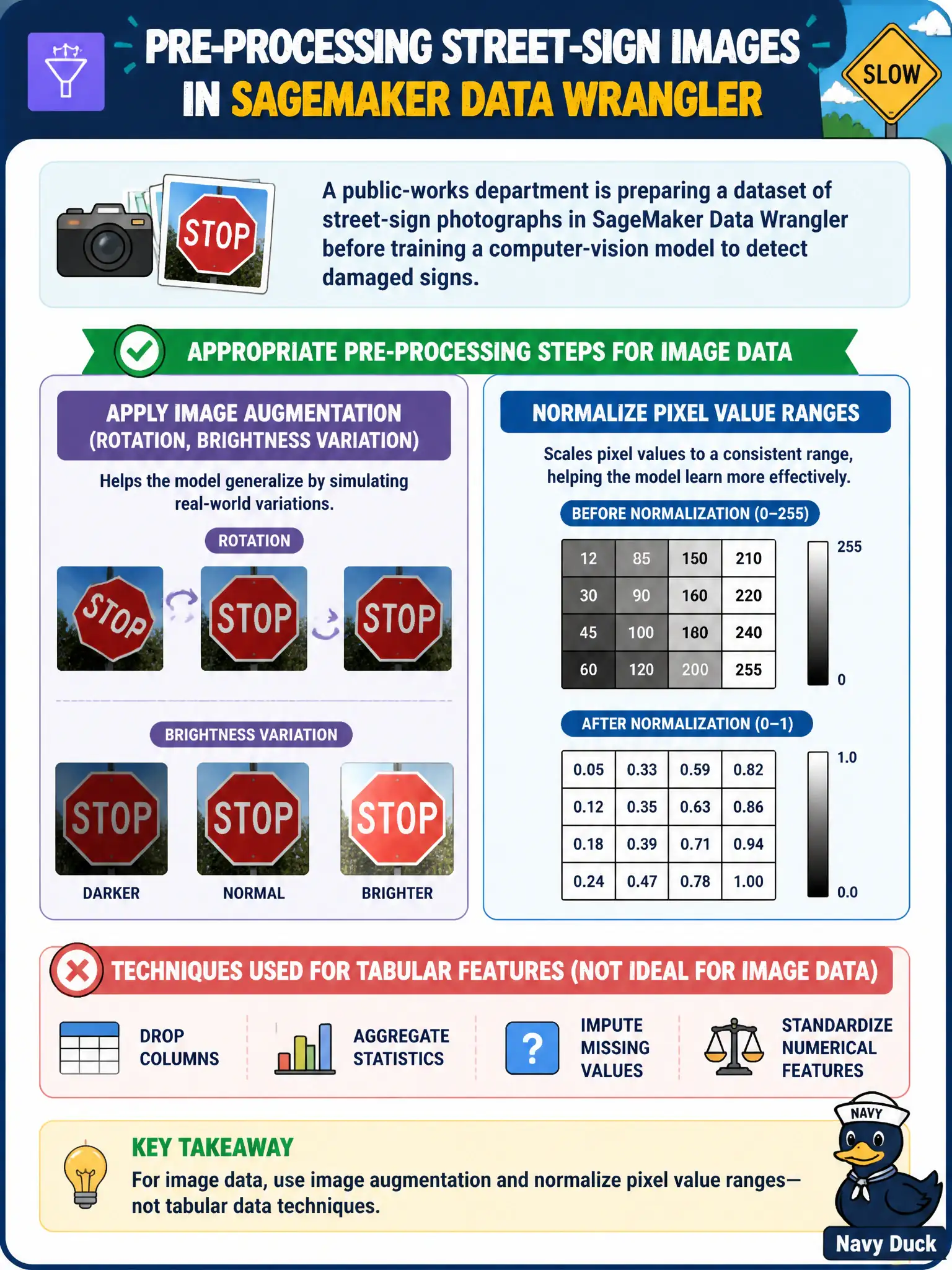
Training a vision model is like teaching someone to spot a stop sign in the rain, glare, and dusk, not sorting numbers into tidy buckets. Rotating and varying brightness during augmentation, then normalizing pixel ranges, prepares the model for exactly that kind of real-world variation.
Full Explanation
Mechanism: image augmentation techniques like rotation and brightness variation expose the model to the visual variation it will actually encounter in the field, improving generalization, while normalizing pixel value ranges rescales intensity values to a consistent scale so training proceeds stably, these are image-specific transforms distinct from tabular feature engineering. Why the wrong options fail by concept: standardizing numeric columns and one-hot encoding categorical labels are techniques built for structured tabular fields, raw pixel data has no columns or categories in that sense, so these transforms simply don't apply to an image dataset. Mean/mode imputation and deduplication address missing or duplicate rows in structured tables, a photograph doesn't have a missing value the same way a table cell does, and near-duplicate images require different handling than duplicate table rows. Binning continuous values and log-transforming skewed distributions are numeric feature-engineering techniques for tabular data, they have no meaningful application to pixel intensity data being prepared for a computer-vision model. Scope caveat: augmentation should reflect the real-world conditions the model will face, like weather or sign angle, augmenting with unrealistic distortions can hurt rather than help detection accuracy. Operational check: visually spot-check a sample of augmented images in the Data Wrangler flow to confirm the signs remain recognizable and their labels still apply after the transformation.