
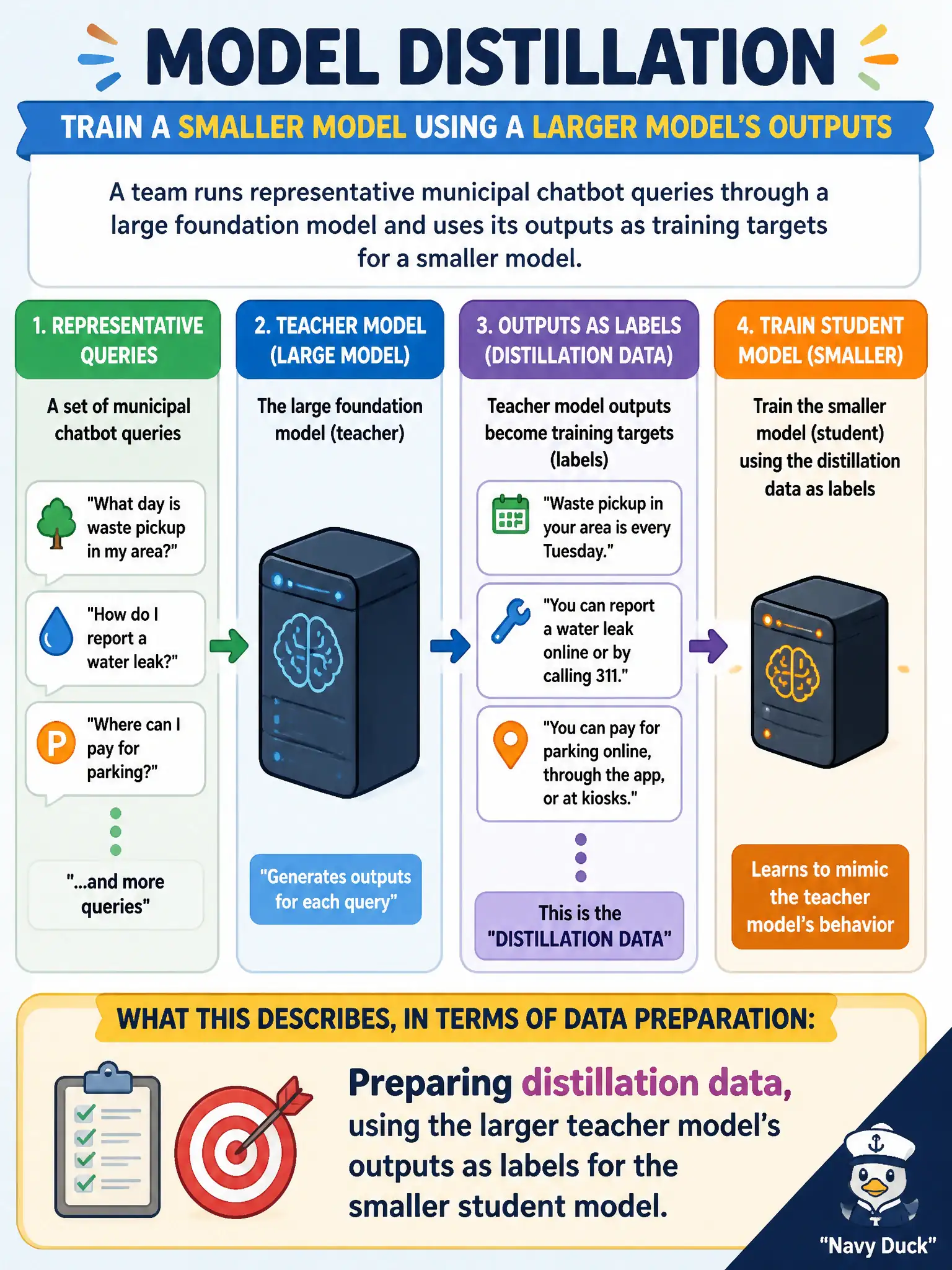
A team wants to train a smaller, cheaper model to mimic the behavior of a larger foundation model on municipal chatbot queries. They plan to run a set of representative queries through the larger model and use its outputs as training targets for the smaller model. What does this describe, in terms of data preparation?
Select an answer to reveal the explanation.
Short Explanation
It's an apprentice learning by copying a master's finished work, not being graded against an independent answer key. That's distillation: the teacher model's own outputs become the lesson the smaller student model studies from.
Full Explanation
Mechanism: distillation data preparation uses a larger teacher model's outputs on a set of representative inputs as the training targets for a smaller student model, transferring the teacher's learned behavior into a cheaper model, this is distinct from ordinary fine-tuning because the labels come from another model's generated outputs rather than from human-authored ground truth. Why the wrong options fail by concept: calling it a standard human-labeled fine-tuning dataset misses the defining trait here, the labels are machine-generated by the teacher rather than authored or verified by a person, which changes how label quality and inherited teacher errors need to be handled. Framing it as continuous pre-training data misapplies that concept, continuous pre-training uses raw unlabeled domain text with a self-supervised objective, while this scenario deliberately pairs specific queries with teacher-generated outputs as supervised targets. Describing it as evaluation data confuses the purpose, these teacher outputs are meant to shape the student model's weights during training, not to serve afterward as a held-out benchmark for scoring performance. Scope caveat: any errors or biases present in the teacher model's outputs get inherited by the student model, so distillation data typically benefits from some filtering or quality review of the teacher's responses before they're locked in as training targets. Operational check: sample a batch of teacher-generated outputs and manually review them for correctness before finalizing them as training targets for the student model.