
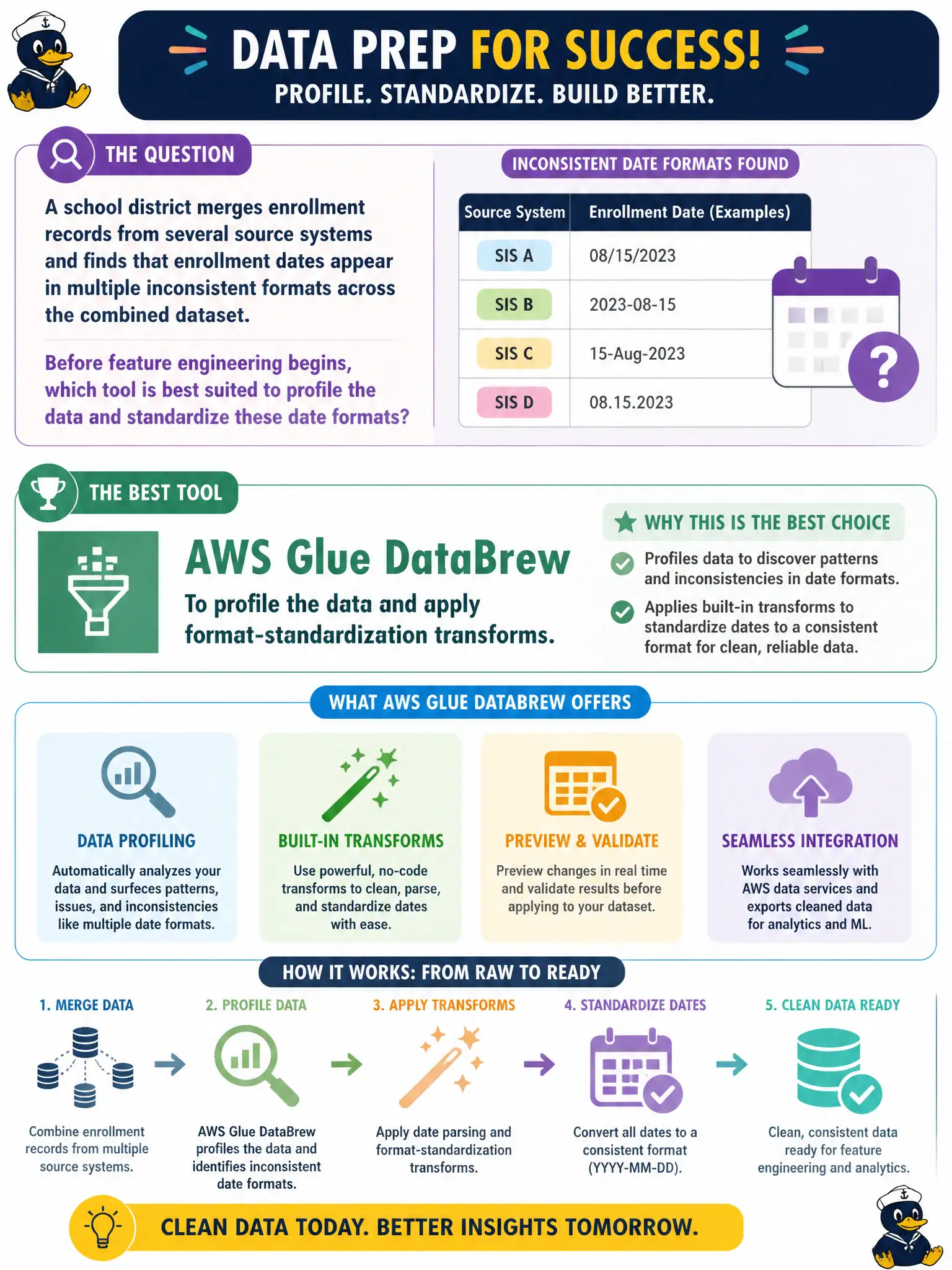
A school district merges enrollment records from several source systems and finds that enrollment dates appear in multiple inconsistent formats across the combined dataset. Before feature engineering begins, which tool is best suited to profile the data and standardize these date formats?
Select an answer to reveal the explanation.
Short Explanation
Picture a proofreader scanning a manuscript for inconsistent spellings before anyone starts real editing. Glue DataBrew's profiling does that scan for you, showing exactly which date formats are mixed in before you standardize them.
Full Explanation
Mechanism: Glue DataBrew's visual data profiling surfaces the distribution and format variants present in a column, including how many rows use each date pattern, and its built-in transforms can then standardize those formats without custom code, making it the right first step before the cleaned column feeds downstream feature engineering. Why the wrong options fail by concept: SageMaker Feature Store is a repository for storing and serving already-engineered features consistently between training and inference, it doesn't profile raw data or fix inconsistent formatting on its own, it assumes clean features arrive ready to register. OpenSearch Service indexes data for fast search and analytics queries, it plays no role in detecting or correcting inconsistent date formats during data preparation. Kinesis Data Streams handles real-time streaming ingestion, this scenario is a batch cleanup of merged historical enrollment records, not a live stream, so it doesn't match the workload. Scope caveat: after standardizing formats, the target format chosen needs to match what downstream feature-engineering steps expect, picking the wrong target format just replaces one inconsistency with a uniform but incorrect one. Operational check: rerun DataBrew's data profile job after applying the transform and confirm the date column now shows a single consistent format with no remaining format anomalies flagged.