
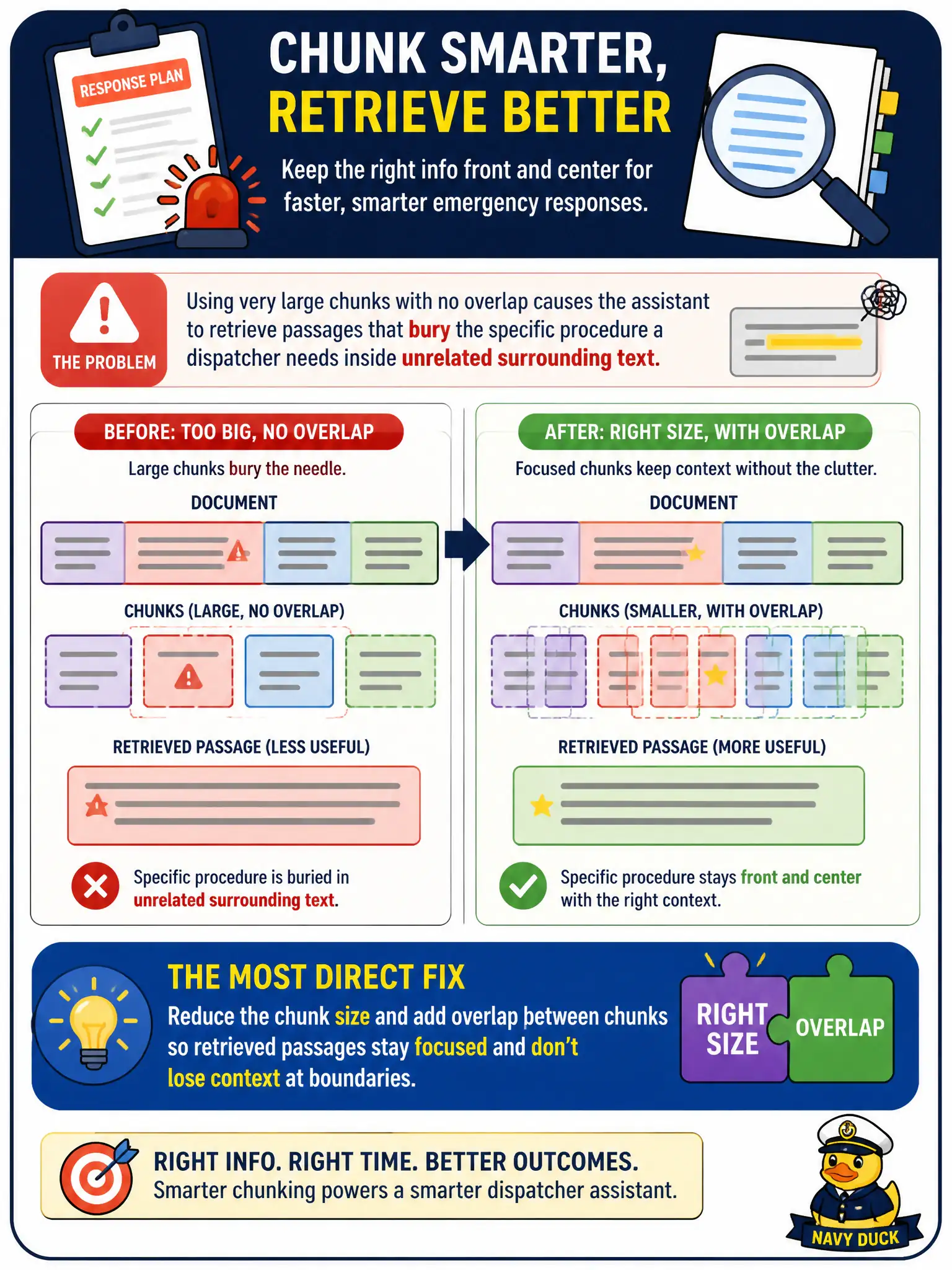
An emergency-management team is chunking lengthy response-plan documents before embedding them for a RAG-based dispatcher assistant. Using very large chunks with no overlap causes the assistant to retrieve passages that bury the specific procedure a dispatcher needs inside unrelated surrounding text. What is the most direct fix?
Select an answer to reveal the explanation.
Short Explanation
It's like handing a dispatcher one clear index card instead of the whole binder, they find the procedure faster when the chunk is focused. Smaller chunks with a little overlap keep each retrieved passage on-topic without chopping a key sentence in half.
Full Explanation
Mechanism: reducing chunk size concentrates each embedded passage around a narrower slice of content, so a similarity search returns text tightly focused on the query instead of a whole procedure diluted by unrelated surrounding material, and adding overlap between chunks prevents a key sentence or step from being split awkwardly across a chunk boundary and losing its surrounding context. Why the wrong options fail by concept: increasing chunk size further compounds the exact problem described, a whole-document chunk embeds many procedures into a single vector, diluting the specific match a dispatcher's query is trying to find rather than sharpening it. Removing metadata fields relates to structured filtering during retrieval, it has no bearing on chunk-boundary loss or dilution of the retrieved passage's relevance. Switching to keyword-only search abandons semantic matching's ability to handle paraphrased dispatcher queries against procedure language, trading the dilution problem for a different, more brittle limitation. Scope caveat: overlap that's set too large increases storage and embedding cost with diminishing retrieval benefit, so it's tuned relative to corpus size and typical query length rather than maximized without limit. Operational check: run representative dispatcher queries against the re-chunked index and confirm the top retrieved passage contains the specific procedure without excess unrelated surrounding text.