
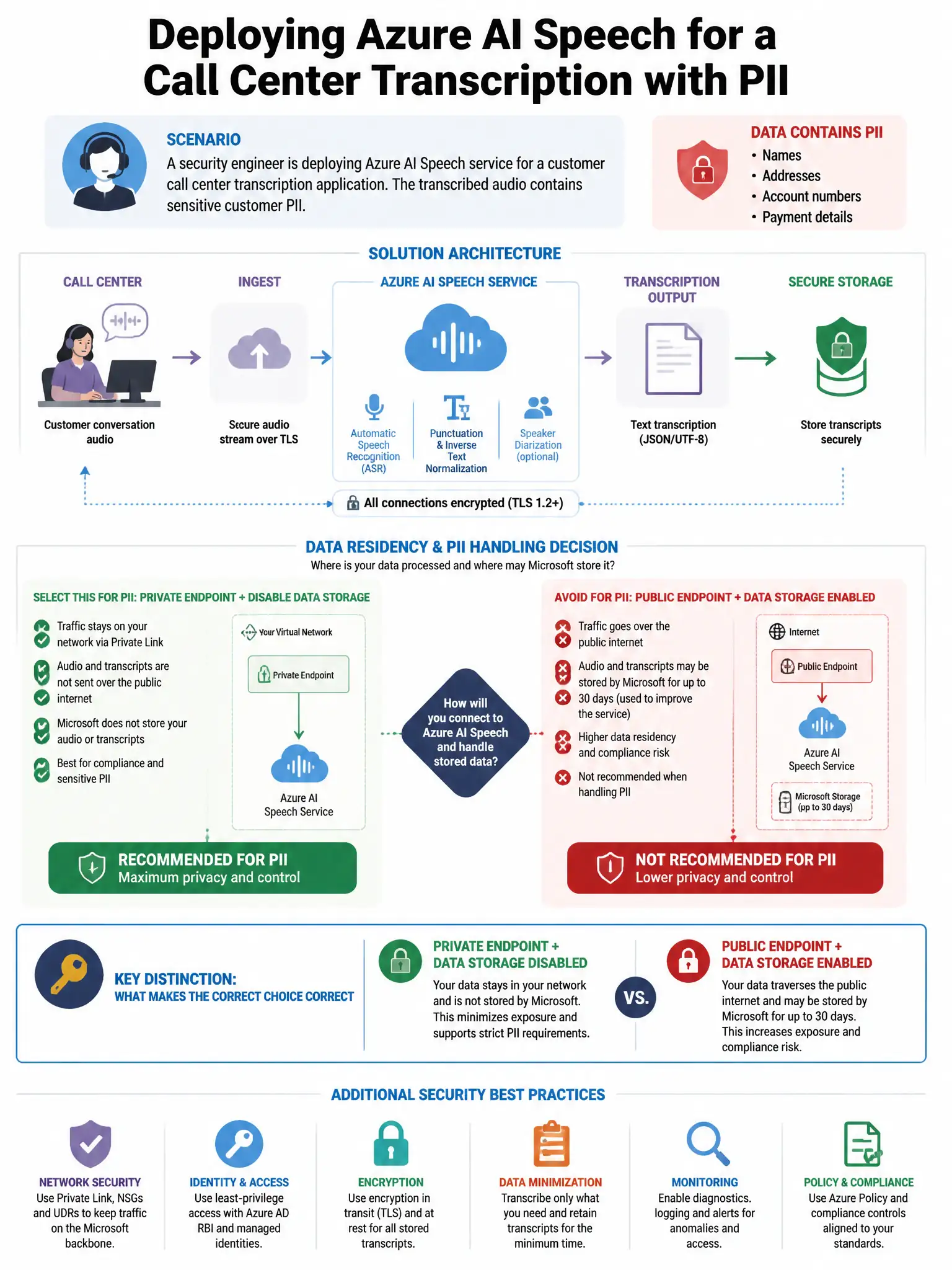
A security engineer is deploying Azure AI Speech service for a customer call center transcription application. The transcribed audio contains sensitive customer PII. The security team requires that transcriptions are stored in a customer-owned storage account rather than Microsoft's storage. Which Azure AI Speech configuration achieves this?
Select an answer to reveal the explanation.
Short Explanation
Here's the deal — use Bring Your Own Storage (BYOS) to point Azure AI Speech at your own Azure Blob Storage account. That keeps transcription outputs and training data in storage you control, not Microsoft's Speech service infrastructure.
Full Explanation
The correct configuration is to configure Azure AI Speech with Bring Your Own Storage (BYOS) connecting to the organization's Azure Blob Storage account. Azure AI Speech supports BYOS configuration where customers connect their own Azure Blob Storage account to the Speech service. Transcription outputs and training data are stored directly in the customer-controlled storage account, not in Microsoft's Speech service infrastructure. The option to export transcription results via Azure Event Hub to the organization's Azure Data Lake is incorrect because Event Hub is a streaming platform for event ingestion; while transcriptions can be routed through Event Hub, this does not configure the Speech service to use customer-owned storage as the primary storage backend. The option to deploy the Azure AI Speech SDK on-premises in the customer data center is incorrect because deploying on-premises addresses a different scenario (no cloud at all); BYOS is the appropriate cloud configuration for keeping data in customer-controlled storage. The option to enable Azure AI Speech output redirection in the Azure Portal to specify the customer storage endpoint is incorrect because there is no 'output redirection' setting in the Azure Portal for Azure AI Speech; BYOS is configured through the Speech resource creation or programming interface.