
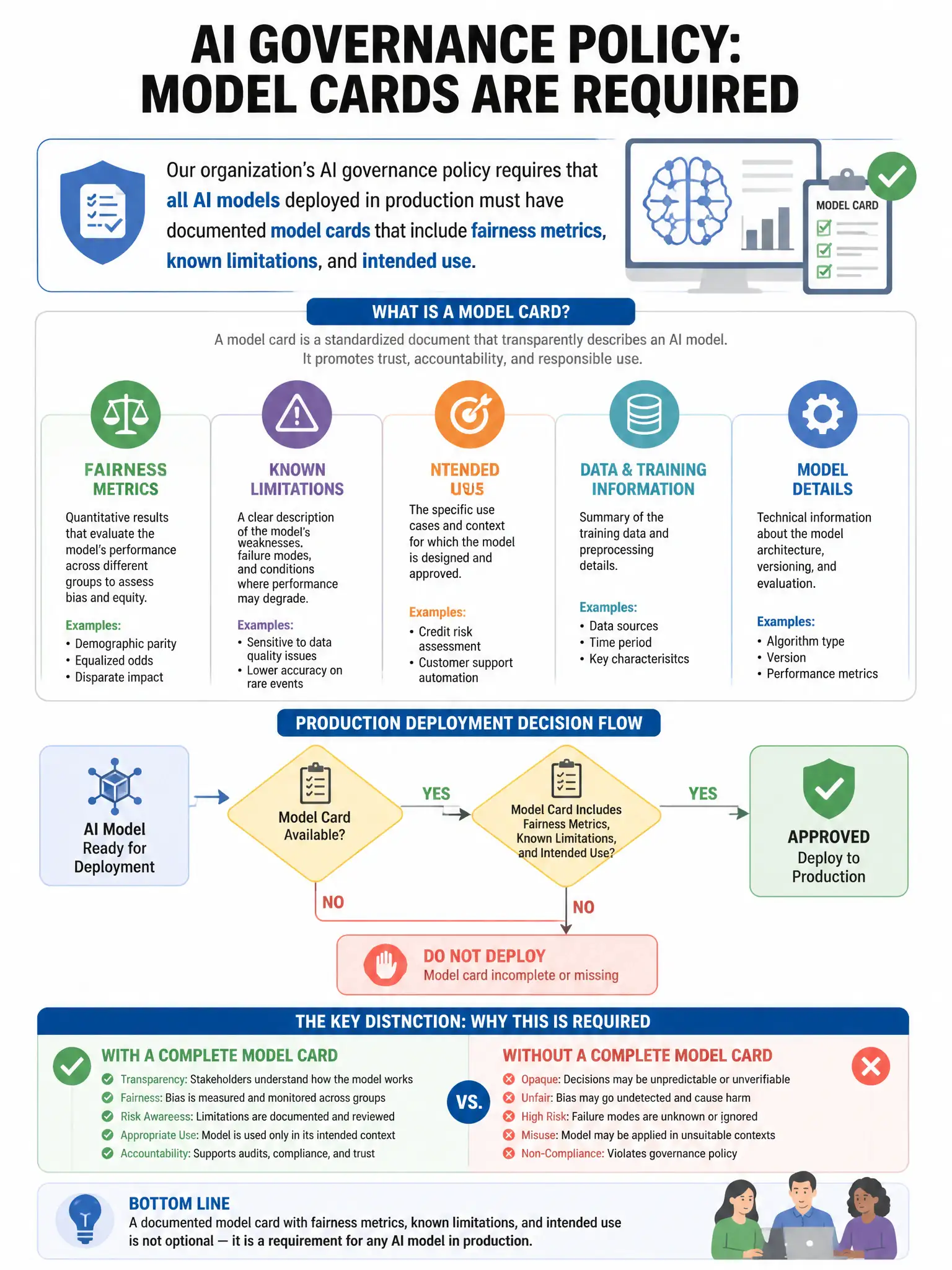
An organization's AI governance policy requires that all AI models deployed in production must have documented model cards that include fairness metrics, known limitations, and intended use cases. Where in Microsoft's AI platform should these model cards be stored and managed to be discoverable by the security and compliance teams?
Select an answer to reveal the explanation.
Short Explanation
Here's the deal — you’ll store and manage model cards in the Azure Machine Learning Model Registry because it’s built for production AI models. You can attach fairness metrics, known limitations, and intended use cases to model versions through descriptions, tags, and documentation. That keeps them discoverable with the deployed model for security and compliance teams.
Full Explanation
The Azure Machine Learning Model Registry with attached documentation in model tags and descriptions is correct because the Azure Machine Learning Model Registry is the purpose-built location for registering production AI models. Models can include detailed documentation, including model cards with fairness metrics, known limitations, and intended use cases, stored in model descriptions, tags, and attached README files. The registry provides version control and enables the security and compliance teams to review model documentation alongside deployment history, making the model cards discoverable where the production model itself is managed. The Microsoft Purview Data Catalog option is incorrect because, while Purview Data Catalog can catalog models as data assets, it is primarily designed for data assets such as datasets and tables and requires additional setup to serve as a model governance catalog compared to the purpose-built Azure Machine Learning Model Registry. The Azure DevOps repository option is incorrect because storing model card documentation alongside model training code provides version control but makes the model cards less discoverable for compliance teams who need to review production model governance across the organization. The Microsoft SharePoint site option is incorrect because SharePoint is a generic document management system that lacks integration with the model deployment lifecycle.