
A security engineer needs to configure Microsoft Purview Information Protection to automatically classify and label documents generated by an Azure OpenAI GPT-4 model when they contain financial projections, without user interaction. Which Microsoft Purview feature enables automatic labeling of AI-generated content stored in SharePoint?
Select an answer to reveal the explanation.
Short Explanation
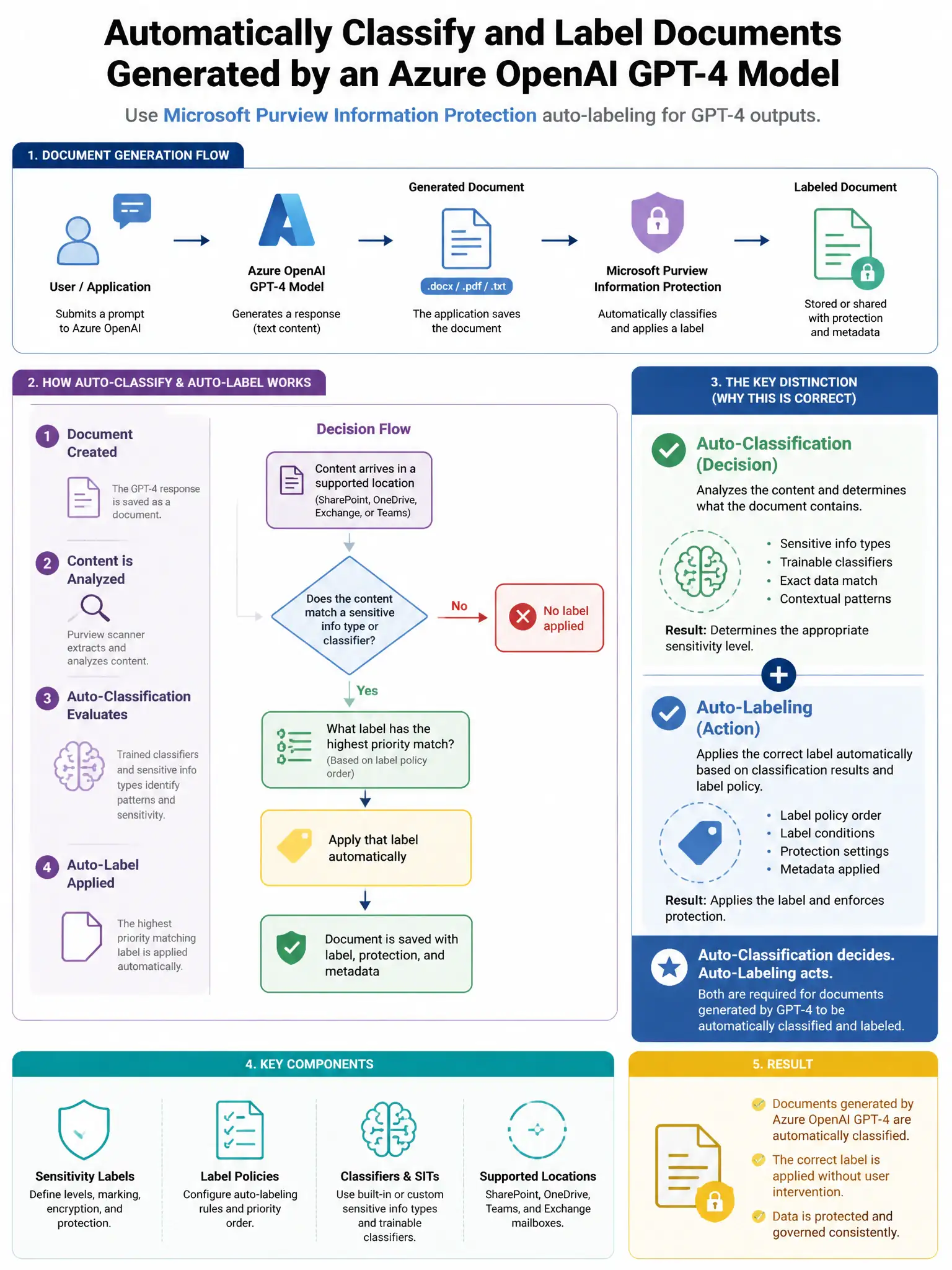
Here's the deal — you need a Microsoft Purview auto-labeling policy for SharePoint because it scans stored files and applies sensitivity labels automatically from sensitive information type patterns, with no user action. The client-side trainable classifier label won't cover files saved straight to SharePoint without an app context.
Full Explanation
The correct capability is a Microsoft Purview auto-labeling policy for SharePoint using sensitive information type patterns. It can scan content already stored in SharePoint, including files generated by Azure OpenAI GPT-4, and apply sensitivity labels automatically when the content matches sensitive information type patterns or trainable classifiers that detect financial projection content, without requiring user interaction. The sensitivity label with client-side automatic labeling using trainable classifiers is incorrect because client-side automatic labeling occurs in Microsoft 365 apps when users interact with documents; it does not apply to AI-generated files saved directly to SharePoint without user application context. The Microsoft Purview DLP policy with auto-classification rule for financial content is incorrect because DLP policies enforce data handling rules but do not apply sensitivity labels. The Microsoft Defender for Cloud Apps file policy with automatic labeling action is incorrect because Defender for Cloud Apps file policies have more limited pattern matching capabilities compared to Purview native auto-labeling with trainable classifiers.