
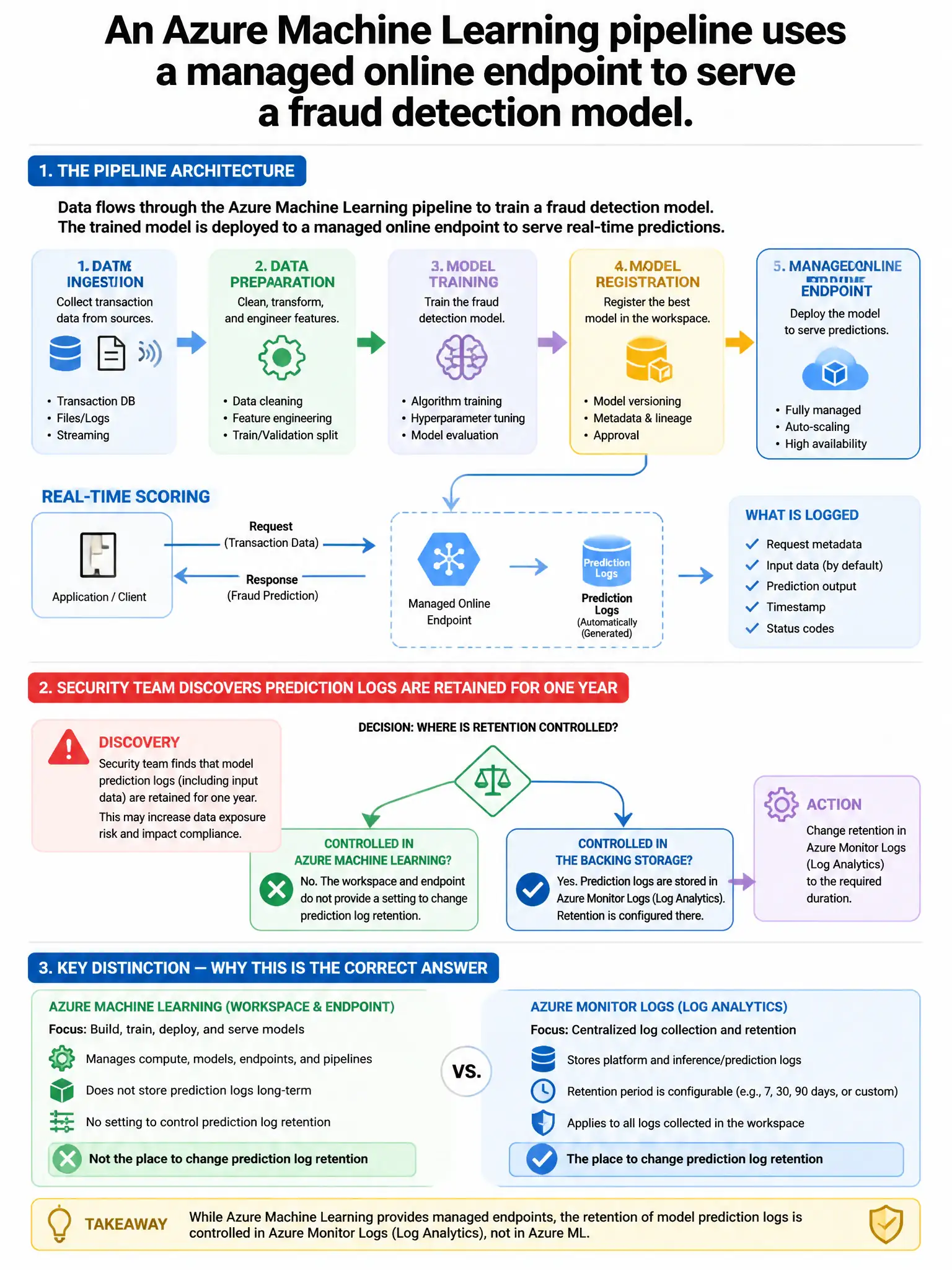
An Azure Machine Learning pipeline uses a managed online endpoint to serve a fraud detection model. The security team discovers that model prediction logs are being retained for only 30 days, insufficient for forensic investigations requiring 1-year retention. What is the most efficient solution?
Select an answer to reveal the explanation.
Short Explanation
You want the simplest native path: configure Azure Monitor Diagnostic Settings on the Azure Machine Learning workspace to send logs to a Log Analytics workspace with 365-day retention. That gives you the forensic retention you need without building custom logging.
Full Explanation
The correct solution is to configure Azure Monitor Diagnostic Settings on the Azure Machine Learning workspace to send logs, including managed online endpoint request and response logs, to a Log Analytics workspace with a 365-day retention setting. This provides the required forensic retention period without custom development. A custom logging solution using Azure Functions to copy logs to Azure Blob Storage with a one-year lifecycle policy is incorrect because it is operationally complex and unnecessary given Azure Monitor's native log routing capabilities. Enabling Azure Machine Learning model monitoring with a 365-day data drift detection window is incorrect because model monitoring data drift detection is for performance monitoring of model behavior over time, not security audit log retention. Configuring Azure Monitor Export to export logs to Azure Event Hub and store them in Azure Data Lake with a one-year retention policy is incorrect because it is significantly more complex than simply configuring the Log Analytics retention period.